During the first panel discussion, “The War of Democracies Against Dictatorships. A Reality Check for Ukraine and Japan” at the VI Ukraine–Japan Forum, experts discussed Ukraine’s role in deterring Russia, the importance of Japan’s support, mutual exchange of experience in defense and strategy, and the need to uphold a rules-based international order in the broader geopolitical context.
Below are the key messages from the Ukrainian and Japanese speakers:
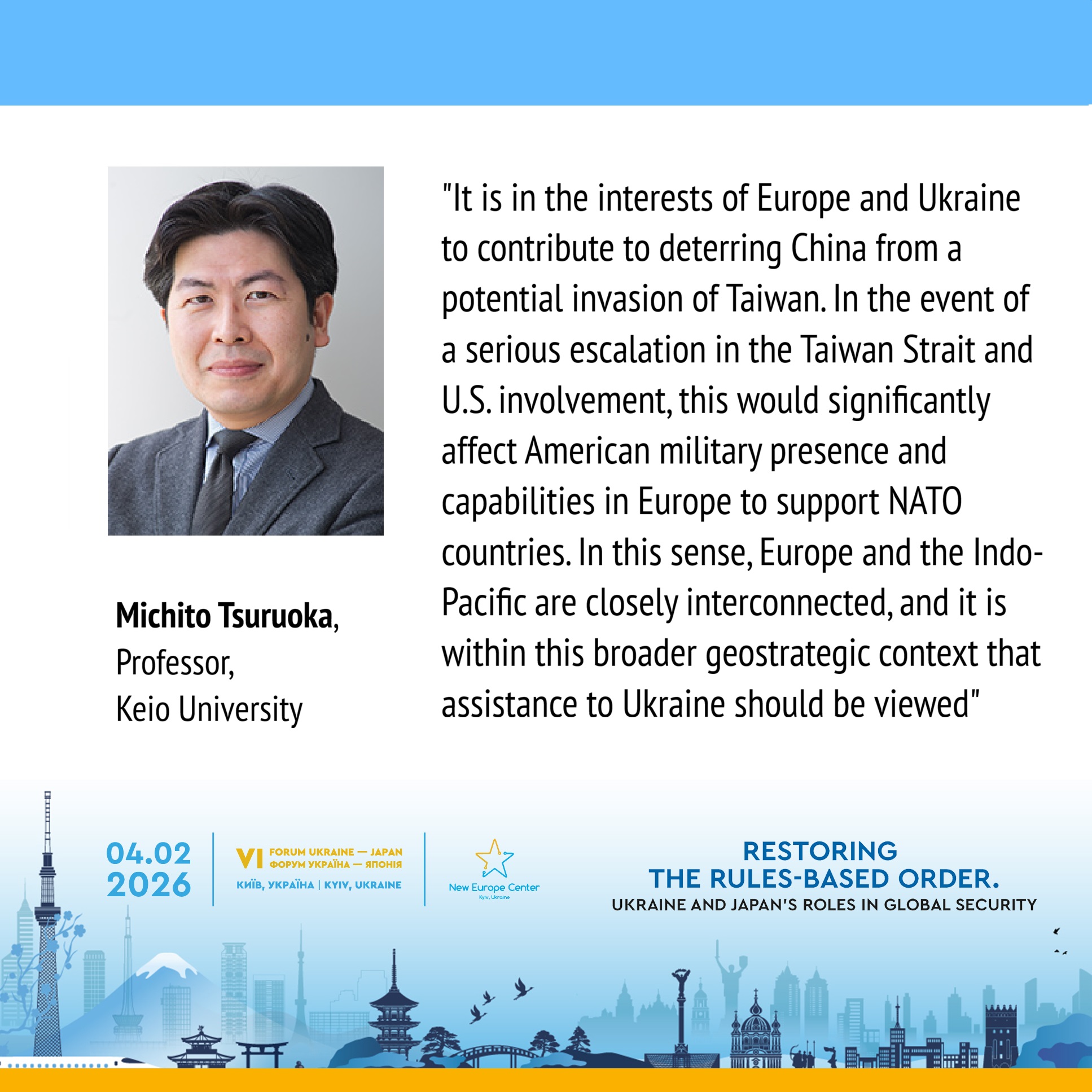
Michito Tsuruoka, Professor, Keio University
In Japan, as in Europe and Ukraine, there is currently a high level of frustration over the unpredictability of U.S. policy during President Trump’s administration. At the same time, we have far more in common with the United States than with China or Russia, with whom we do not share common values. Therefore, the United States remains on our side — it would be premature to write it off.
Japan’s assistance and support for Ukraine is not a one-sided process. It is not only about Japan providing aid, but also about mutual learning and the exchange of experience. Japan is learning a great deal from Ukraine and should continue to do so. This applies not only to sector-specific expertise, such as warfare involving drones, but also to broader strategic approaches.
Ukraine is becoming increasingly important for European defence. It depends on the supply of weapons and ammunition from NATO countries, yet at the same time, it is the only European state with real experience of conducting a full-scale war against Russia.
After the war ends, NATO will rely heavily on Ukraine in deterring Russia. In the context of the Alliance’s defence strategy, Ukraine will become a key element of European security. This is also of strategic importance to Japan, as deterring Russia in Europe serves its national interests. A serious escalation in Europe would inevitably affect the situation in the Indo-Pacific region, particularly the scale of U.S. military presence there. That is why supporting the deterrence of Russia is an important component of Japan’s security policy.
It is in the interests of Europe and Ukraine to contribute to deterring China from a potential invasion of Taiwan. In the event of a serious escalation in the Taiwan Strait and U.S. involvement, this would significantly affect American military presence and capabilities in Europe to support NATO countries. In this sense, Europe and the Indo-Pacific are closely interconnected, and it is within this broader geostrategic context that assistance to Ukraine should be viewed.
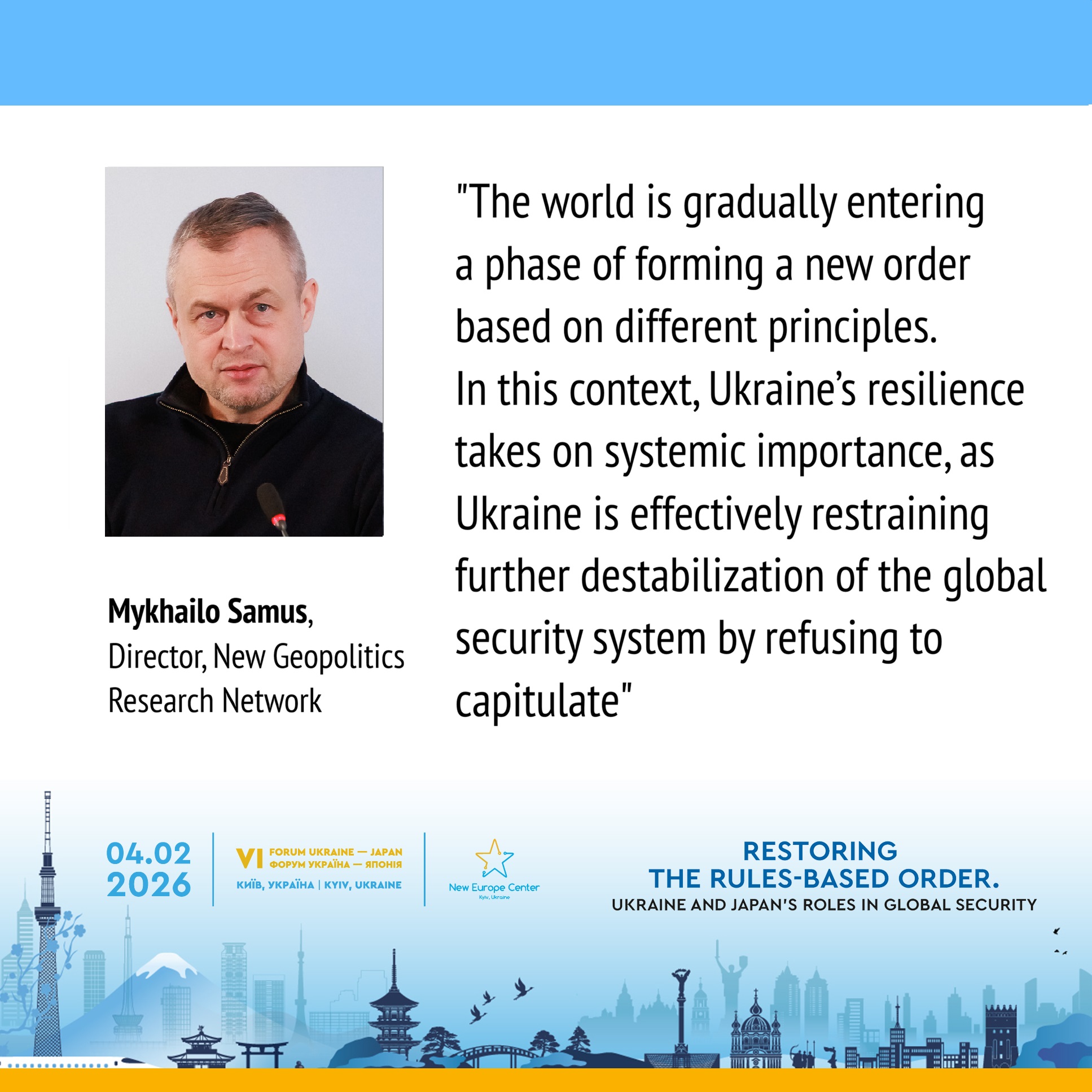
Mykhailo Samus, Director, New Geopolitics Research Network
Donald Trump’s remark, “He kept his word,” indicates that he is effectively justifying and possibly even positively assessing Putin’s actions. Such an assessment implies recognition that Putin “kept his word” and presents him as an effective leader of a state that launches strikes in freezing temperatures, committing war crimes in full view of the world. The President of the United States does not describe these actions as criminal or genocidal; instead, he seeks to explain them as stemming from Putin’s own plan and perceived right to act accordingly.
The world is gradually entering a phase of forming a new order based on different principles. In this context, Ukraine’s resilience takes on systemic importance, as Ukraine is effectively restraining further destabilization of the global security system by refusing to capitulate.
Ukraine may be the only state that directly articulates the true nature of what is happening and has demonstrated the capacity for full-fledged agency. It has its own position and does not accept the terms proposed by imperial centers of power. Ukraine’s strategy is based not only on defending its national interests but also on safeguarding Europe’s security. At present, the interests of Europe and the Indo-Pacific countries are increasingly converging. The destruction of European unity and the weakening of NATO would also serve China’s interests, granting it broader room for maneuver with regard to Taiwan.
The so-called “double strike” scenario — simultaneous aggression against a European state and an operation against Taiwan — calls into question the ability of the United States and NATO to respond effectively and in a synchronized manner to two large-scale conflicts. The likelihood of an adequate response on both fronts appears uncertain. That is why states supporting Ukraine are effectively investing not only in its survival, but also in preserving international rules and deterrence mechanisms.
Europe, which remains one of the key centers of democratic values, together with other democracies — particularly those in the Indo-Pacific region — must coordinate efforts to counter Russian aggression and prevent similar scenarios in other parts of the world. The United States may remain an ally, but the nature of that alliance could transform in the new geopolitical reality. Under such circumstances, preserving a shared understanding of fundamental values, both in Europe and in the Indo-Pacific, becomes decisive.
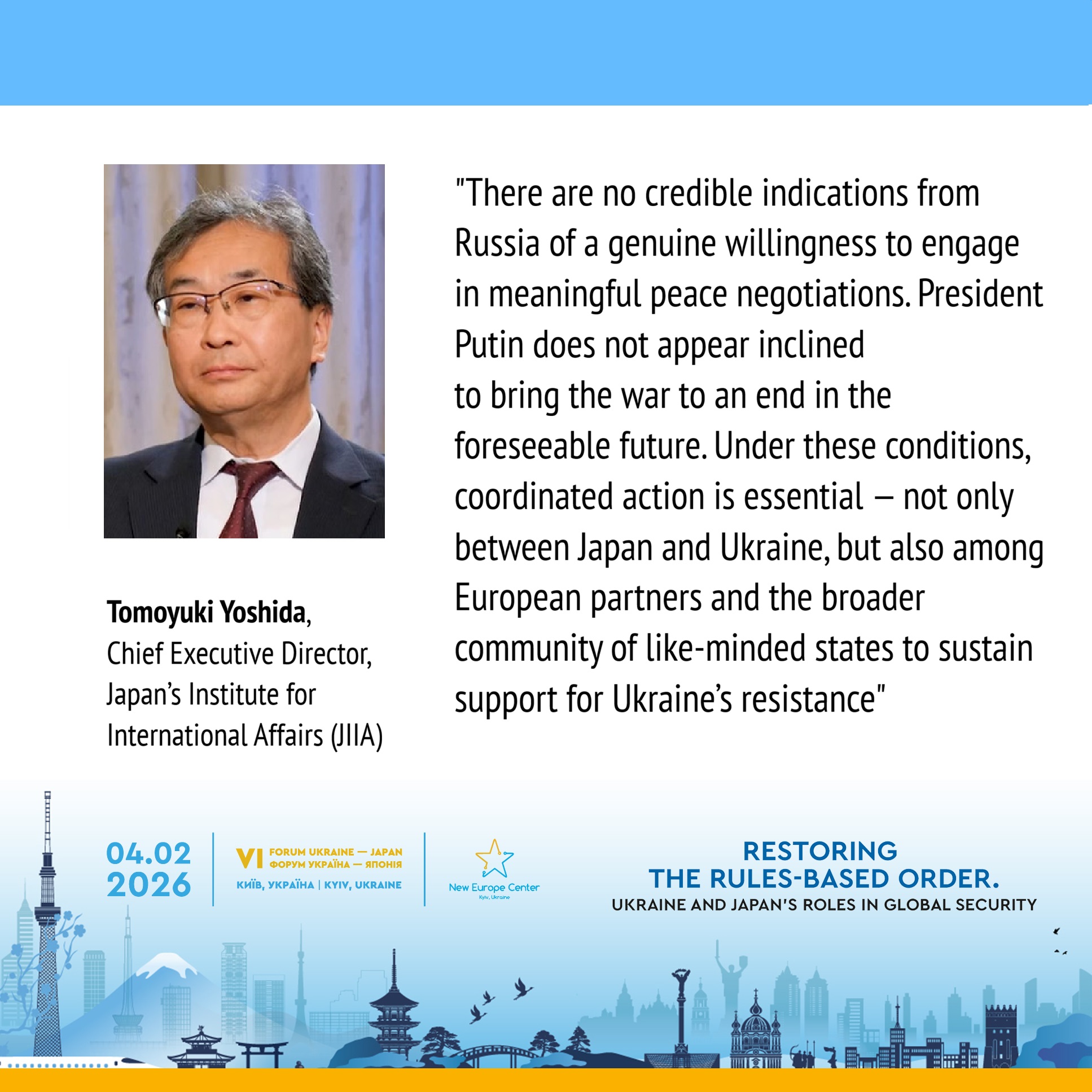
Tomoyuki Yoshida, Chief Executive Director, Japan’s Institute for International Affairs (JIIA)
The international system is undergoing rapid transformation. Under President Trump’s leadership, the United States appears less committed to actively upholding foundational principles such as human rights, democracy, and the rule of law. Nevertheless, there is no viable alternative to continued engagement with the United States in matters concerning the security of our nations.
This reality applies equally to Japan and Ukraine. Even if expectations regarding U.S. leadership in defending the rules-based international order and democratic norms have diminished, the United States remains indispensable in terms of strategic capacity and deterrent power necessary to sustain peace and stability.
At present, there are no credible indications from Russia of a genuine willingness to engage in meaningful peace negotiations. President Putin does not appear inclined to bring the war to an end in the foreseeable future. Under these conditions, coordinated action is essential — not only between Japan and Ukraine, but also among European partners and the broader community of like-minded states to sustain support for Ukraine’s resistance.
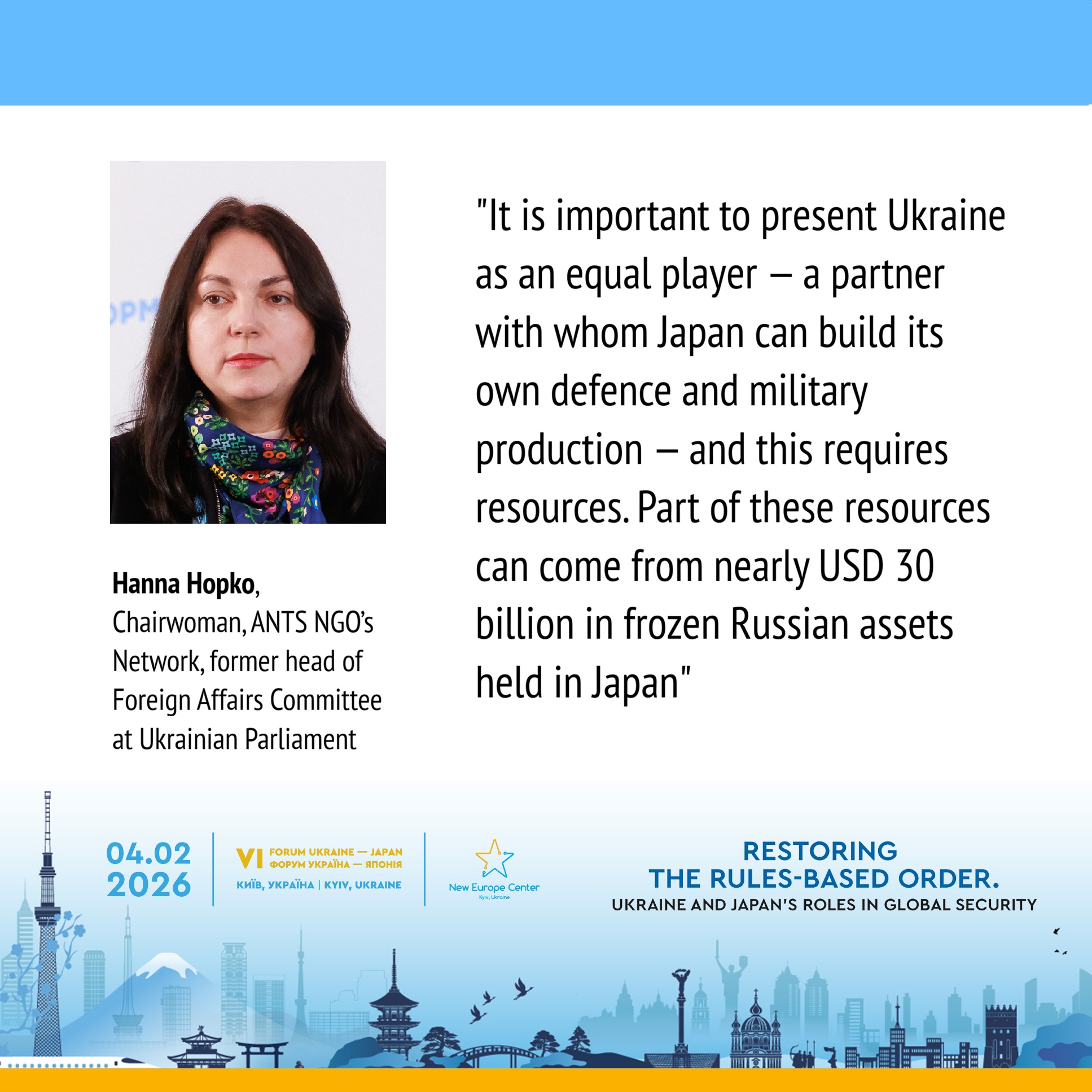
Hanna Hopko, Chairwoman, ANTS NGO’s Network, former head of Foreign Affairs Committee at Ukrainian Parliament
Ukraine, as a state resisting a full-scale aggression, cannot rely on changes in the international context or on the automatic shift in the behavior of authoritarian regimes. In particular, our trip in November to Korea, Japan, and Taiwan allowed us to assess fresh perspectives on how Ukraine is perceived in Asia. Since 2014, when Russia’s first invasion took place, Japan has gradually come to recognize the threat posed by Russia and the importance of Ukraine for international security.
Japan has consistently supported Ukraine throughout Russia’s aggression, while Prime Minister Takaichi is considering increasing the defense budget and revising security documents. This opens prospects for bilateral cooperation, including the development of joint defense production and the use of frozen Russian assets (approximately $30 billion) to create a special fund that will finance Ukraine’s defense needs. Such measures allow the maximization of asset returns and strengthen financial independence from Europe, which is not always ready to act quickly and decisively.
Scenarios for ending the war remain a subject of discussion among international partners. “Compromise agreements” are often proposed, which envision Ukrainian concessions on occupied territories in exchange for security guarantees and financial aid. These scenarios are dangerous because they legitimize occupation, undermine EU unity, and threaten long-term security. Ukraine’s strategy should focus on the complete defeat of Russian imperialism, which is a key guarantee of security for both Ukraine and Europe.
Ukraine demonstrates agency and the capacity to shape new international security concepts. Ukraine’s unique experience includes the active participation of indigenous peoples of the Russian Federation on the side of the Ukrainian Armed Forces, creating prospects for restoring the world order based on principles of de-imperialization. A Ukrainian victory is a more effective guarantee of security than NATO’s Article 5 or other traditional mechanisms. It ensures stability for future generations and enables the building of new economic and security alliances with regions such as Yakutia, Buryatia, Bashkortostan, and Tatarstan.
Strategic financial autonomy is also important: the effective use of frozen Russian assets, along with sanctions pressure on the aggressor’s economy, can halt war financing and reduce human losses. Ukraine’s strategy envisions the asymmetric use of resources and technology to neutralize the Russian war machine, allowing results to be achieved without the need for direct conventional confrontation.
Finally, Ukraine acts as a center for analytical work and strategic calculations for international partners. Its experience shows that without active agency and a clear strategy, it is impossible to counter modern imperial ambitions, preserve democratic values, and develop new security doctrines. Supporting Ukraine is a necessary condition for the stability of Europe and the global security system, while failure to take decisive action risks the restoration of the Russian economy and further destabilization of the international order.
Video recordings of the forum are available in Ukrainian and English.
Photo report is here.
Mediapartner: Ukrinform.