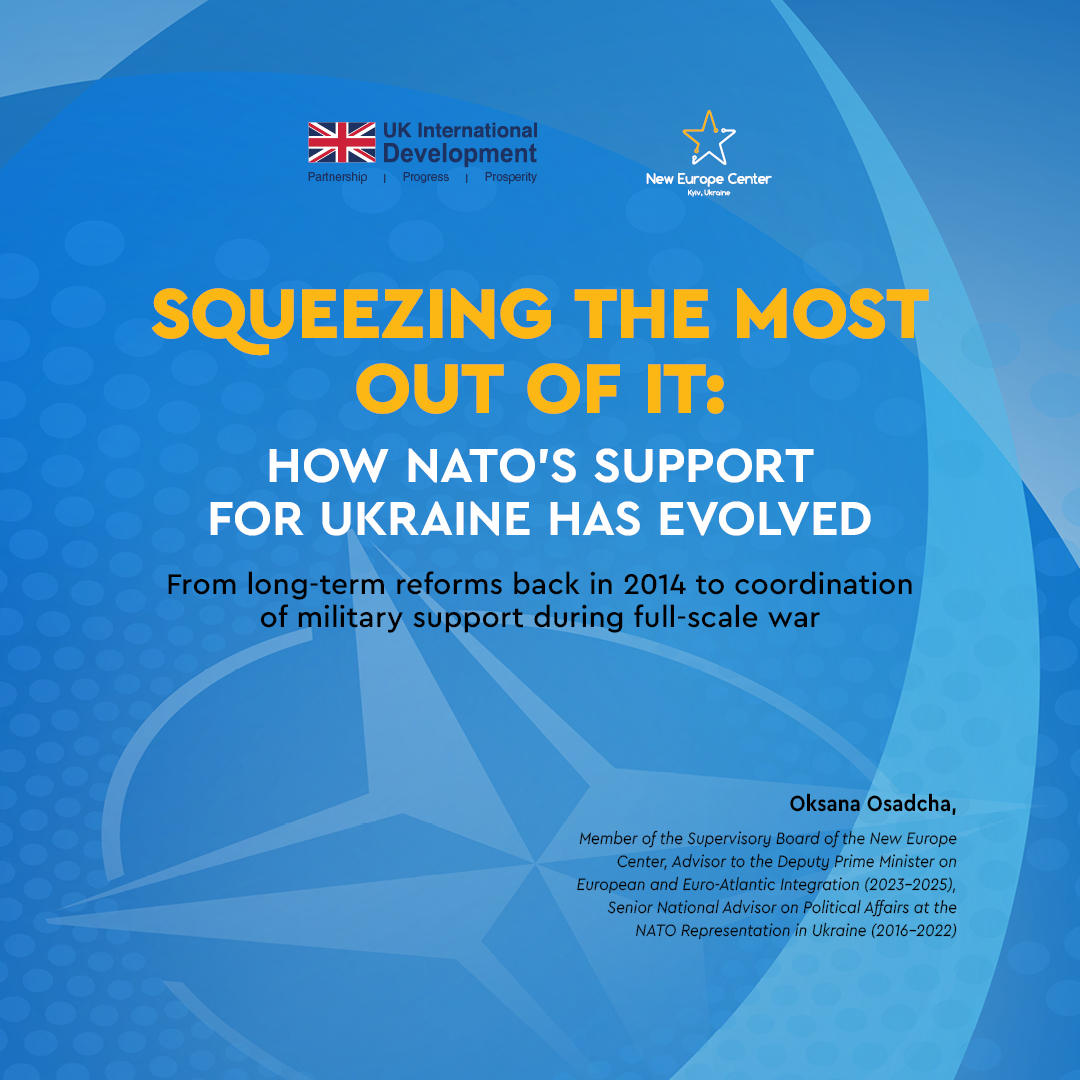
Author: Oksana Osadcha, Member of the Supervisory Board of the New Europe Center, Advisor to the Deputy Prime Minister on European and Euro-Atlantic Integration (2023–2025), Senior National Advisor on Political Affairs at the NATO Representation in Ukraine (2016–2022)
Executive Summary
Over the last decade, Ukraine-NATO relations underwent serious transformation – from cautious support for strategic defence reforms after 2014 to large-scale coordination of military assistance during full-scale war. The initial Alliance approach was based on the long-term development of defence capabilities, institutional reforms, and the provision of primarily non-lethal assistance. This model allowed to create a foundation for the transformation of Ukraine’s defence and security sector, including the development of command and control systems, personnel training, and separate key capabilities. Even the full-scale invasion did not significantly alter NATO’s approach.
After 2024 the logic of support gradually changed: along with reforms programme and development of capabilities, NATO started to play an increasingly prominent role in coordinating international military assistance, training Ukrainian forces, and developing new formats of practical cooperation. Initiatives such as NSATU, revision of the Comprehensive Assistance Package, the launch of JATEC, and other new innovative programmes indicate a gradual shift from limited advisory support to more active involvement by the Alliance in ensuring Ukraine’s defence capabilities in wartime.
Despite the growing level of practical cooperation, the political framework of future relations remains uncertain, creating the gap between the dynamics of the war and the slower logic of NATO’s institutional planning. Ukrainian experience of modern warfare, the large-scale use of unmanned systems, and the rapid adaptation of the national defence industry are increasingly influencing discussions on the future development of defence capabilities in Europe.
Under these conditions, Ukraine–NATO cooperation is gradually shifting from a model of one-sided assistance to a logic of mutual strategic value (inter-improvability). Ukraine’s wartime experience is becoming a source of practical lessons for modernising the Alliance’s approaches to defence planning, innovation, and deterrence, whilst cooperation with NATO opens up opportunities for Ukraine to develop defence-industrial cooperation, technological partnerships, and contribute to shaping a new security architecture in Europe.
Recommendations
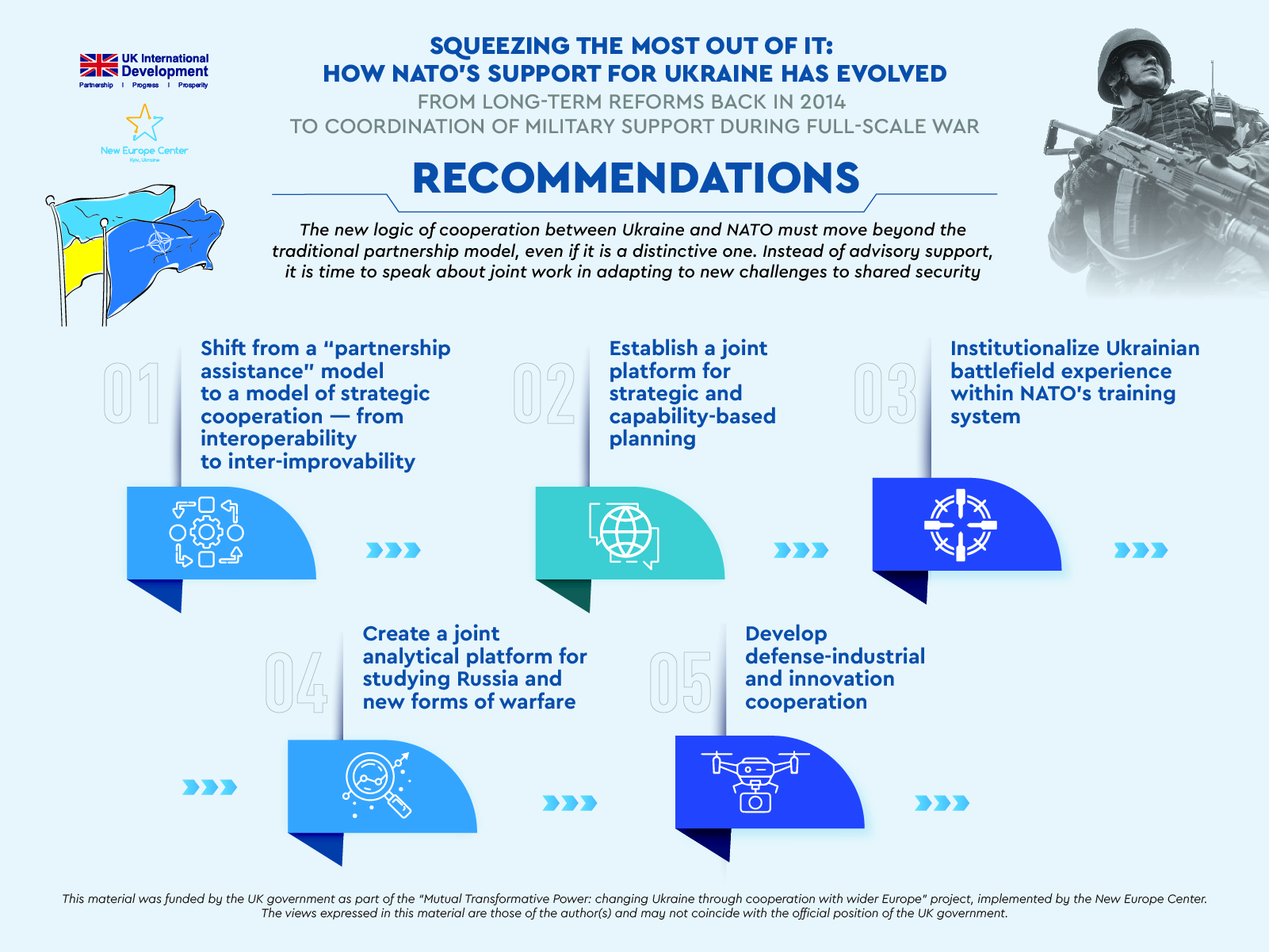
- Shift from a “partnership assistance” model to a model of strategic cooperation – from interoperability to inter-improvability.
NATO and Ukraine should gradually transform the logic of their interaction from one of one-sided support – which Ukraine does not always require – toward jointly shaping a new deterrence architecture in Europe. This implies greater Ukrainian participation in setting the cooperation agenda, as well as the institutionalization of joint mechanisms for planning and developing defense capabilities to address shared security challenges in the Euro-Atlantic region. At the same time, Ukraine should align its national defense planning with the long-term logic of cooperation with NATO. Even under wartime conditions, it is important for Ukraine to develop and share a clearer vision for the development of its Defense Forces in the medium and long term. The presence of strategic benchmarks will allow allies to better understand Ukraine’s needs, increase the predictability of support requests, and facilitate the mobilization of resources for defense capability development.
- Establish a joint platform for strategic and capability-based planning.
Ukraine and the allies could initiate a permanent mechanism for scenario-based modeling of future conflicts and the development of defense capabilities based on real data from modern warfare. The combination of Ukraine’s battlefield experience with NATO’s defense planning system would enable the creation of more adaptive models of deterrence and defense in the Euro-Atlantic area.
- Institutionalize Ukrainian battlefield experience within NATO’s training system.
It is necessary to expand the participation of Ukrainian military personnel in NATO exercises, particularly in the role of a Red Team, and to integrate Ukrainian lessons learned into the training, planning, and evaluation of allied operations. This would help the Alliance more rapidly adapt its doctrinal approaches to the realities of modern technological warfare. At the same time, the capabilities of the Joint Analysis, Training and Education Centre should receive adequate funding and be systematically expanded.
- Create a joint analytical platform for studying Russia and new forms of warfare.
Ukraine and NATO could develop systematic cooperation in researching Russian military strategy, adaptive warfare models, and instruments of hybrid influence. In this context, such an initiative could serve as an appropriate response to the proposal by Ukraine’s Minister of Defense to establish an Institute of Russia, which could become a center for joint research on Russian military doctrines, the war economy, mobilization mechanisms, and instruments of cognitive warfare. Such a platform would allow for the systematic integration of Ukraine’s wartime experience with the analytical resources of the Allies.
- Develop defense-industrial and innovation cooperation.
Ukraine’s defense-industrial complex is increasingly seen by allies as a partner in the joint production and development of defense technologies. Initiatives such as Build in Ukraine / Build with Ukraine, participation in programs like DIANA and the NATO Innovation Fund, as well as the development of dedicated tracks for Ukraine within NSPA, could create a foundation for integrating Ukrainian technological solutions into Euro-Atlantic defense supply chains and accelerating innovation cycles in areas such as unmanned systems, electronic warfare, and robotic platforms.
The full discussion paper is available here.
This material was funded by the UK government as part of the “Mutual Transformative Power: changing Ukraine through cooperation with wider Europe” project, implemented by the New Europe Center. The views expressed in this material are those of the author(s) and may not coincide with the official position of the UK government.