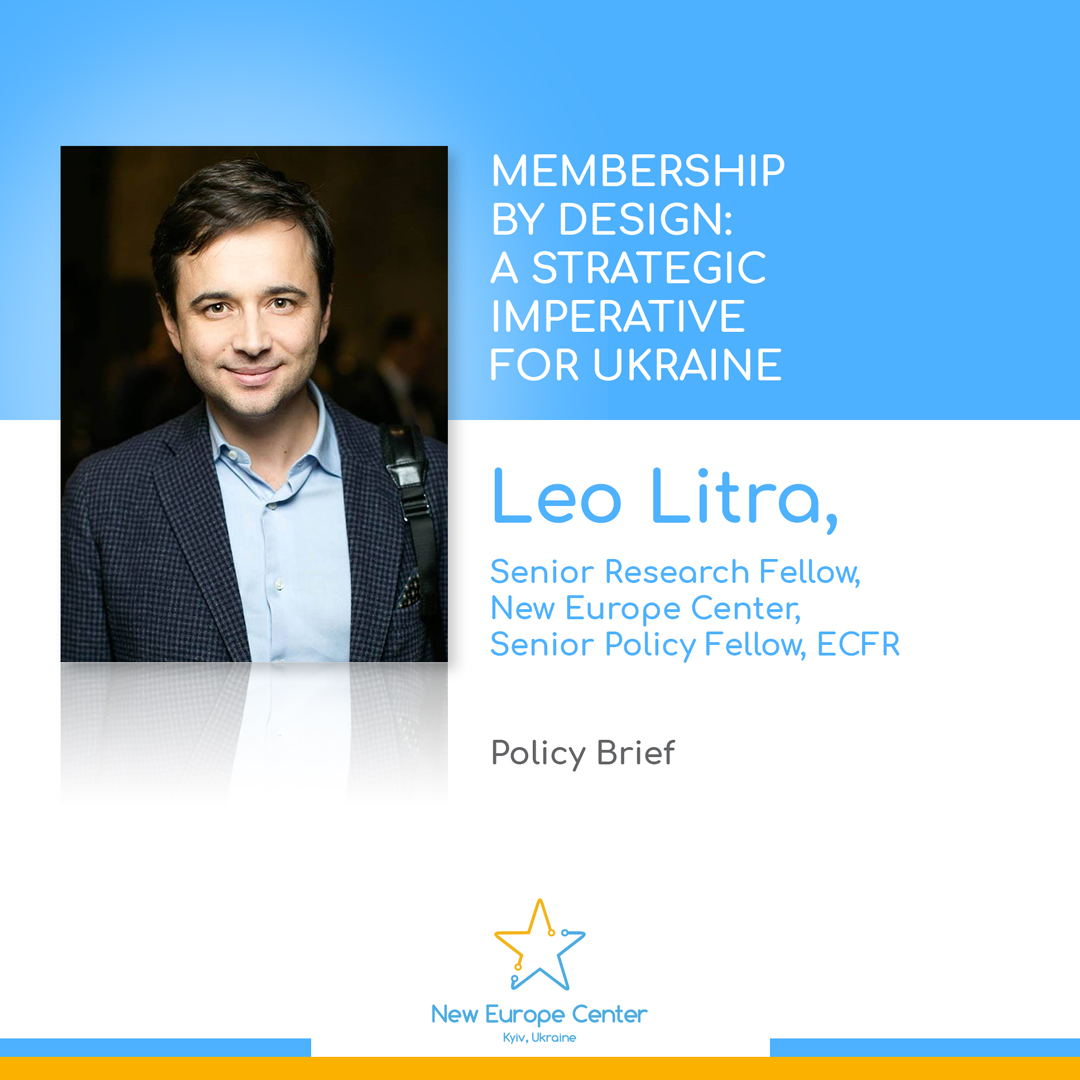
Policy Brief prepared by Leo Litra, Senior Research Fellow, New Europe Center, Senior Policy Fellow, ECFR
Executive Summary
The Russian war against Ukraine has fundamentally altered the geopolitical architecture of Europe, necessitating a radical rethinking of the European Union’s enlargement methodology. As momentum builds for a negotiated settlement, the EU faces a dual imperative: acting as a credible guarantor of Ukrainian security while preserving its own institutional integrity. Recent high-level proposalsregarding “reverse membership” or “fast-track accession” have sparked significant debate. However, much of the negative sentiment generated at the closed door high level dinner in Brussels in early March—stems from a misunderstanding of the variables. These concepts were erroneously perceived as “shortcuts” rather than a structured process of filling a political status with institutional substance. This brief advocates for a clarified “Membership by Design” model. It posits that while a peace settlement is inextricably linked to immediate political accession, the actual substance of that membership must remain strictly conditional. The implementation of fundamental reforms is not bypassed; rather, it becomes the key to unlocking the rights within this specific membership design. A geopolitical approach, bolstered by US endorsement, is required to overcome internal EU deadlock, but it must be grounded in the rigorous delivery of the “fundamentals”.
The Strategic Context: The Peace-Accession Nexus
In the effort to end the Russian war, the West is developing a framework for a future settlement. A central pillar of any credible security guarantee is Ukraine’s accession to the EU. This ambition is driven by mutual interdependence: Ukraine needs the EU for security and reconstruction, while the EU needs Ukraine’s military capabilities to secure its eastern flank. Consequently, the debates over creative accession models depend highly on the prospects of a ceasefire. Strategic consultations indicate that EU capitals will find it difficult to reject a peace plan where EU membership serves as the primary stabiliser. However, for this to work, the “creative format” must be credible. It cannot be a free pass; it must be a mechanism where the political status of membership is granted to secure the peace, while the functional attributes of membership are earned through rigorous reform.
The Merit-Based approach vs. Geopolitical Reality
While many Member States cling to a “merit-based” approach as the only viable path, historical precedent suggests otherwise. The history of enlargement demonstrates that “merit” is not a linear concept; strict compliance has frequently been superseded by strategic geopolitical imperatives. Greece entered the Community despite a negative Commission opinion, while Romania and Bulgaria achieved membership before full compliance with all requirements – there are many examples that deserve our attention. Hungary joined as a democracy, but has backslided significantly while within the Union. These examples highlight that accession is multifaceted, involving a calculation of gains and losses that extends far beyond technical benchmarks.
Furthermore, the argument that the current process is strictly merit-based is undermined by reality. Ukraine successfully met the requirements to open three negotiation clusters, yet the process was blocked by Hungary despite the EU confirming Kyiv’s “merit”. The EU states did not trigger article 7, which would suspend Hungary’s voting rights in the Council. Similarly, the Western Balkans have stagnated for years despite positive Commission reports “certifying” readiness. The political game has consistently overridden technical merit.
The Core Policy Dilemma: Internal Deadlock and Misconceptions
A significant obstacle is the convenient diplomatic shielding provided by Budapest. While Hungary is the vocal veto player, intelligence suggests other Member States—reluctant to expand even on merit-based grounds—are “hiding” behind Budapest’s obstructionism. They would face a difficult political reality if Hungary were to lift its veto.
Regarding the “fast-track” misunderstanding, informal discussions in Brussels in early March reportedly faced backlash. However, private consultations suggest this was not a rejection of creative models per se, but rather a reaction to being kept in the dark by EU institutions. Media leaks portraying new formats as “shortcuts” damaged credibility. Member States acknowledge the current methodology is obsolete, but fear domestic backlash against any perceived lowering of standards. The lesson is clear: if the debate is not managed through a deliberative, low-profile format, it risks toxic politicisation.
Moreover, the often-cited “decision-making deadlock” (unanimity requirements) is a convenient scapegoat. The EU has discussed internal reform for years without result. The inability of the EU to reform itself is blocking the merit-based approach; in this context, the problem lies with the EU, not the candidate countries.
The Proposed Solution: A “Membership by Design” Model
To resolve these contradictions, the EU must move past the binary “in or out” logic and the misleading “fast-track” terminology. We propose a model of “Membership by Design”. In this paradigm, the political architecture of membership is established immediately by design, but the substance—rights, voting powers, and funds—is unlocked only as reforms are verified. Unlike the phased accession, the membership of Ukraine will not be questioned and the process will focus on deliverables to acquire rights and and powers through reforms.
First, this requires political membership first. Ukraine formally signs and ratifies the accession treaty, providing the irreversible political signal required for a peace deal. This cements geopolitical alignment. However, this design confers no voting power until the fundamentals are addressed.
Second, Ukraine must leverage US endorsement. Ukraine’s push for a creative model has a two-fold diplomatic objective. First, to secure US support for enlargement—a critical factor in all previous expansion waves. Second, to use this US endorsement to influence reluctant states, specifically Hungary, to lift blockages. US diplomatic weight can expose those “hiding behind” the veto and force a consensus.
Third, there must be absolute clarity on Fundamentals. The success of Ukraine in meeting the “7 steps” for the candidate status was due to the clear causal link between reform and reward. To avoid the “Macedonian scenario” of endless technical stagnation, the new model must offer the same clarity: specific reforms in the fundamentals cluster (Rule of Law, Justice) must trigger specific, automatic unlocking of membership rights. The creative model is not an escape from reforms; it is an incentive structure where membership is the guarantee, but the content of that membership is the reward for implemented reforms.
Operationally, this implies conditional voting rights. Ukraine would hold a seat at the table, but voting rights would be suspended and unlocked incrementally based on compliance with the Rule of Law. This mitigates the risk of importing institutional instability. Immediate benefits would focus on the Single Market and security alignment, while full access to fiscal transfers (CAP) would be phased in to protect the EU budget.
Recommendations
- Reframe the Narrative
Abandon terms like “Reverse Accession”, “Staged Accession”, or “Fast-Track”, which imply shortcuts or endless waiting rooms. Adopt “Membership by Design”, emphasizing that the political framework is immediate, but the substance is strictly conditional on fundamentals.
EU institutions and the Member States need to work together to provide a legal reasoning on how an Accession Agreement formulated in the “Membership by Design” style would not contradict the EU Treaty
- Prioritise the Fundamentals
Explicitly communicate that while the accession timeline is accelerated politically, the implementation of judicial and anti-corruption reforms remains the non-negotiable key to unlocking voting rights and funds within that membership design.
- Deliberative Diplomacy
Move discussions away from media-driven leaks to confidential, deliberative formats to prevent Member State backlash regarding perceived “shortcuts”.
- Utilise the US Lever
Actively engage the United States to endorse this specific model, using their influence to unlock the vetoes of Hungary and the “reluctant silent bloc.”
- Restore the Reform-Reward Link
Establish a rigid, automatic mechanism where verified reforms immediately unlock specific treaty rights, removing the possibility of politically motivated delays by the Council.