Commissioned by the New Europe Center, Info Sapiens studied the opinions of Ukrainians regarding security issues. We bring to your attention the first part of the results.
-
“Nuclear” guarantee
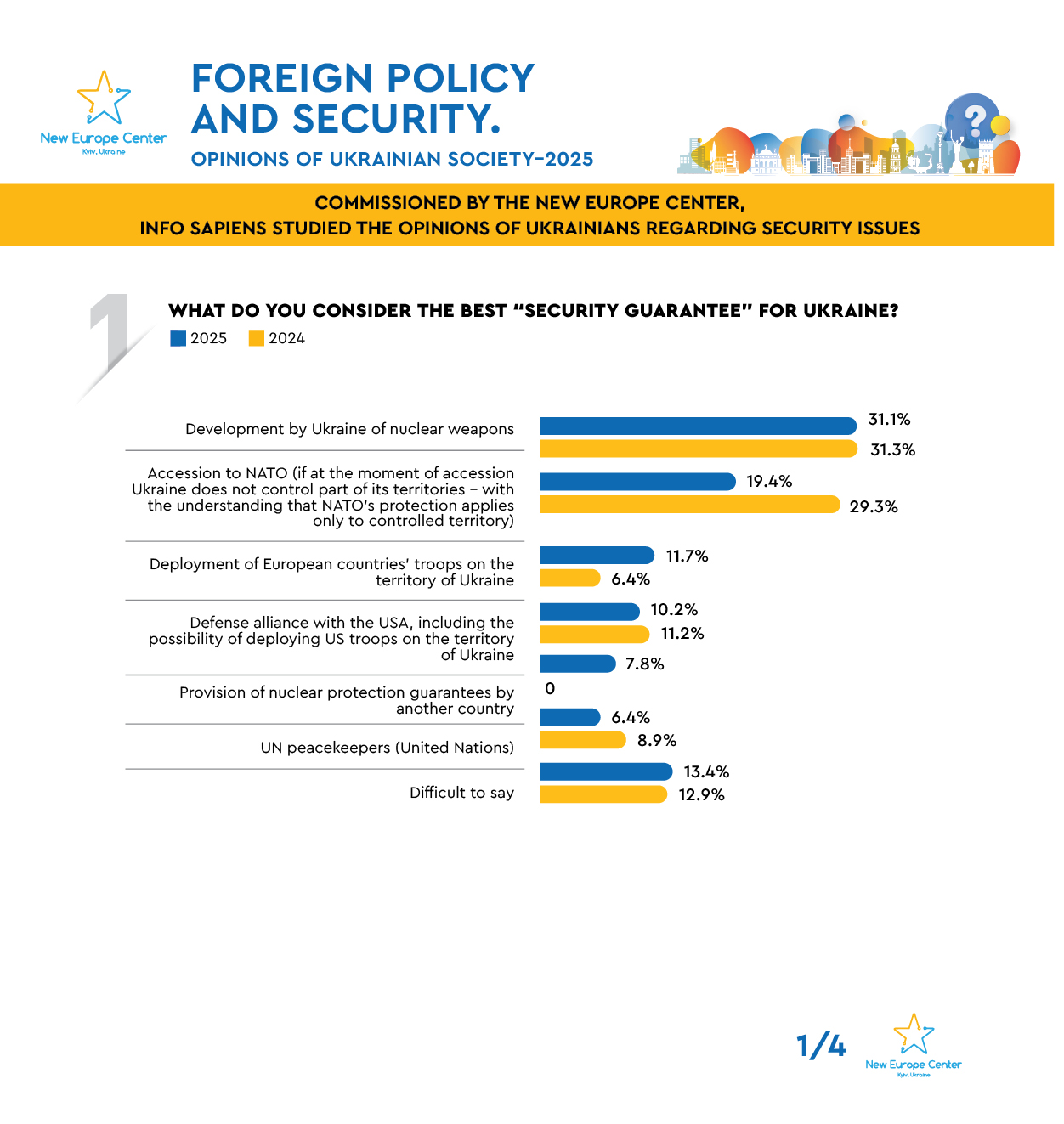
Ukrainians continue to consider Ukraine’s development of its own nuclear weapons the best security guarantee – 31.1%, which practically coincides with last year’s indicator (31.3%). This indicates, on the one hand, Ukrainians’ disappointment in international support, in external security guarantees, and on the other hand reflects the understanding that it was precisely nuclear weapons that allowed Russia to play on the fears of the West, and this, in turn, affected the slow, hesitant military assistance to Ukraine.
This same trend of disappointment in external guarantees is reflected in the decline in support for Ukraine’s accession to NATO – by 10% (from 29.3% to 19.4%). Other possible options for guaranteeing security have moderate or low support. 10.2% of respondents believe in the effectiveness of a defense alliance with the United States, 6.4% rely on a UN peacekeeping mission.
A notable trend is the increase in support for the option of deploying European countries’ troops on the territory of Ukraine – the indicator has almost doubled: from 6.4% to 11.7%. A new option – the provision of nuclear protection guarantees by another country – is supported by only 7.8% of respondents.
A noticeable general trend remains the desire for self-sufficient and maximally reliable security mechanisms: in the Ukrainian hierarchy of guarantees, the priority remains Ukraine’s own Armed Forces, and only then – the capabilities of partners.
It should be noted that respondents could only select one answer to this question. Data on trust in NATO and support for Ukraine’s accession to the Alliance will be presented in the second part of the survey.
-
Negotiations without guarantees – a bad idea
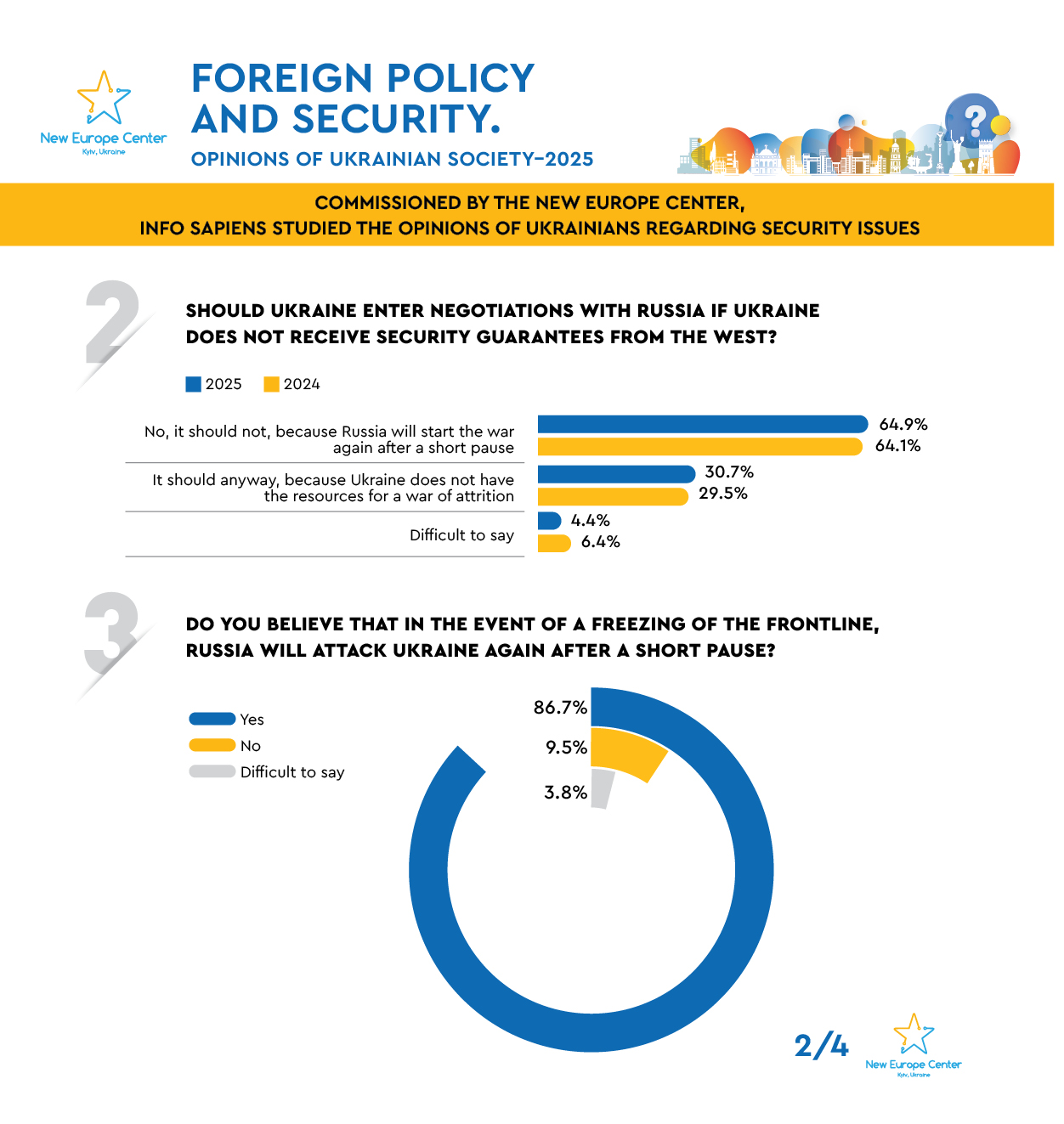
Ukrainian society remains unwavering in its conviction that negotiations without security guarantees are not a reliable path to peace, and that without external safeguards any compromise will only postpone a new aggression by Russia.
The position of Ukrainians regarding negotiations with Russia remains stable: almost two-thirds of respondents (64.9%) believe that Ukraine should not enter negotiations if it does not receive security guarantees from the West. This indicator has practically not changed compared to 2024 (64.1%). Almost a third of respondents (30.7%) view negotiations positively even without security guarantees. Overall, as we can see, skeptical attitudes toward “negotiations for the sake of negotiations” continue to prevail among Ukrainians.
-
Freezing the frontline will not stop Russia from attacking
Ukrainian society expresses a unanimous forecast regarding Russia’s behavior in the event of a possible freezing of the frontline: 86.7% of respondents believe that after a short pause, Russia will attack Ukraine again. Only 9.5% of respondents assume that freezing could secure a longer peace. The “freeze” scenario is not perceived by society as a realistic path to lasting peace.
-
Unacceptable concessions
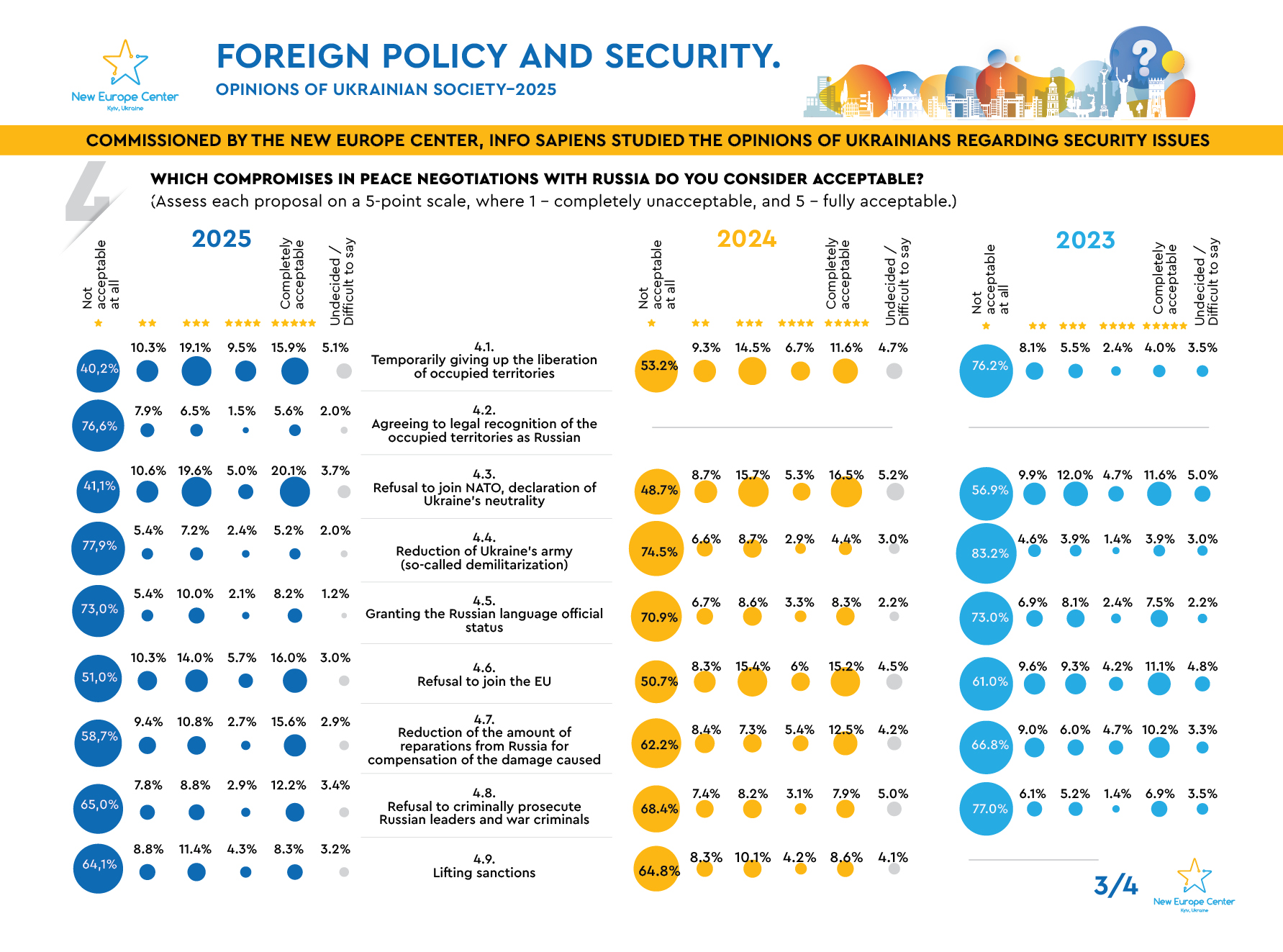
Most Ukrainians reject key political and security compromises that Russia traditionally tries to impose as conditions for negotiations. Although Ukrainians’ positions regarding certain issues have somewhat softened in recent years, the overall logic of public sentiment remains unchanged. Record indicators regarding the inadmissibility of compromises concern the following issues: reduction of Ukraine’s army (83.3%), legal recognition of the occupied territories as Russian (84.5%), granting the Russian language official status (78.4%).
-
Every second Ukrainian will protest
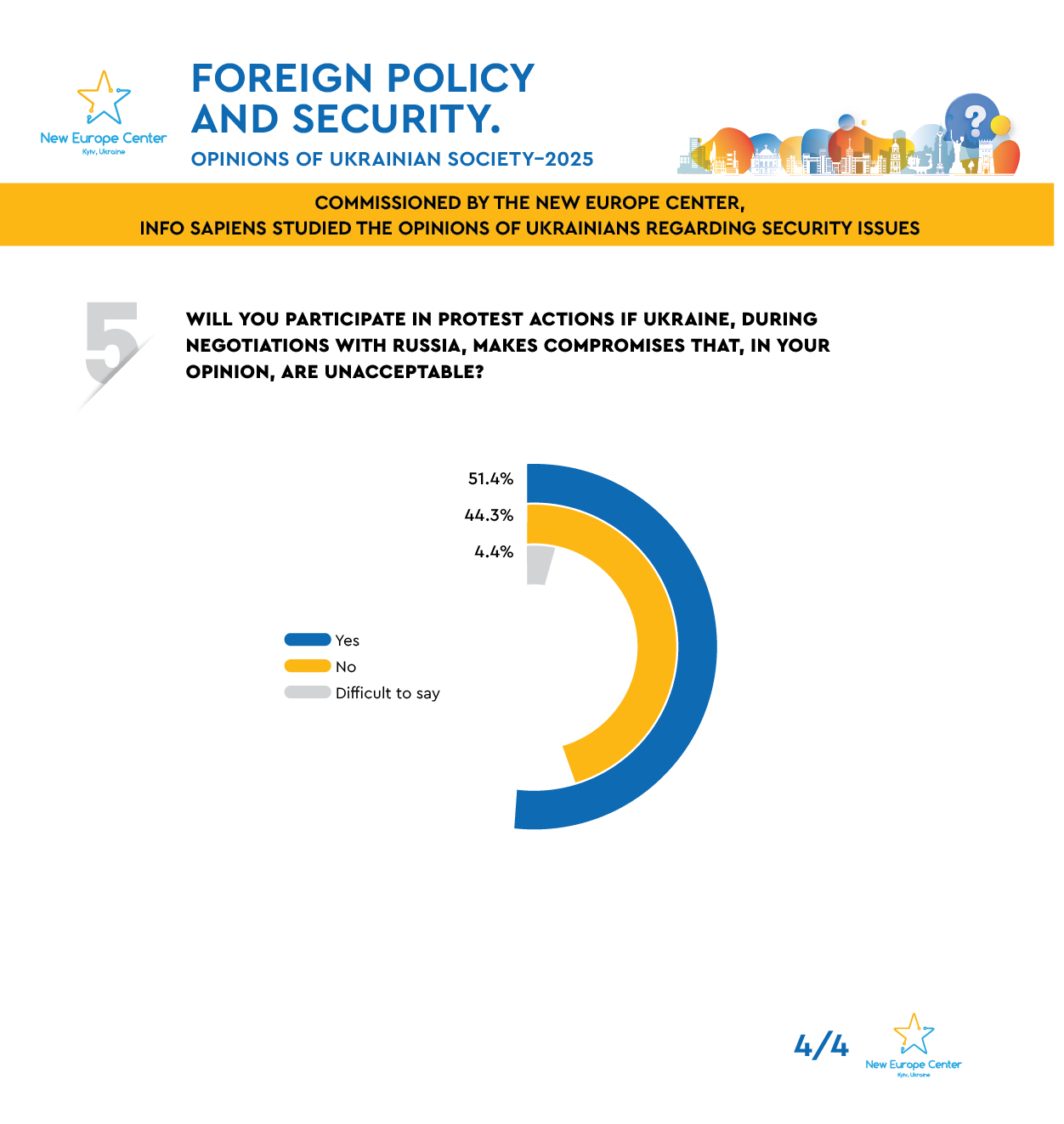
51.4% of respondents answered that they would participate in protest actions if Ukraine, during negotiations, makes compromises that respondents consider unacceptable.
The opinion poll was conducted by INFO SAPIENS LLC on behalf of the New Europe Center during the period from November 5 to November 26, 2025. The sample consists of 1,000 respondents. The opinion poll was carried out using the CATI method (computer-assisted telephone interviews) based on a random sample of mobile phone numbers. The sample is representative of the Ukrainian population aged 16 and above, considering gender, age, region, and size of settlement prior to the full-scale invasion according to the latest available data of the State Statistics Service of Ukraine as of 01.01.2022. The theoretical margin of error does not exceed 3.1% with a probability of 0.95%. The opinion poll was not conducted in the temporarily occupied territories of the Autonomous Republic of Crimea, the city of Sevastopol, Donetsk and Luhansk regions, and other territories that are under occupation, as well as territories where Ukrainian mobile communication is unavailable.