The first year of implementation of the Ukraine-UK 100 Year Partnership Agreement has demonstrated significant potential for cooperation, but has also revealed the need for a more systematic approach. In the context of war and global turbulence, the partnership must go beyond political statements and transform into a system of concrete security, economic, and institutional decisions. It is also important to understand how the Partnership is perceived by the Ukrainian and British public, whether its mutually beneficial nature and the results of the first year are evident, and what examples most convincingly demonstrate its value to different audiences. That is why the New Europe Center, together with Ukraine Forum (Chatham House, UK), asked leading British and Ukrainian experts a key question: what specific steps should Ukraine and the UK take in the near future to give real strategic substance to the 100 Year Partnership?
PDF-version is here.
Key conclusions:
- Ukraine-British partnership as a foundation for a new security architecture. The 100 Year Partnership should transform from support to systematic defence alliance. The key areas are joint arms production, integration of Ukrainian combat experience, development of interoperability, and creation of sustainable defense chains. Ukraine is not only a recipient of aid, but also a full-fledged security actor in shaping the new security architecture in Europe.
- Russia’s loss – a focal point of the United Kingdom’s security. Ukraine’s victory means strategic weakening of Russia and reduction of long-term threats to Europe. Therefore, hard security must remain a priority for cooperation: long-range missiles, air defense systems, maritime defense, and stable annual funding for military aid.
- Security cooperation should transform into in-depth technological cooperation. This involves the creation of joint production clusters in the field of military technology, localization of production, and systematic exchange of innovations and combat practices. Institutional formalization of joint ventures with intellectual property protection will allow for the formation of interdependent defense chains and increase the strategic autonomy of both states.
- Financial support for Ukraine should shift from increasing debt to creating a system of macro-financial security. Ukraine does not have the capacity to absorb new loans without the risk of a debt crisis, especially in the event of hryvnia devaluation. Innovative multilateral mechanisms are needed, such as financial backstops in the form of currency swaps or stabilization funds, to ensure fiscal self-sufficiency and gradual integration into the European market.
- Long-term nature of partnership: resilience, mutual benefits, and political symbolism. The partnership requires not only military assistance, but also macro-financial stability, investment mechanisms, and joint economic projects. Political gestures, namely the use of £2.5 billion from the sale of Chelsea in favor of Ukraine, a possible visit by the King, the expansion of regional contacts, and the minimization of visa barriers, strengthen trust. The combination of security, economy, and public support makes the partnership strategically irreversible.
- Black Sea and maritime area is a strategic pillar of long-term partnership. The development of Ukraine’s navy, mine clearance, and coastal defense fortifications form the basis for the safe operation of trade routes and the stability of food markets. The UK’s experience as a maritime power provides a natural basis for deeper cooperation.
- The 100 Year Declaration has not only practical, but also significant political symbolism. This signalises a long-term faith of the United Kingdom in Ukraine’s existence and potential as a strategic partner. Symbolic dimensions enhance the negotiation position of Ukraine, especially in the context of its relations with the U.S. and potential EU membership.
- The effectiveness of the partnership depends on Ukraine’s internal reforms and institutional capacity. There should be a reboot of strategic dialogue with NATO, simplification of procedures for cooperation with foreign partners, reform of defence management, fair mechanisms for selecting military personnel, strengthening of the judicial system and anti-corruption standards.
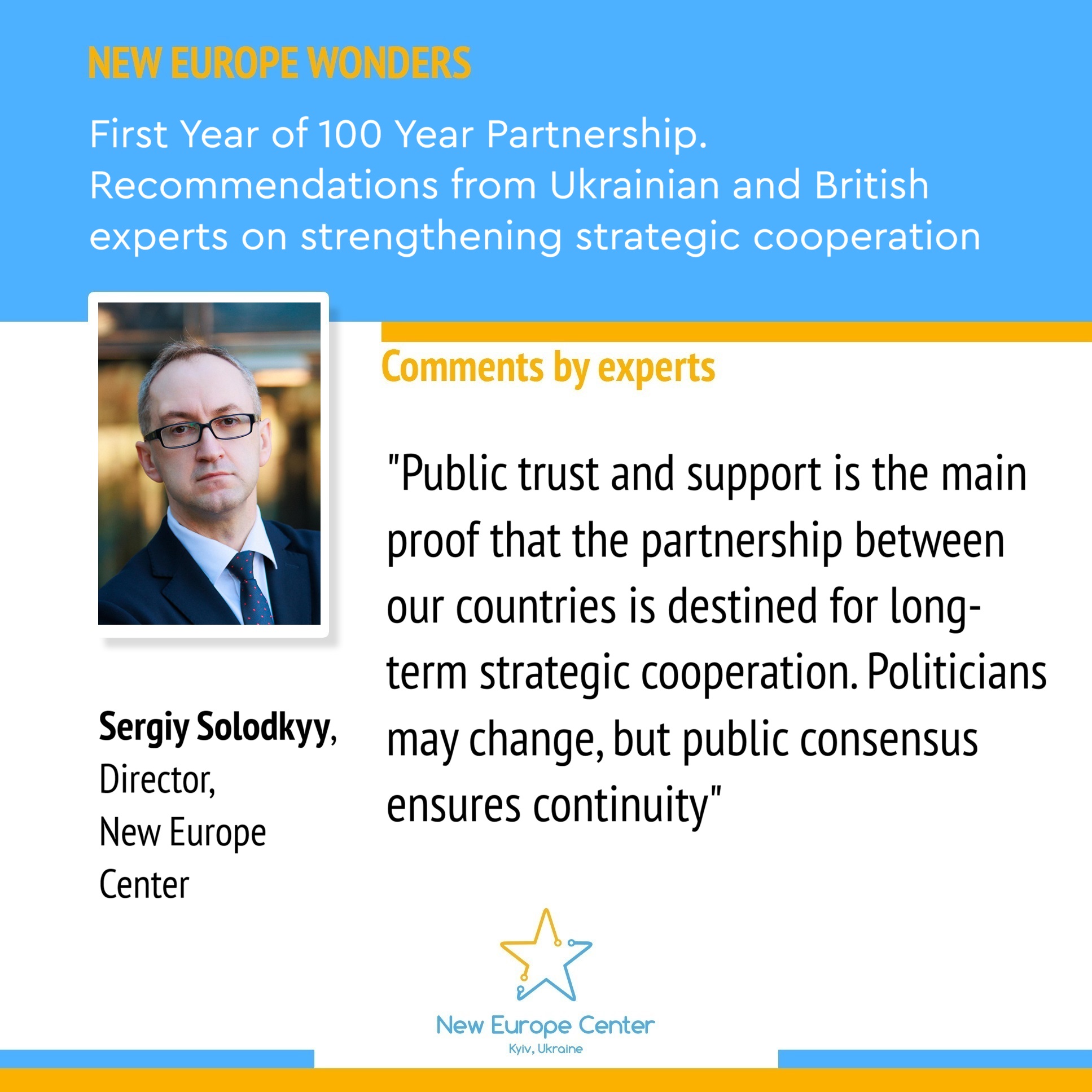
Sergiy Solodkyy, Director, New Europe Center
The United Kingdom is one of the most trusted and strategically consistent partners for Ukraine. There is a constant political and security dialogue between Kyiv and London at a high-level. The UK is amongst the leaders of military support for Ukraine. London consistently supports Ukraine’s membership in NATO and plays an important role in preserving Transatlantic communication – in particular, along the Kyiv-Washington line.
The 100 Year Partnership Agreement became a unique diplomatic signal that confirms the long-term nature of British intentions. In the context of Russia’s aggression, which has always relied on short-term Western support, such a strategic horizon is of fundamental importance for security.
The enemy’s calculations will be undermined by projects and initiatives that meet three criteria: scale, ambition, and long-term nature. A striking example of such a partnership is the production of Octopus interceptor drones on British territory. London’s commitment to provide Ukraine with military aid over the next five years – at least £3 billion annually – is also important (this creates predictability and strategic stability). The century-long partnership between Ukraine and the UK correctly outlines all possible vectors of interaction that prove the long-term nature of the partnership: the task now is to deepen and scale it up.
The United Kingdom is one of the founders of “the Coalition of the Willing” that has potential to become an instrument for the shaping of Ukraine’s post-war security guarantees. In order to strengthen the trust in such a format, London and other allies should demonstrate stronger determination as soon as possible in those questions, where Ukraine’s needs are critical –.long-range weapons, systematic strengthening of anti-air defence, scaling up joint arms production, active diplomatic work with countries that have the relevant resources.
The long-term nature of the partnership is based not only on government decisions, but also on public support. The UK has long earned the widespread respect of Ukrainians. The latest New Europe Center opinion poll showed that the British Prime Minister has become the leader in public trust among Ukrainians. British society also consistently advocates for comprehensive support for Ukraine. This public trust and support is the main proof that the partnership between our countries is destined for long-term strategic cooperation. Politicians may change, but public consensus ensures continuity.
If we talk about interpersonal dimension in general, the one of the most convincing evidence to demonstrate the irreversibility and strategic scale of the partnership would be taking steps to minimize barriers to travel for Ukrainians to the UK.
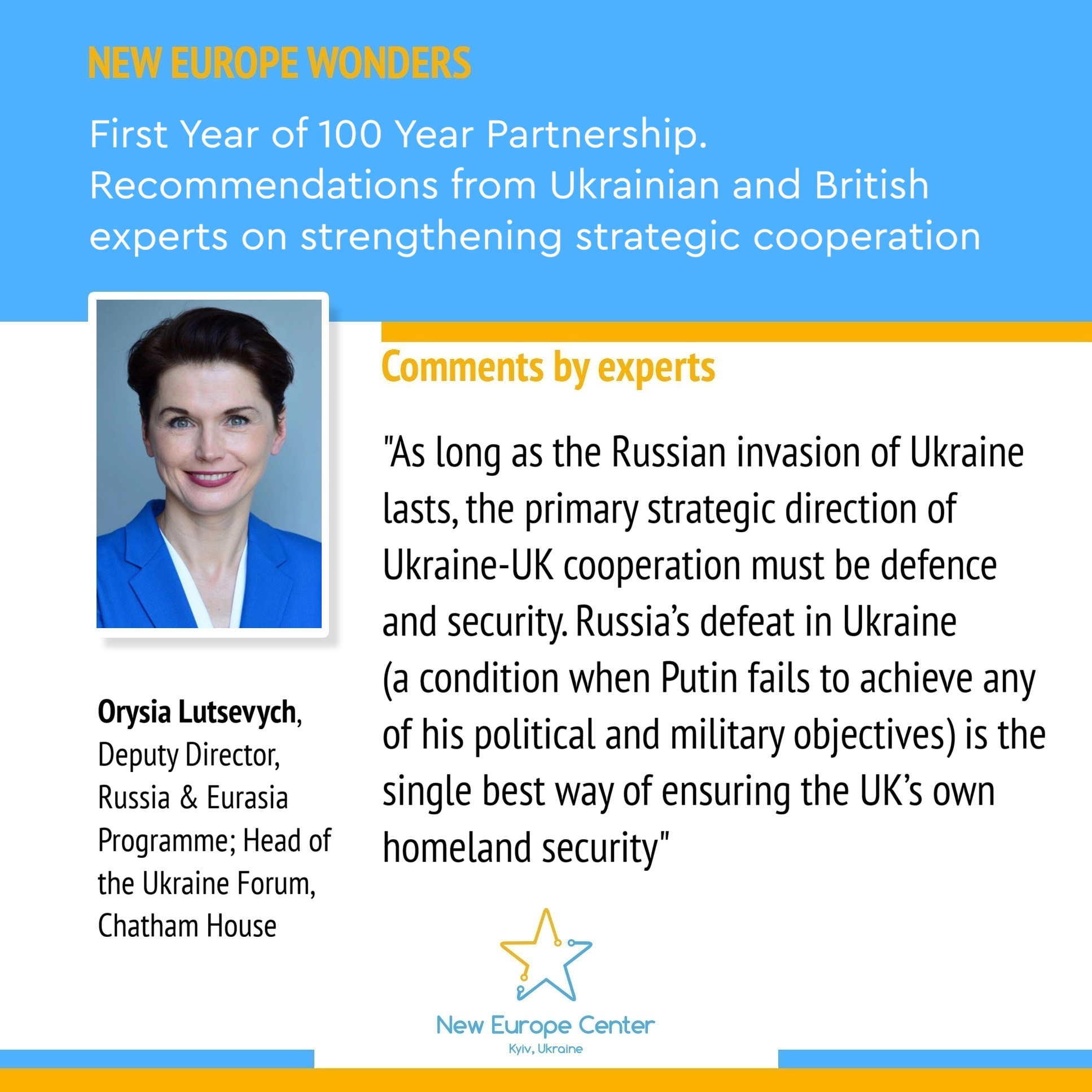
Orysia Lutsevych, Deputy Director, Russia & Eurasia Programme; Head of the Ukraine Forum, Chatham House
As long as the Russian invasion of Ukraine lasts, the primary strategic direction of Ukraine-UK cooperation must be defence and security. Russia’s defeat in Ukraine (a condition when Putin fails to achieve any of his political and military objectives) is the single best way of ensuring the UK’s own homeland security. The UK was always at the forefront of capability provision to Ukraine. In 2026, Ukraine will need a significant supply of long-range missiles to strike military targets inside Russia and powerful air-defence. Specific land-use capabilities that the UK can supply include Storm Shadows, mid-range (25 km) air defence, signals intelligence and electronic warfare, engineer support, and protection for armoured vehicles.
The UK and Ukraine need to launch more joint stock ventures in new technological warfare manufacturing. Expanding on state-run drone interceptor production in the UK (project Octopus), facilitate new British Ukrainian private companies that scale Ukrainian defence intellectual property to future-proof the UK’s defence and deterrence and enable speedy and steady supply to the Ukrainian Army. It is important to engage Ukrainian military-technology experts in sharing their knowledge with Dstl (Defence Science and Technology Laboratory).
The Black Sea is a crucial conduit for international trade and has paramount strategic importance. Support Ukraine’s naval capability to secure freedom of navigation and food security. Ukraine has destroyed 30 per cent of the Russian Fleet and pushed the rest into Novorossiysk. The UK should continue to enhance support for Ukraine’s de-mining capabilities and coastal defence.
Lastly, action a handover of £2.5 billion of proceeds from the sales of Chelsea (by Abramovich) to compensate the victims of war in Ukraine. These funds could be directed to housing projects to attract Ukrainian back home, mental health support to veterans and their families.
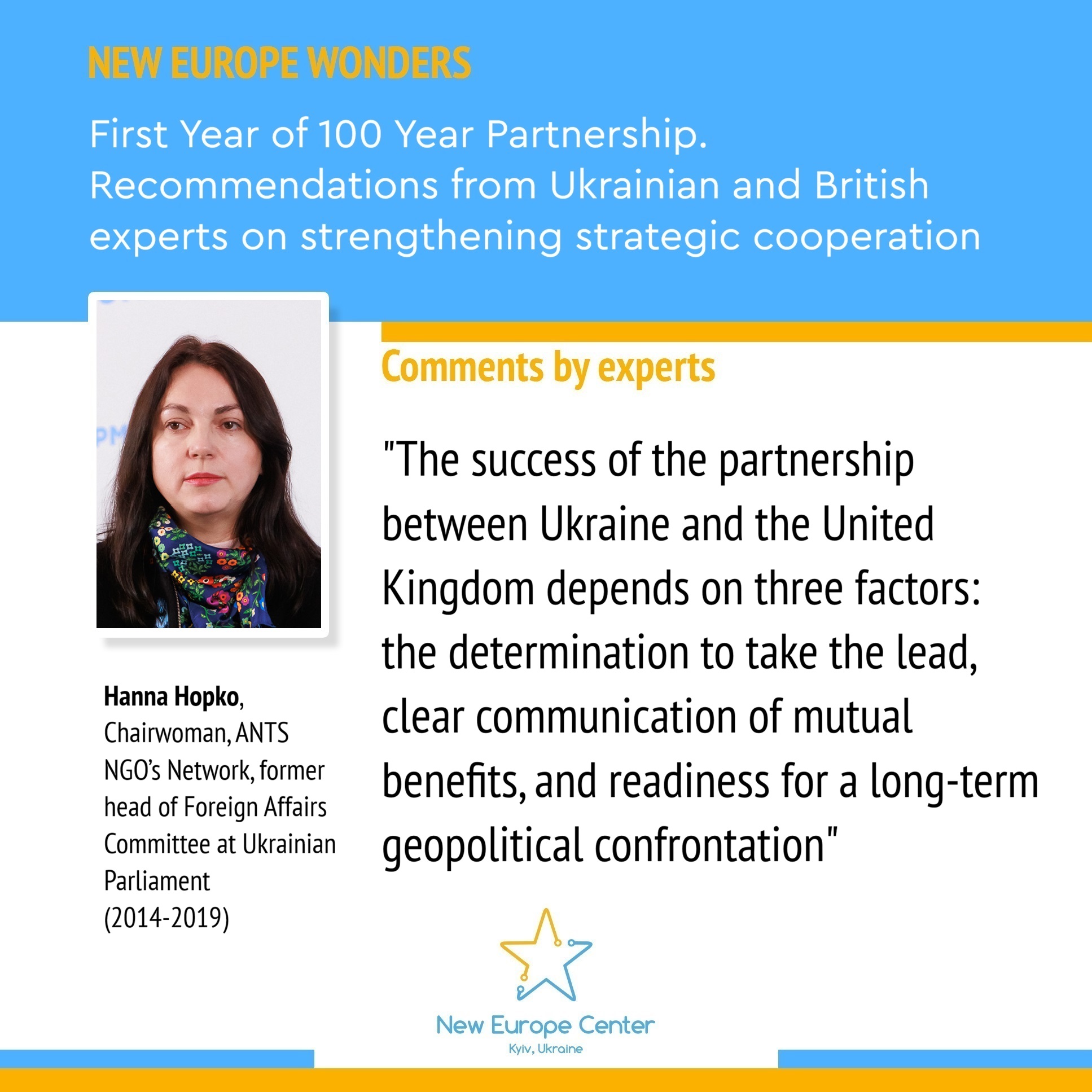
Hanna Hopko, Chairwoman, ANTS NGO’s Network, former head of Foreign Affairs Committee at Ukrainian Parliament
The filling of the 100 Year Partnership Declaration with real strategic content should be based on an awareness of the new reality. The partnership between Ukraine and the United Kingdom could become:
- a core for the new security architecture in Europe;
- a driver for defence innovations;
- a model for economic and technological integration.
But its success depends on three aspects:
- The determination to take the lead and back it up with specific defence and technology projects right now.
- Clear communication of mutual benefits.
- Readiness for a long-term geopolitical confrontation.
Here are the concrete steps for the closest period. First of all – deimperialization of russia.
- To counteract pressure from the US and russia on Ukraine regarding a poor “peace agreement” that will lead to defeat for all in the medium term, increased risks to Ukraine’s statehood, and the acceleration of continental war in Europe.
- Make a plan of russia’s deimperialization together with Europe – at least finishing off the aggressor’s economy, confiscation of assets, with the creation of a fund to maximize profits from investments in defence, stronger sanctions.
- Acknowledge the aggression as genocide, as it was acknowledged by 8 other parliaments.
Second step – preparation for war in Europe, opposition to the axis of evil. Defence and security – main priority:
- When increasing military aid, launch programs to monitor the effectiveness of its use so that support for Ukraine’s defense capabilities becomes a significant boost to the development of defense infrastructure, joint arms production, and maritime security.
- Given NATO’s inability and the lack of testing of Article 5 in the European theater, build and strengthen the Ukraine-UK Alliance and prepare an alternative.
Concrete steps right now. Ukraine should increase joint defense production (UAVs, air defense systems, missiles) with real contracts; reform defense procurement to meet transparency standards; and provide infrastructure for the long-term presence of British instructors. Recommendations for the UK: localisation of weapons production in Ukraine; systematic training programmes for officers and staff; programme interoperability. This is not about integrating the Ukrainian army into British military doctrines and NATO standards, but about bringing protocols in line with modern warfare.
The UK’s core position on continuing reforms in Ukraine – particularly critical ones – fundamentals (rule of law, judiciary reform, anticorruption infrastructure, consumers and investors protection).
In the economic and financial areas it is important to form credit lines through UK Export Finance, investment insurance, joint infrastructure projects.
It would be important for the King to visit Ukraine and tour one of the castles (for example, in Lutsk or Zolochiv) to reinforce the continuity of over 1,000 years of history.
Insufficient emphasis on mutual benefits: messages about partnership often focus on helping Ukraine rather than on bilateral advantages. It is necessary to explain that Ukraine has become a donor of knowledge rather than a recipient of aid.
The term “100 year Partnership” is often considered as a hyperbole, not as a flexible framework with day-to-day review, which this Agreement is: for example, this January, a year after signing the Agreement, the UK and Ukraine signed a roadmap for defense partnership.
There is a lack of communication on precise successes in the framework of Agreement realisation. We should talk more about success stories.
Leaders of two countries meet only in capitals, however, important are the visits to small communities both in the UK, as well as in Ukraine.
The Ukrainian public views the partnership in an exclusively positive light. The majority of the British also support the partnership with Ukraine. 70% of the British want Ukraine to win. Regardless of their political sympathies, a clear majority of each voter group in the UK supports Ukraine – from 64% among those who voted for Reform UK to 83% among Conservative Party voters. 79% of British believe that defending Ukraine is important for their country.
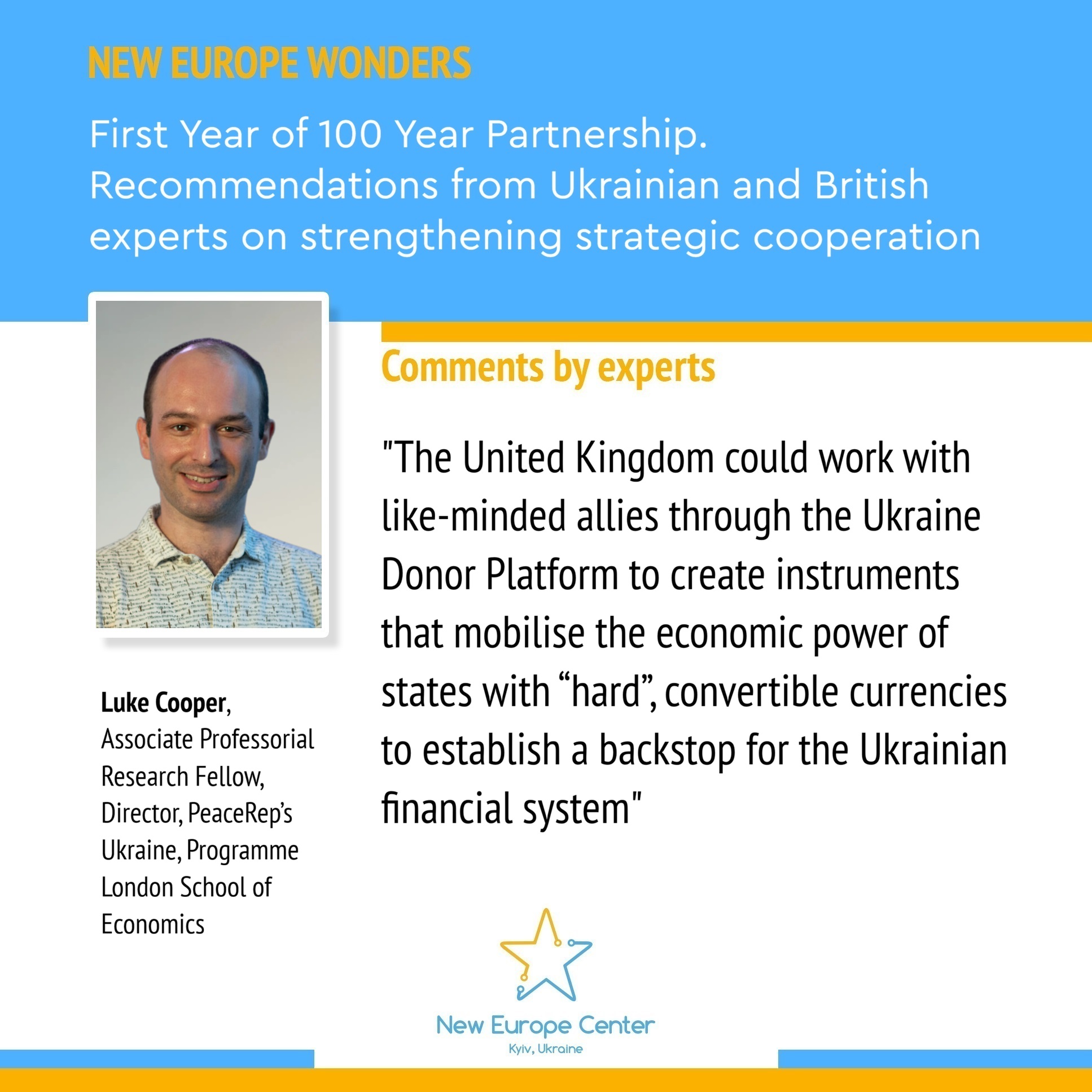
Luke Cooper, Associate Professorial Research Fellow, Director, PeaceRep’s Ukraine, Programme London School of Economics
Talk of a century of partnership can easily inspire cynicism. There are, however, steps that the United Kingdom and Ukraine can take together – in concert with allies – that put “flesh on the bone” of this commitment, while also assisting with Ukraine’s immediate investment and financing needs. Here a critical priority has to be creating financial instruments that support the goal of putting Ukraine on a path to fiscal self-sustainability and its phased integration into the European single market. The United Kingdom could work with like-minded allies through the Ukraine Donor Platform to create instruments that mobilise the economic power of states with “hard”, convertible currencies to establish a backstop for the Ukrainian financial system.
The need for this effort was implicitly recognised at the close of 2025. In the throes of the debate over utilising Russian sanction assets to meet Ukraine’s financing needs, the European Commission correctly argued that Ukraine did not have the capacity to absorb further debt even in the form of concessional loans. Denominated largely in Euros, the loan repayment terms are only favourable so long as the Ukrainian hryvnia retains its value in international markets. In the event that it did not, Ukraine would face a sovereign debt crisis. Fortunately, Ukraine’s allies’ own experience of dealing with financial crises can be drawn in to develop instruments that close off these downstream risks. This has developed models like the Federal Reserve’s dollar swap line and the European Union’s European Stability Mechanism (ESM) that create a precedent for the kind of financing backstop Ukraine needs. There is no “template” here for Ukraine but the United Kingdom could lead the debate through the donor group on an innovative multilateral solution.
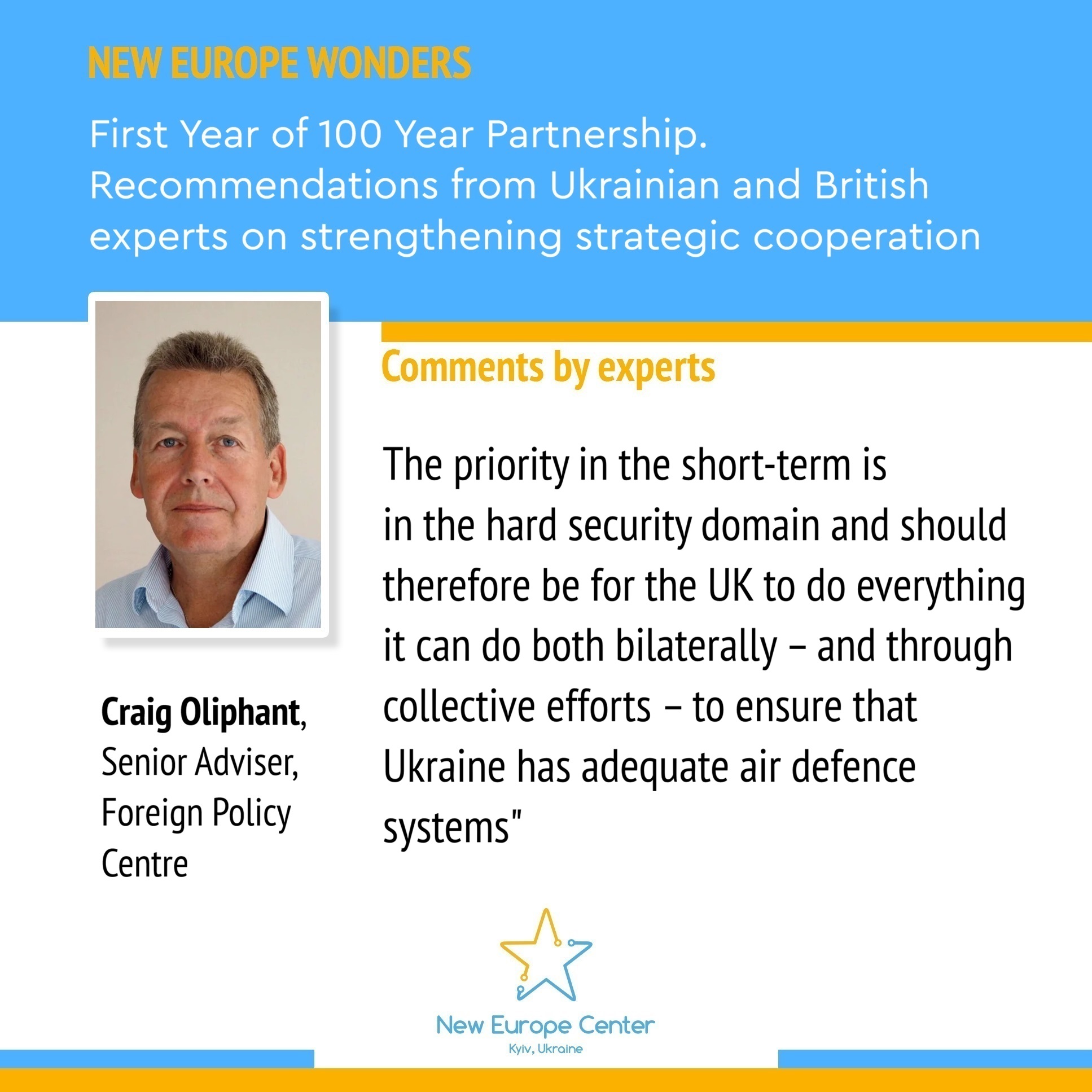
Craig Oliphant, Senior Adviser, Foreign Policy Centre
The priority in the short-term is in the hard security domain and should therefore be for the UK to do everything it can do both bilaterally – and through collective efforts – to ensure that Ukraine has adequate air defence systems. Also, in terms of practical & essential help in the immediate term, it should provide more mobile generators and warming stations, and humanitarian assistance, to help local city and town residents cope in the bitter winter temperatures.
It is imperative that Ukraine prevails in the war that Russia has unleashed. And as part of that the UK should actively lobby with the US specifically for the supply of Tomahawk missiles in order for Ukraine to be able to carry out targeted strikes against the locations from which RF missiles are fired. Defence cooperation should shift from pure donations to co-production, with a focus on integrating Ukrainian battlefield experience and drone expertise with UK manufacturing, and with a firm UK commitment to provide at least £3 billion in annual military assistance until 2030/31.
On lookahead, and not so much in the UK’s remit but an area we can crucially seek to influence through contacts with Berlin, Paris and key European capitals, Ukraine needs to be given an identified date for fast-track membership into the EU. That would importantly underpin and help to strengthen Ukraine’s negotiating position in any peace talks.
On Recovery planning & action, key practical steps need to be taken now, designed and shaped, through participatory approaches, to create a “reinsurance” model for Ukraine’s security and economic resilience. That will best ensure that even in a changing geopolitical landscape, the UK-Ukraine partnership remains central to European security.
And, as part of that, legal & civil society sector cooperation to strengthen Ukraine’s judiciary and public procurement regimes will continue to be essential through expertise sharing, and into the medium term, aiming for higher transparency and anti-corruption standards.
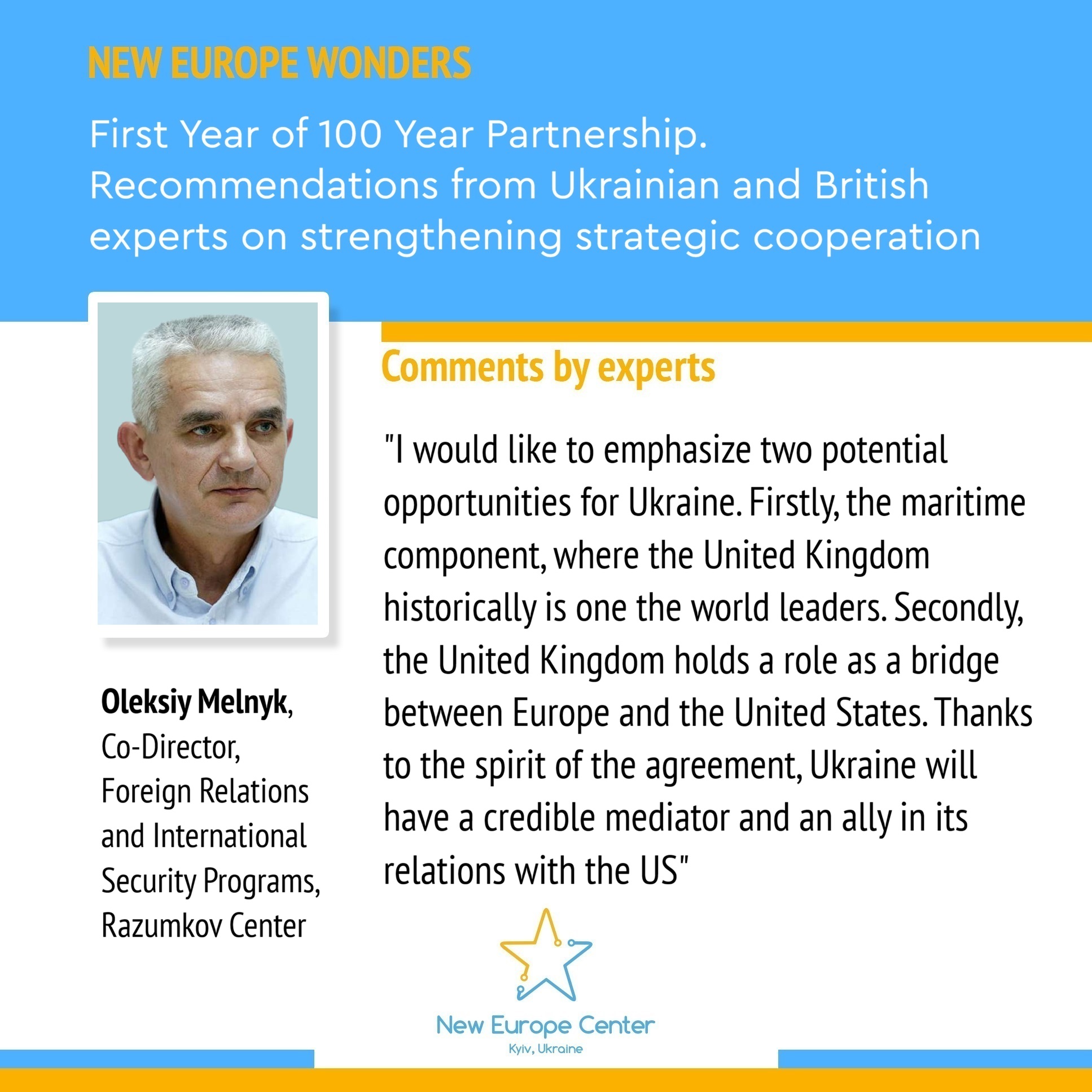
Oleksiy Melnyk, Co-Director, Foreign Relations and International Security Programs, Razumkov Center
The 100 Year Partnership Declaration is a politically binding international agreement and political manifest. Looking at the time of the agreement, meaning in the midst of full-scale Russia’s war, every feature has a unique value for Ukraine. The practical aspect, without a doubt, is easier for qualitative and quantitative assessment of mutually beneficial cooperation. At the same time, in the context of today’s historic moment, the symbolism of the United Kingdom’s faith and confidence in the long-term prospects not only of the Ukrainian state’s existence, but also of Ukraine as a reliable partner with similar interests and values, is no less important.
Talking about the possibilities for Ukraine, we should emphasize two key aspects. Firstly, the maritime component, where the United Kingdom historically is one the world leaders and despite losing its “global weight”, still holds not only scientific and technological expertise, but also maritime traditions. Secondly, the United Kingdom holds a role as a bridge between Europe and the United States. Thanks to the spirit of the agreement, Ukraine will have a credible mediator and an ally in its relations with the US. It is hard to say how long-term the changes in the US foreign policy will be after Donald Trump, but, in the long term, the relevance of the special partnership between the United Kingdom and the United States will clearly remain.
Filling the 100 Year Agreement with practical content, as always, depends on the mutual desire of the parties. Further political, executive and technical agreements or additions could probably be implemented within the existing regulatory framework, but references to the 100 Year Agreement will give them important symbolism in international politics.
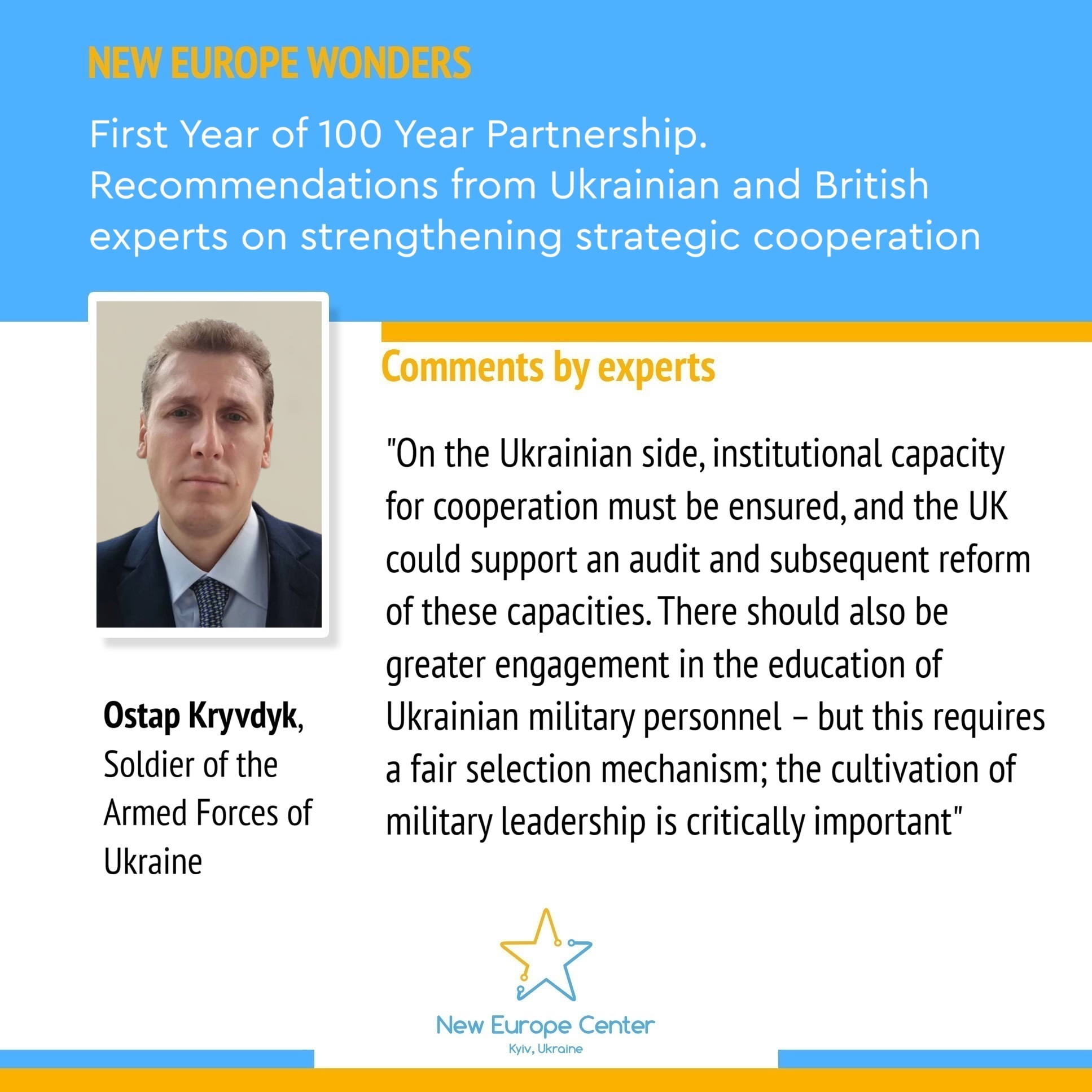
Ostap Kryvdyk, Soldier of the Armed Forces of Ukraine
Within the scope of my expertise, I see the need for several steps.
First, along the NATO track, the strategic dialogue at the level of the Ministries of Defence should be relaunched, with a clear and coherent explanation of the interdependence between policy changes and concrete assistance within NATO.
On the Ukrainian side, institutional capacity for cooperation must be ensured, and the UK could support an audit and subsequent reform of these capacities. There should also be greater engagement in the education of Ukrainian military personnel – but this requires a fair selection mechanism, rather than simply favoring those “closest to senior officials.” The cultivation of military leadership is critically important.
Within cooperation on military technologies, it is necessary to resolve the issue of protecting Ukrainian inventions and to balance conditions so that effective production takes place in Ukraine, rather than merely relocating inventions and manufacturing abroad. At the global level, it would also be pragmatic to consider the possibility of strengthening the UK’s defence through Ukrainian maritime defence capabilities and to ease visa requirements for Ukrainians.
This material was funded by the UK government as part of the “Mutual Transformative Power: changing Ukraine through cooperation with wider Europe” project, implemented by the New Europe Center. The views expressed in this material are those of the author(s) and may not coincide with the official position of the UK government.