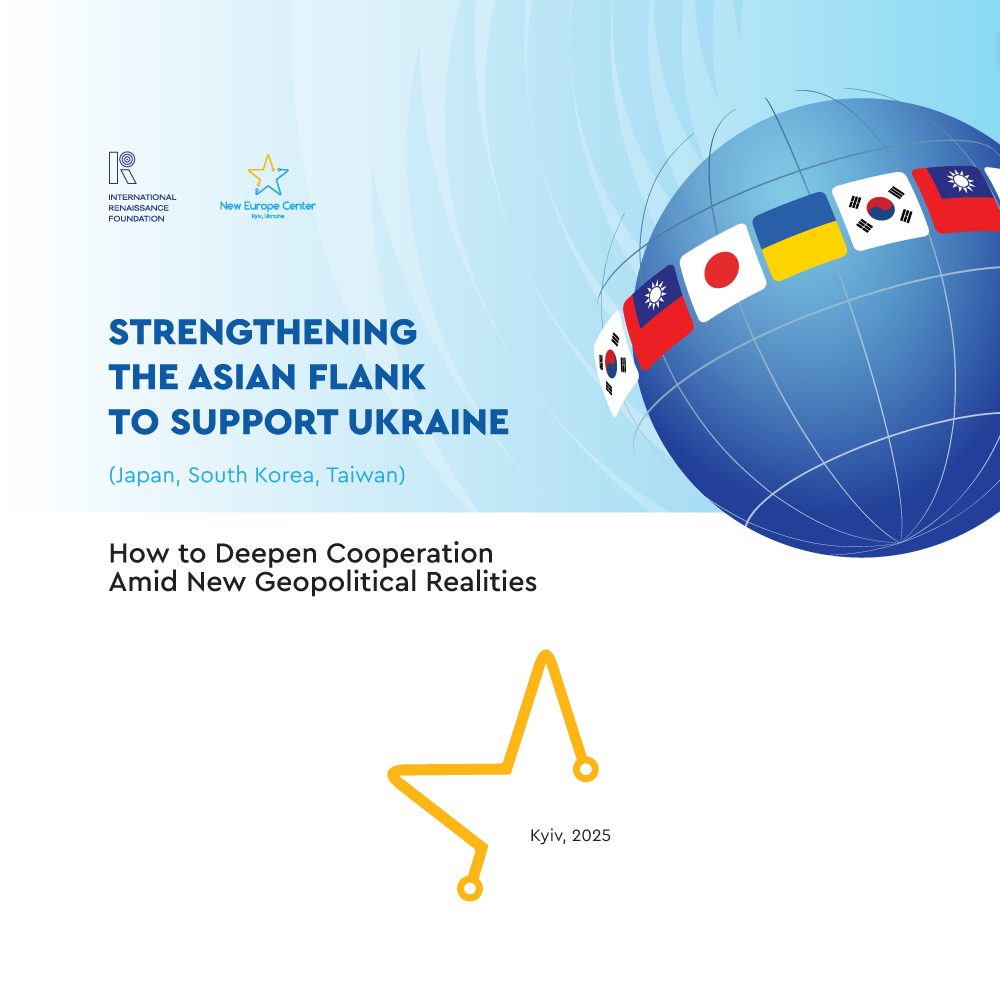
A brief version of analitycal paper prepared by Nataliya Butyrska, Associate Senior Fellow at New Europe Center
With Donald Trump’s return to the White House, U.S. policy toward Ukraine and the configuration of the Western support network for Kyiv – within which the United States has traditionally played a central role – have changed. Donald Trump seeks to achieve an end to the Russian-Ukrainian war, but instead of strengthening Ukraine in order to reach a just peace, he is exerting pressure on Kyiv so that Ukraine would give up part of its territories and accept terms that appear favorable to Russia; otherwise, the U.S. threatens to withdraw its support for Ukraine. Instead of strengthening a united front with Western allies and jointly pressuring the Russian Federation, Trump is splitting this front, ignoring the interests of partners and attempting to build his own separate relationship with Russia.
For East Asian countries, which through their aid to Ukraine have actively invested in strengthening support for European security – given its interconnectedness with the Indo-Pacific theater – Washington’s new approaches have raised concerns about the reliability of U.S. security guarantees. And although during his visits to Japan and South Korea in October 2025 Donald Trump reaffirmed his commitment to alliances with Asian partners, these countries realized the need to focus on strengthening their own defense capabilities and to move toward greater strategic autonomy and regional resilience.
Trump’s second term has demonstrated inconsistency in American policy and the transactional nature of relations with allies. Japan and South Korea agreed to invest 550 billion USD and 350 billion USD, respectively, in the United States in order to conclude a trade deal and reduce tariff rates from 25% to 15% that had been imposed on them by Donald Trump. This became a kind of fee for preserving the favor of the American president, but at the same time showed that U.S. security guarantees now depend on payment rather than on shared strategic interests.
Tokyo and Seoul’s focus on economic negotiations with the U.S. and on building relations with the Trump administration, reinforced by changes in political leadership in both countries, has limited their orientation toward more active engagement with European partners, particularly in the context of the Russian-Ukrainian war. A telling sign of this was the absence of the leaders of the Indo-Pacific Four (IP4), which includes Japan and South Korea, from the NATO summit in The Hague on June 24–25, 2025 – despite the fact that against the backdrop of Russian aggression against Ukraine in previous years, there had been significant interest from these countries’ leaders in developing NATO–IP4 partnership.
Japan and South Korea’s approach to supporting Ukraine and interacting with Western allies is largely determined by their own strategic priorities and the character of their relations with the United States. Since part of their efforts was a response to Washington’s requests, the change in Donald Trump’s policy has caused a noticeable shift in Tokyo and Seoul’s attention toward domestic and regional challenges, even though their fundamental interest in deterring aggressors and supporting the international order remains unchanged.
This is especially true for South Korea. The newly elected president, Lee Jae-myung, who assumed the presidency on June 4, 2025, after a prolonged political crisis in the country, favors a “pragmatic foreign policy” focused on national interests. Part of this is maintaining relations with China – the country’s leading trading partner – as well as improving relations with Russia and North Korea to reduce tensions on the Korean Peninsula. Lee Jae-myung criticized his predecessor for an unbalanced policy toward Russia and support for Ukraine, which, in his view, led to an escalation of the situation on the Korean Peninsula. Instead, he is ready to use the restoration of economic ties to improve relations with Russia in order to involve it in resolving the security problem of the Korean Peninsula.
Trump’s signals about the possibility of lifting sanctions on Moscow in exchange for ending the war have spurred South Korean companies to prepare to resume business in Russia, something that has been repeatedly mentioned in Russian and South Korean media. Russia is trying to exploit the shift in the South Korean government’s policy to its advantage, calling for the restoration of cooperation between the two countries, including the resumption of air travel, as well as for participation in Arctic projects that were halted after 2022. In this way, Moscow seeks to undermine the international coalition of Western states and weaken support for Ukraine. However, the South Korean president’s desire to reset relations with Russia runs up against the ongoing Russian-Ukrainian war and the need to comply with international sanctions; the drawn-out peace process initiated by Donald Trump, along with the deepening of Russian–North Korean military cooperation, which has a direct impact on the security of the Republic of Korea, also poses obstacles.
Against the backdrop of the new government’s coming to power, relations between Seoul and Kyiv are showing signs of political decline. The reason is that the issue of supporting Ukraine and the country’s policy regarding the Russian-Ukrainian war became central to the political struggle between two competing parties, and also a part of the 2022 presidential campaign between the two candidates – Yoon Suk Yeol and Moon Jae-in – and later an instrument for criticizing President Yoon’s policy by the opposition, led by the current president. Lee criticized the Yoon Suk Yeol administration for financial assistance to Ukraine and opposed supplying weapons. This has narrowed the possibilities for continuity in the bilateral relations developed with the previous government. And the accusations against the former First Lady of manipulating shares of Well Biotec and SAMBU Construction by allegedly exploiting the topic of Ukraine’s reconstruction to artificially inflate share prices and obtain illegal profits amounting to tens of billions of won to some extent cast a shadow over reconstruction projects that had been developed in the past.
In the six months of Lee Jae-myung’s presidency, the leaders of Ukraine and South Korea have not held a single phone call or bilateral meeting, even though the opportunity existed during the G7 summit in Canada and at the UN General Assembly. Such a dialogue would have helped to relaunch relations between the countries and to find a framework for interaction under the new South Korean government’s policy. During his presidential campaign, Lee Jae-myung had declared his intention to contribute to Ukraine’s reconstruction – this could become a basis for deepening pragmatic partnership between Seoul and Kyiv.
Unlike South Korea, Japan – despite two changes of prime minister within a year – demonstrates a consistent policy of supporting Ukraine. Immediately after her election, Sanae Takaichi took part in an online summit of the “coalition of the willing in support of Ukraine,” organized by the governments of the United Kingdom and France, and also held a phone call with Volodymyr Zelenskyy. She emphasized that the outcome of the Russian-Ukrainian war will have a significant impact not only on Europe, but on the entire international order, including East Asia, and she made three statements:
First, Russia’s invasion of Ukraine is an outrageous act that undermines the foundations of the international order, and Japan’s position of “standing on Ukraine’s side” remains consistent.
Second, Japan will continue to support Ukraine in cooperation with the international community, as well as maintain sanctions against Russia.
Third, Japan will assist Ukraine’s efforts to strengthen its social and economic resilience through public–private partnership in recovery and reconstruction.
Japan will continue close cooperation with other countries to achieve a just and lasting peace in Ukraine.
Thus, Sanae Takaichi’s position not only sent a positive signal regarding the sustainability of Japanese support but also outlined the potential for further expansion of bilateral interaction – from Japan’s participation in reconstruction to Tokyo’s more systematic involvement in shaping long-term security and economic frameworks for Ukraine.
Meanwhile, in Taiwan, with Donald Trump’s rise to power, fears have intensified regarding the future of American support for the island in light of the situation around Ukraine. After the start of the Russian-Ukrainian war, Ukraine’s determined resistance to Russian aggression and strong support from Western democracies, including the U.S. and Europe, resonated on the island, which faces a similar threat. This gave its citizens hope for resisting a possible military annexation by China, generating the popular slogan “Today Ukraine, tomorrow Taiwan,” as well as an opportunity to enhance Taiwan’s moral legitimacy at the international level by winning international sympathy and support.
Now, however, in light of changes in international politics, parallels with Ukraine are acquiring different meanings: there is growing concern on the island that the U.S. might sacrifice the island’s interests in order to conclude a major trade deal with China. Hopes for the “silicon shield,” which had been considered a “protective mountain” or “geostrategic shield,” also dissipated when, under pressure from Donald Trump, the company announced its intention to invest at least 100 billion USD in chip plants in the United States. This may reduce Taiwan’s strategic value to the U.S., which had previously been seen as the main reason it would be willing to defend the island.
Under these conditions, the narrative of interconnectedness with Ukraine, which had boosted the morale of Taiwanese society, is transforming into an awareness of a different reality that requires realistic and pragmatic assessments of the situation. And while the country’s leadership clearly understands the importance of a just peace for Ukraine – one in which Russian aggression is neither tolerated nor rewarded, so that it does not become a model for China – the newly elected Kuomintang leader, Zheng Liwen, is advancing a different line. In a recent interview with DW, she spoke of the need for normalization, reconciliation, and cooperation between both sides of the Taiwan Strait. She emphasized that the Kuomintang seeks a peaceful, prosperous, and secure future for Taiwan, not a path that could lead to its destruction through military conflict. Zheng Liwen directly invoked the example of Ukraine, stating that Taiwan can never become “another Ukraine,” whereas, in her opinion, the practices and rhetoric of Lai Ching-te and the Democratic Progressive Party could replicate the Ukrainian scenario. She also noted that it is important to take China’s reaction into account and not create precedents that would encourage Beijing to resort to aggression.
China is attempting to use the political factor to fragment Taiwanese society and promote the idea of unification with the island through pro-Chinese political forces. This is precisely why, for the Taiwanese government, supporting Ukraine remains an important factor in upholding the values of freedom, democracy, and human rights. And although official contacts between Ukraine and Taiwan are limited, there are prospects for strengthening ties through economic cooperation, cultural exchanges, and business, using the island’s powerful economic and technological potential for Ukraine’s post-war reconstruction.
The new geopolitical realities underscore the strategic role of the democratic countries of East Asia – Japan, South Korea, and Taiwan – in supporting Ukraine. They demonstrate different approaches: from Japan’s active financial, humanitarian, and technological engagement, to South Korea’s flexible diplomatic support, and Taiwan’s strategic participation through technological and humanitarian projects. This assistance not only strengthens Ukraine’s defense capabilities and reconstruction but also forms a new network of international solidarity, where Ukraine’s success is perceived as a key factor in global stability.
However, the experience of these countries shows that support will remain sustainable only if short-term solidarity is transformed into long-term strategic partnerships that take into account the political, economic, and security interests of both sides.
This raises the question of how Ukraine can ensure lasting international support in the conditions of a protracted war, particularly against the backdrop of political pressure from some international partners, such as Donald Trump, and Russia’s attempts to impose capitulation terms. To effectively strengthen its position, Ukraine needs not only short-term military assistance, but also systematic, long-term support that would encompass security aspects as well as economic, technological, and infrastructural cooperation on recovery.
To Maintain and Expand the Support of Japan, South Korea, and Taiwan, Ukraine Should Focus on the Following Steps
Maintaining International Pressure on Russia to Achieve a Just Peace in Ukraine
Ukraine should intensify bilateral and multilateral cooperation with the Republic of Korea, Japan, and Taiwan in order to increase international pressure on Russia. This includes regular information exchange on the observance of sanctions by international companies, coordination in introducing new restrictive measures, and support for initiatives aimed at preventing sanctions evasion.
In parallel, it is necessary to continue coordinating diplomatic steps to prevent Russia’s return to the G7 and other platforms until a just peace is achieved, as well as to develop economic and security mechanisms of support for Ukraine that would strengthen strategic relations with these countries and enhance the effectiveness of pressure on Russia.
Strengthening Political Dialogue
Ukraine should encourage Japan’s continued active stance on support at the international level by deepening cooperation with the new government.
Ukraine should establish contact with the new president and government of the Republic of Korea in order to give impetus to bilateral cooperation between the countries.
The Ukrainian government should consider the possibility of establishing a Taipei office and maintaining ties with Taiwan, relying on the policies and experience of European countries and the EU.
Promoting Interparliamentary and Interparty Dialogue with a Focus on Optimizing Foreign Policy Goals
It is advisable for Ukraine to strengthen interparliamentary and interparty dialogue with Asian partners, clearly orienting such contacts toward achieving practical foreign policy, technological, and investment results. Delegations should travel with a concrete list of goals and projects aimed at exchanging experience, accessing advanced technologies, developing security cooperation, and attracting financial resources for Ukraine’s recovery.
It is important to use parliamentary diplomacy to strengthen sustainable political support for Ukraine from various parties and committees, creating long-term thematic formats of interaction. The dialogue should be regular, institutionally anchored, and aligned with Ukraine’s overall strategy in Asia. Involving business, academia, and local authorities in the composition of delegations should ensure a transition from protocol visits to real cooperation projects. This approach will allow Ukraine to make maximum use of the potential of Asian partners for modernization and post-war development.
Strengthening Financial, Economic, and Humanitarian Support for Ukraine
In the context of weakened American assistance, it is critically important for Ukraine to ensure uninterrupted support from Japan, the Republic of Korea, and Taiwan for the stable functioning of Ukraine’s financial system, economy, and energy sector – in particular, to support energy resilience, critical infrastructure, and the provision of medical and logistical support for the civilian population.
Cooperation Through NATO and EU Formats
Further strengthening of interaction within NATO in regard to demining programs and the treatment and rehabilitation of Ukrainian soldiers. Expanding support programs for prosthetics and training Ukrainian specialists.
Work on involving Japan in the Prioritized Ukraine Requirements List (PURL) program.
Encouraging further cooperation in the areas of intelligence sharing and cybersecurity.
Given the Republic of Korea’s aspiration to continue exporting weapons to European countries, this factor should be used to replenish allies’ stockpiles and stimulate greater cooperation in the field of European security.
Adapting Ukrainian Diplomatic Efforts to the Strategy of Expanding K-Diplomacy to Find Ways of Interaction with the New Government of the Republic of Korea
Ukraine can become a natural partner for South Korea in implementing President Lee Jae-myung’s vision of “K-democracy” as a model that combines the protection of democracy, human rights, sustainable development, the development of advanced technologies, green transformation, and adaptation to new global challenges. Joint initiatives in the areas of digital security, sustainable recovery, industrial partnership, and countering authoritarian threats create a basis for practical and long-term cooperation between Kyiv and Seoul.
Participation in Ukraine’s Post-War Reconstruction
Japan, South Korea, and Taiwan are interested in and have the financial and technical capacity to participate in Ukraine’s post-war reconstruction. The Ukrainian government must demonstrate a comprehensive vision of Ukraine’s reconstruction, as well as develop mechanisms of transparency and trust for investors, which form the foundation for attracting these countries.
Engaging South Korea in Supporting the Creation of a Special Tribunal
Ukraine should use North Korea’s participation in Russia’s military support as an argument to mobilize South Korea’s political and diplomatic backing for the creation of a Special Tribunal for the crime of aggression. Cooperation should include coordination in submitting cases against Russian and North Korean officials, sharing legal expertise, and promoting the tribunal initiative at international platforms, thereby ensuring the mechanism’s legitimacy and effectiveness in bringing perpetrators to justice.
Strengthening Cultural and Humanitarian Cooperation
Ukraine should actively develop cultural, educational, and humanitarian programs with Japan, South Korea, and Taiwan, which will help shape a positive image of Ukraine, deepen mutual understanding, and engage the public in supporting Ukraine. This includes student and researcher exchanges, joint cultural events, festivals and exhibitions, and the development of humanitarian aid programs and psychological support for those affected by the war.
Special attention should be paid to cooperation with leading analytical centers and think tanks in these countries to conduct joint research, conferences, and publications. Such initiatives make it possible to pool expert potential, raise the level of awareness among governments and societies about Ukraine’s needs, and strengthen strategic partnerships over the long term.
This document was prepared with the support of the International Renaissance Foundation. The material reflects the position of the authors and does not necessarily coincide with the position of the International Renaissance Foundation.