During the third panel discussion, “Soft Power: What Has Changed Over the Past Four Years?” at VI Ukraine–Japan Forum, Ukrainian and Japanese experts examined the transformation of soft power, emphasizing its integration with information security, economic resilience, and hard power. Particular attention was given to Ukraine’s resilience, its technological and defense achievements, the role of Japanese assistance in community reconstruction, and the risks posed by the weaponization of soft power by Russia and China.
Below are the key messages from the Ukrainian and Japanese speakers:
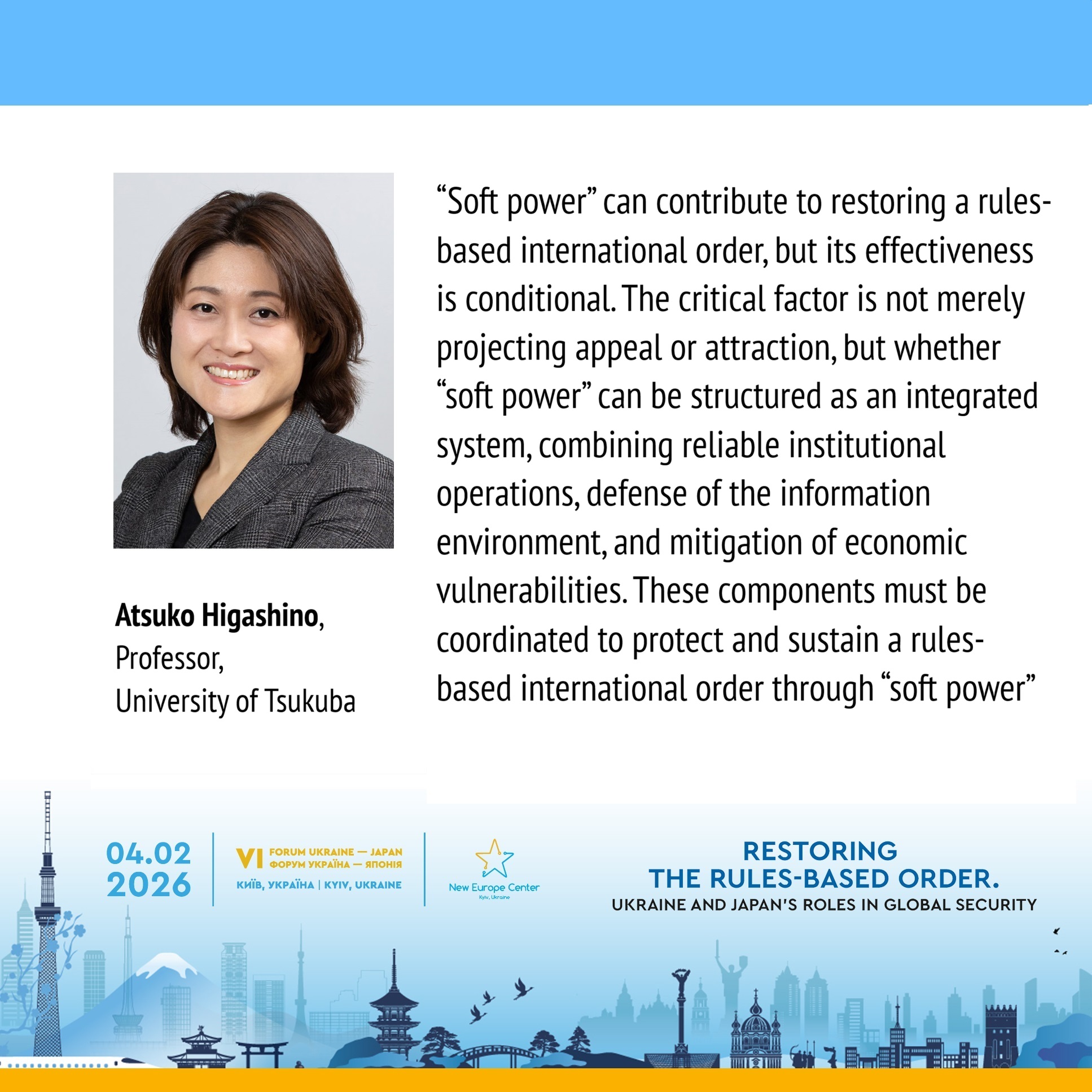
Atsuko Higashino, Professor, University of Tsukuba
The United States continues to consider “soft power” both valid and important, as reflected in the White House’s 2025 National Security Strategy.
“Soft power” can contribute to restoring a rules-based international order, but its effectiveness is conditional. The critical factor is not merely projecting appeal or attraction, but whether “soft power” can be structured as an integrated system, combining reliable institutional operations, defense of the information environment, and mitigation of economic vulnerabilities. These components must be coordinated to protect and sustain a rules-based international order through “soft power”.
“Soft power” is no longer exclusively based on attraction; it must be combined with credibility, informational accessibility, and control over information channels. The issue of “soft power” weaponization is significant. In Japan, the discussion often focuses on China in the context of “sharp power”. While the situation in Ukraine may differ, it is important to analyze and address the weaponization of “soft power”, as well as the “sharp power” strategies of Russia and China.
Ukraine does not need to increase its “soft power” in Japan, as the country’s resilience, resistance, integrity, and determination to resist Russia already constitute a substantial source of “soft power”. However, “soft power” today must be complemented and reinforced by other elements, including hard power. Ukrainian technological advances, new information, and developments in the defense industry represent promising sources of “soft power”. While defense issues are typically associated with “hard power”, Ukraine’s effective military resistance projects an image of “soft power”, portraying the country as a defender of democracy and resilience.
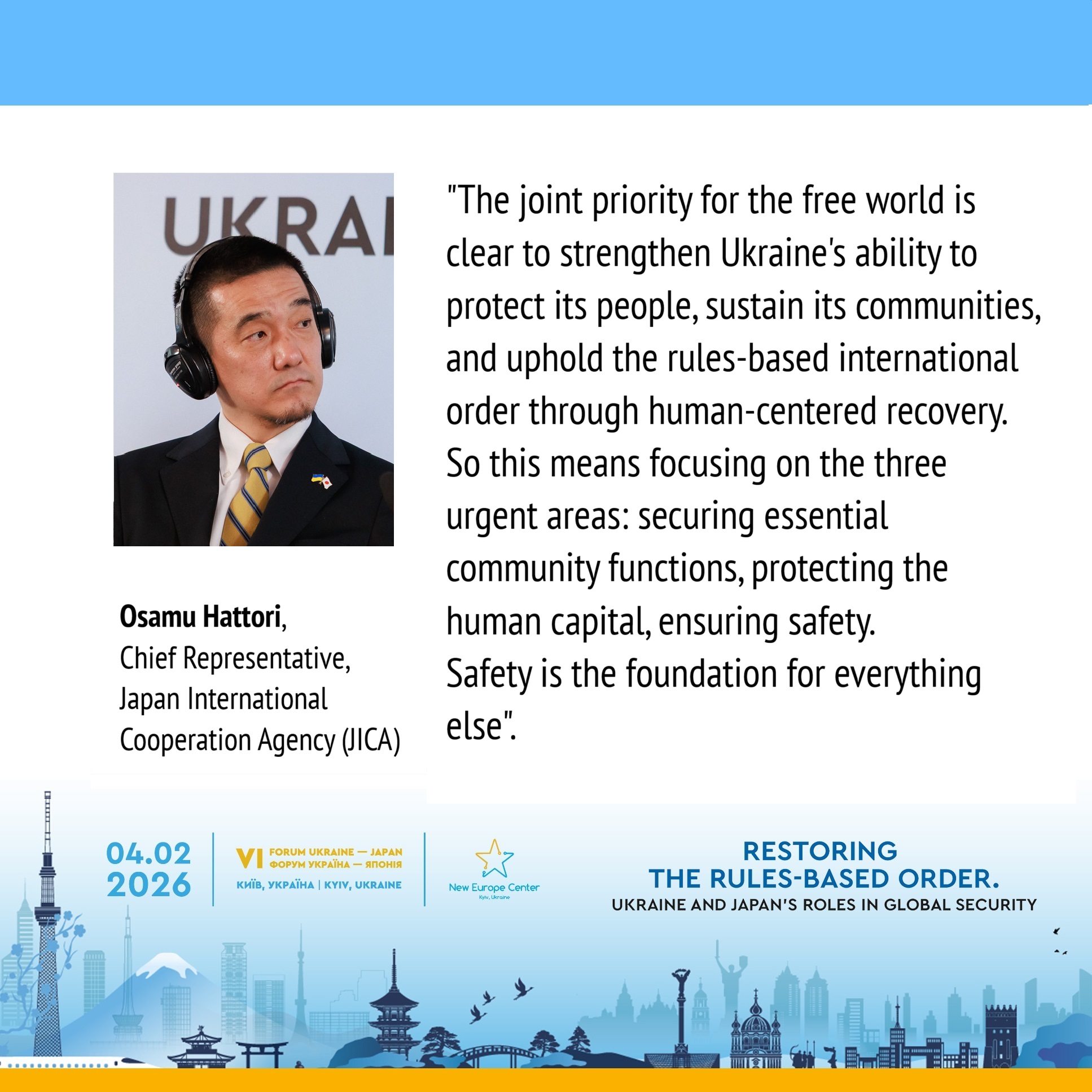
Osamu Hattori, Chief Representative, Japan International Cooperation Agency (JICA)
The joint priority for the free world is clear to strengthen Ukraine’s ability to protect its people, sustain its communities, and uphold the rules-based international order through human-centered recovery. So this means focusing on the three urgent areas.
The first, securing essential community functions: energy, water, transportation, education, etc. So these are not simply utilities. They are the backbone of civilian resilience, so we have supported decentralized power units for municipalities, schools and hospitals because resilience must be local and distributed.
The second is protecting the human capital. This is very important. Millions have been displaced, and thousands of schools have been damaged. So without people, without education, skills, and social cohesion, no reconstruction and recovery can succeed.
And the third point is ensuring safety. Over 30% of Ukraine’s territory is damaged by mines and UXOs. Without de-mining, agriculture cannot resume. People cannot return home. And investors cannot build. So JICA provides the mine removal machines, detection equipment, and training, capacity development for the assessor teams. So safety is the foundation for everything else.
The highest multipliers are the interventions that unlock the entire system of recovery, not just the sector at the time. So from this perspective, I’d like to have two integrated pathways. One pathway is mine action linked to agricultural recovery. So we would like to see not only the removal of the mine action, but also the future recovery of the economy. And the second point is the debris management linked to circular reconstruction. We have plenty of experience to recover from the devastating disaster in Japan, so we would like to apply this kind of experience to Ukraine. So this is the core of our assistance and cooperation with Ukraine.
In short, helping Ukraine means helping its people survive, learn, and rebuild today and tomorrow.
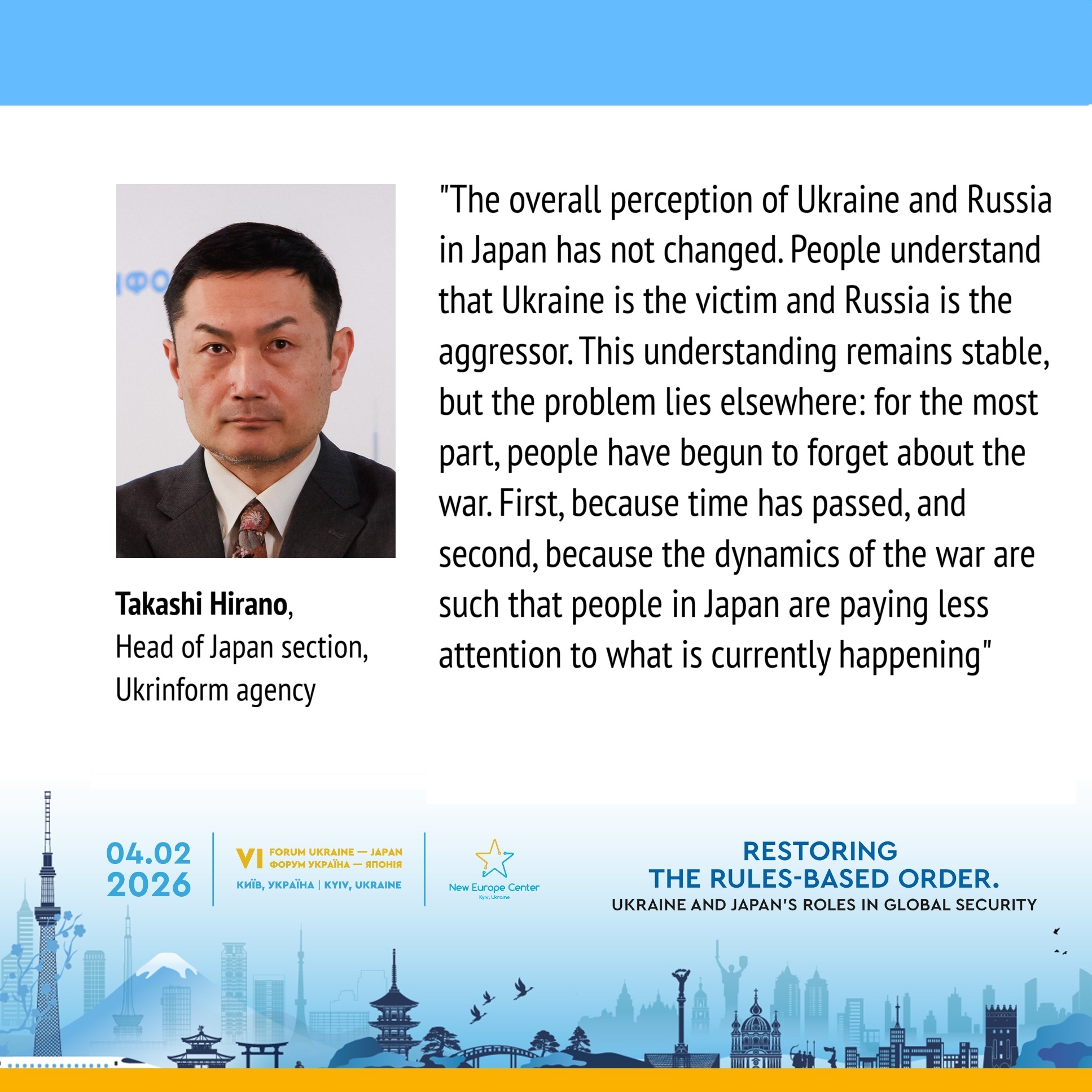
Takashi Hirano, Head of Japan section, Ukrinform agency
The overall perception of Ukraine and Russia in Japan has not changed. People understand that Ukraine is the victim and Russia is the aggressor. This understanding remains stable, but the problem lies elsewhere: for the most part, people have begun to forget about the war. First, because time has passed, and second, because the dynamics of the war are such that people in Japan are paying less attention to what is currently happening.
Since the beginning of Russia’s full-scale invasion of Ukraine, Russian information and narratives have not spread widely in Japan. Japanese society already has a deep understanding that Russia is a country built on lies. Since 2014, experts have analyzed how Russia has spread disinformation about this war, and this work has been effective enough for fact-checking mechanisms to take hold. Russians have attempted to spread disinformation about the war, but the Japanese public is now fairly well protected against these manipulations. Therefore, it can be said that in this respect, the situation in Japan remains favorable for Ukraine.
The risk for Ukraine is that there are people in Japan who want to restore ties with Russia. Even if only in a limited number of areas, they are trying to take advantage of the declining public attention to the war and are searching for narratives that would not provoke strong public criticism.
Have any systemic measures been taken in Japan to counter Russian influence? In fact, no. There are discussions at both the governmental and societal levels. The question of what should be done to protect society from Russian disinformation is being raised. However, so far there have been no concrete measures.
Negative attitudes toward Russia in Japanese society remain very strong. Around 90–95% of the population views Russia negatively. As a result, there is little space for Russians to promote pro-Russian narratives within Japanese society.
At the same time, I currently observe what I consider a concerning trend of pessimism in Japan regarding this war. A significant part of society believes that the war will end in a way that is unfavorable for Ukraine. Therefore, some argue that Japan should already start thinking about how to restore relations with Russia, including in the energy sector.
Japan continues to import gas from Russia, and the Sakhalin-2 project remains operational. This also affects Japan’s sanctions policy, as it has not imposed sanctions on major Russian energy companies. There is a view that if Japan joins this part of the sanctions regime targeting oil companies, Russia could retaliate by halting gas exports to Japan.
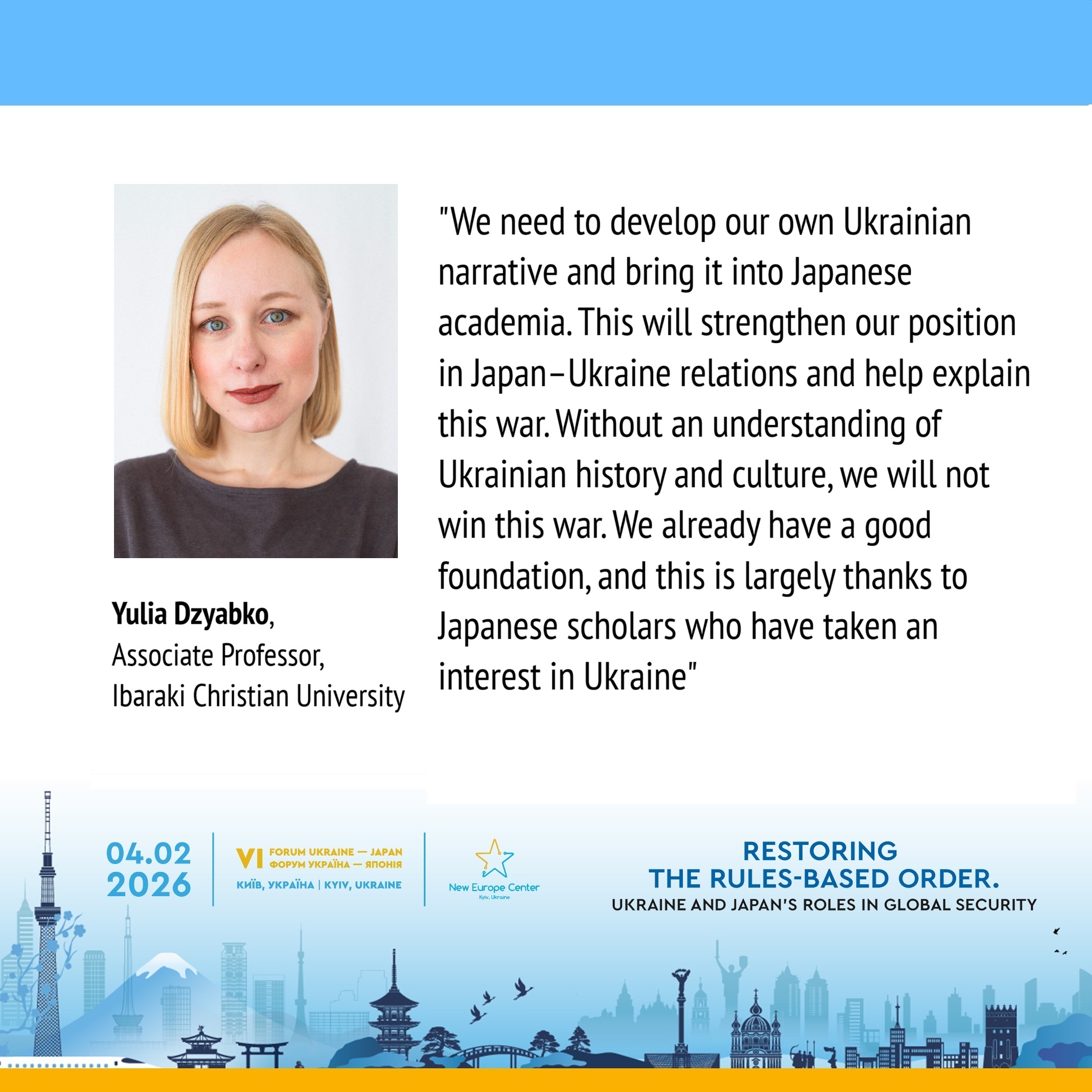
Yulia Dzyabko, Associate Professor, Ibaraki Christian University
Ukraine is no longer terra incognita for the Japanese. However, there are still no widely recognized personalities or artistic and cultural concepts that could serve as clear markers of Ukraine’s identity. These should be consistently present in the public space and help shape a long-term perception of Ukraine in Japan.
Over the past four years, through the efforts of journalists, scholars, active members of the Ukrainian community, and Japanese politicians, a significant body of Japanese-language content about Ukraine has been created. It ranges from simple explanatory materials about where Ukraine is and what Ukraine is, to complex cultural texts. However, issues related to Ukrainian history and culture as subjects of academic research — and the systematic study of Ukrainian culture as an academic field in Japanese higher education institutions — remain critically important.
No Ukrainian studies programs have been established to train specialists in Ukrainian history and culture. In Ukraine, there are more than twelve universities that offer Japanese language and culture either as a discipline or as a full specialization. It is precisely this systematic study of Japan that allows us to say that Ukraine likely understands Japan better than Japan understands Ukraine.
We need to develop our own Ukrainian narrative and bring it into Japanese academia. This will strengthen our position in Japan–Ukraine relations and help explain this war. Without an understanding of Ukrainian history and culture, we will not win this war. We already have a good foundation, and this is largely thanks to Japanese scholars who have taken an interest in Ukraine.
In Japan, there is a genuine demand for a deeper understanding of Ukraine, which means there is strong motivation within society to engage in literary and cultural festivals and to launch new initiatives — from celebrating traditional Ukrainian holidays such as Christmas or Ivana Kupala to inviting Ukrainian writers and organizing literary festivals that explore different aspects of Ukrainian culture.
Two dimensions — Ukrainian studies and the Ukrainian community — are precisely the areas that require further development and close cooperation.
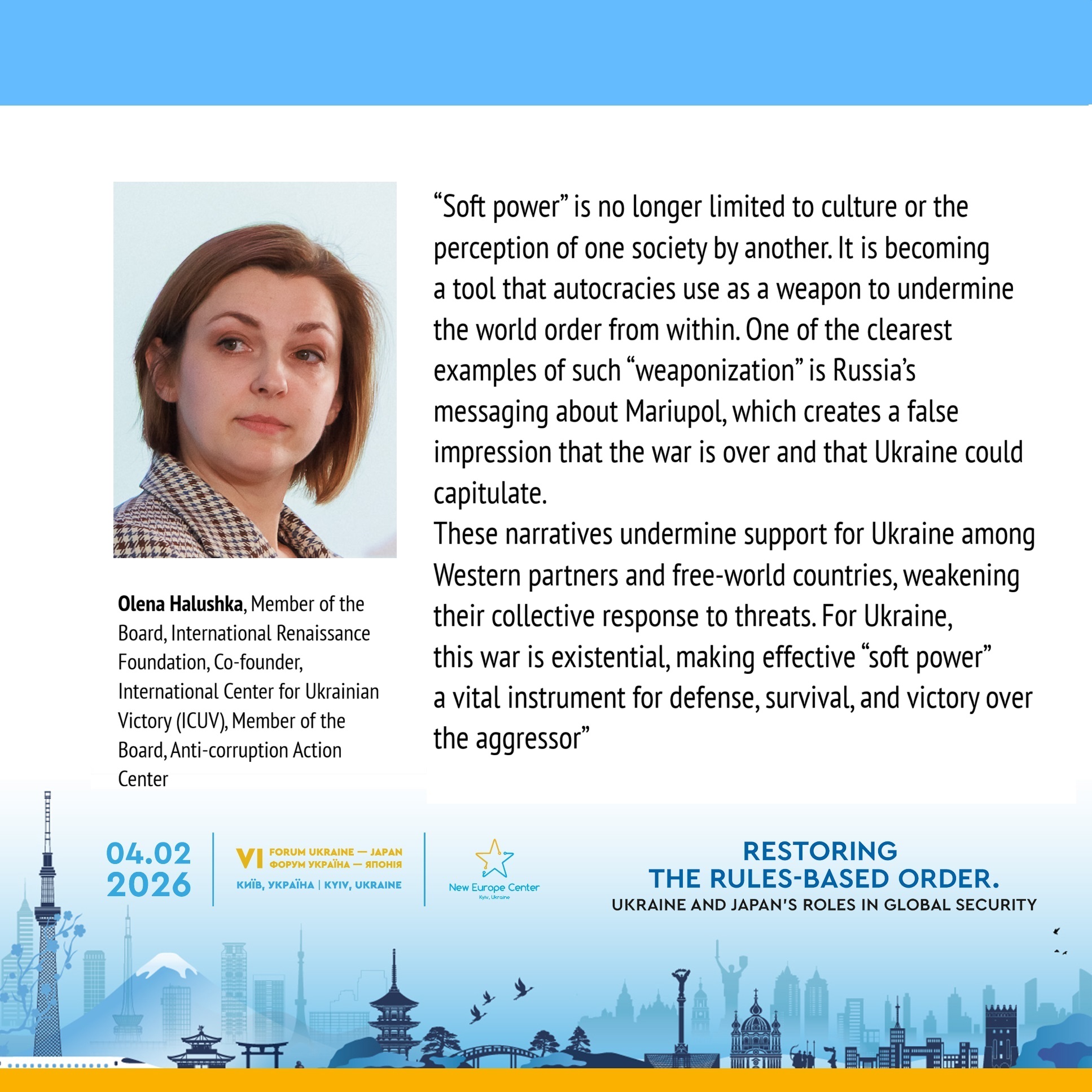
Moderator: Olena Halushka, Member of the Board, International Renaissance Foundation, Co-founder, International Center for Ukrainian Victory (ICUV), Member of the Board, Anti-corruption Action Center
“Soft power” is no longer limited to culture or the perception of one society by another, as it once was. It is transforming into a tool that autocracies use as a weapon to undermine the world order from within.
One of the most illustrative examples is Russia’s messaging regarding Mariupol. This is especially effective in Italy, where the reconstruction of the city and the “comfortable life” of Mariupol residents are showcased. Large-scale campaigns have been launched on TikTok, where influencers portray the city as “thriving.” As a result, public perception develops the idea that the war was brutal, but now the situation is supposedly improving.
Such narratives are dangerous for Ukraine because they undermine the support of our partners — not only Western democracies but free-world countries more broadly. This complicates coordinated efforts to counter the threats we face as a unified front. For Ukraine, this war is existential, and “soft power” is a key instrument for defense, survival, and victory over the aggressor.
Video recordings of the forum are available in Ukrainian and English.
Photo report is here.
Mediapartner: Ukrinform.