During the second panel discussion, “Ad hoc alliances, ambitious partnerships: how cooperation in Europe and Asia has changed since 2022”, Japanese and Ukrainian experts discussed the interconnection between Russia’s war against Ukraine and the risks in the Indo-Pacific region, the growing role of China and North Korea, and practical areas for defence cooperation between Ukraine, Japan, and European states.
Below are the key messages from the panelists of the VI Ukraine–Japan Forum:
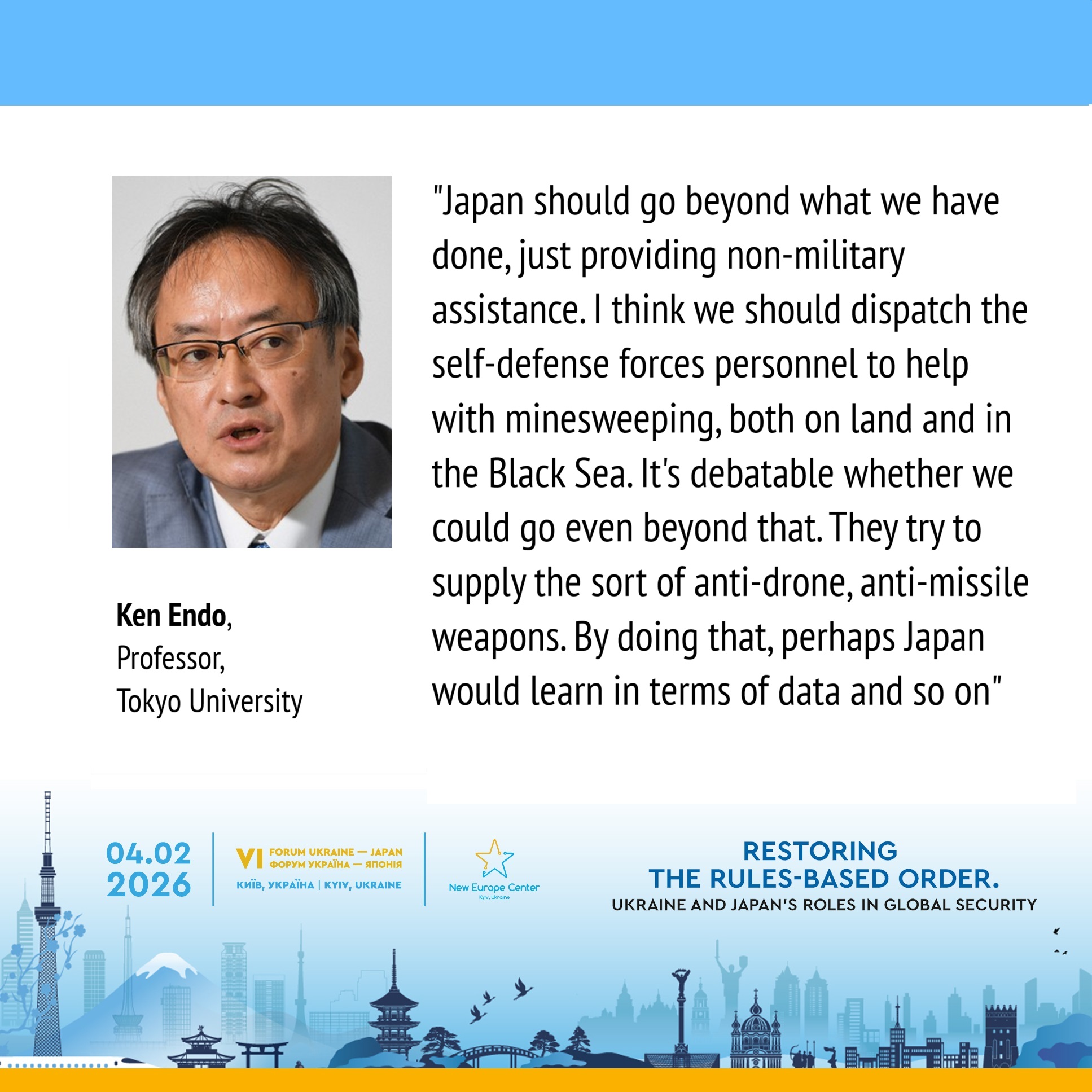
Ken Endo, Professor, Tokyo University
Ukraine could rely on Japan in the “Coalition of the Willing” based on the fact that we have already provided much support in financial terms. We are the fifth biggest contributor to Ukraine, and we are prepared to continue to do so. The present silence in help may have derived from the fact that we are busy dealing with a disruptive US government, which is the only ally for us, and also from the domestic internal turmoil leading up to the general elections, which is ongoing now.
Japan should go beyond what we have done, just providing non-military assistance. I think we should dispatch the self-defense forces personnel to help with minesweeping, both on land and in the Black Sea. It’s debatable whether we could go even beyond that. They try to supply the sort of anti-drone, anti-missile weapons. By doing that, perhaps Japan would learn in terms of data and so on.
Whatever the fetching exercise could be, the Article 5-like, NATO-like sort of security guarantees may well be short of guaranteeing the security in the post-war period. We are entering into perhaps the new era of, post-liberal international type of period. On one hand, there are some positive elements, but on the other hand, at least from a Japanese viewpoint, I feel the limit of the Coalition of the Willing.
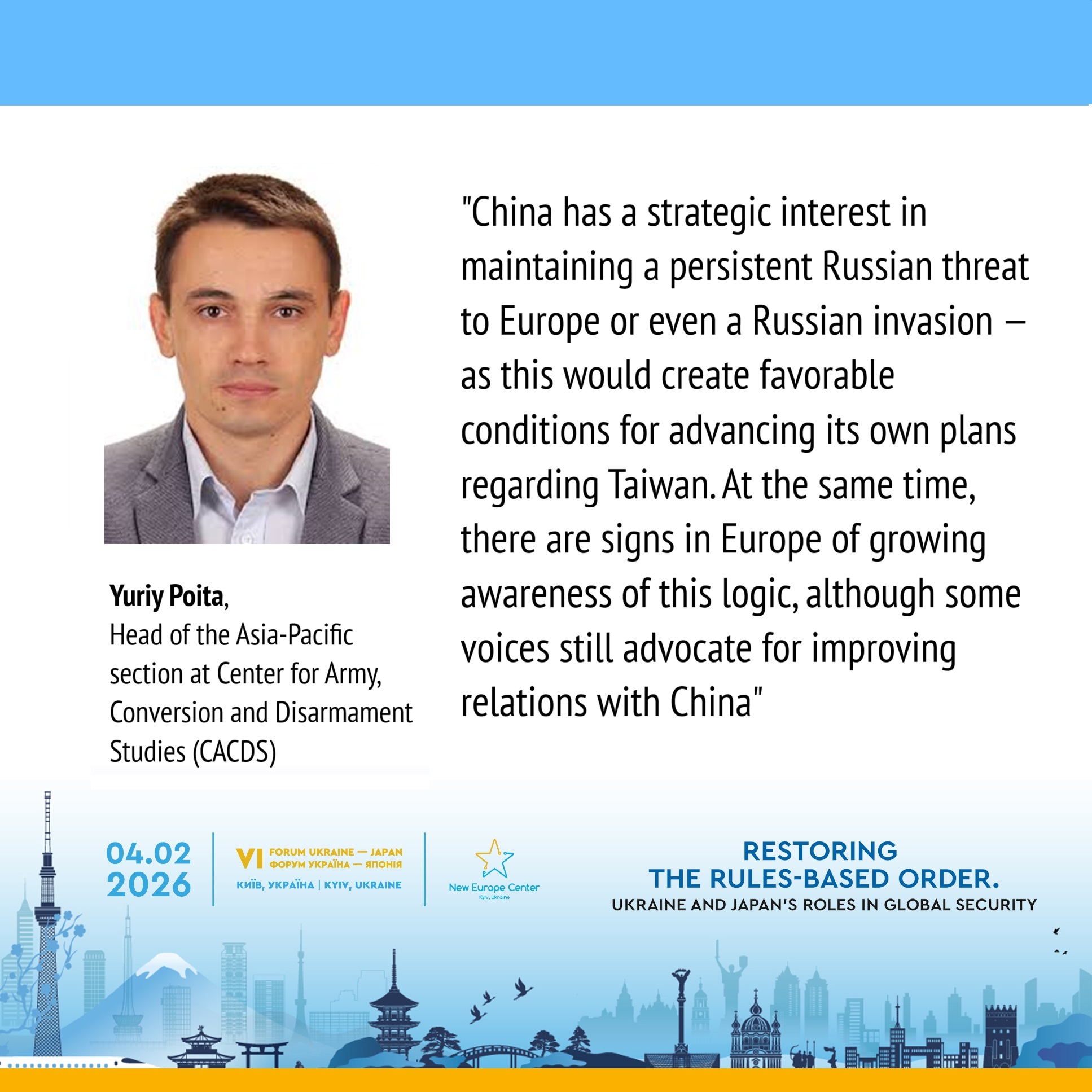
Yuriy Poita, Head of the Asia-Pacific section at Center for Army, Conversion and Disarmament Studies (CACDS)
Decision-making in China remains opaque, and the criteria for determining the likelihood of conflict are unknown; therefore, it is appropriate to apply the classical threat theory consisting of three elements: intentions, capabilities, and opportunity.
Intentions, which remain unchanged, constitute the first element of the threat. The second element is the availability of resources and capabilities to implement it, which China and North Korea are systematically building up. The third element is the presence of a favorable moment to act; the combination of strong intentions, growing capabilities, and an opportune moment significantly increases the probability of a global conflict.
The Chinese threat in the Indo-Pacific and European regions is interconnected, and assessing its actions is complicated by the existence of two theaters of operations and Europe’s ambiguous perception of China as a challenge, a threat, or a potential stabilizer for hedging risks.
The long-term military build-up and exercises of the People’s Liberation Army (PLA) are becoming more intensive and complex, making it difficult to determine whether they are preparations for combat operations or merely training.
“Grey zone” operations, involving the regular deployment of aircraft and ships into the airspace and coastal waters of neighboring countries — including Japan, Korea, the Philippines, and Taiwan — serve to test U.S. alliances with regional partners.
Civil–military fusion, in which the civilian sector is integrated into military tasks, increases operational complexity; an example is the use of thousands of fishing vessels coordinated with the navy and coast guard as elements of reconnaissance and deterrence against third-party intervention.
PLA preparations may be at a final stage for a potential invasion of Taiwan, although the timeline remains uncertain.
China’s intelligence capabilities have significantly expanded, contributing to regional destabilization; in the event of a conflict around Taiwan, China would strike U.S., Korean, and Japanese assets to prevent their involvement.
China is coordinating efforts aimed at dividing Europe and weakening transatlantic ties, thereby creating conditions for an increased Russian threat on the continent. For example, China’s monopoly over the extraction and processing of rare earth materials is accompanied by export controls, the use of which could undermine the defense industrial capacity of European and Asian countries; estimates suggest that if supplies were halted, Europe’s industry could stop within a month.
China has a strategic interest in maintaining a persistent Russian threat to Europe or even a Russian invasion — as this would create favorable conditions for advancing its own plans regarding Taiwan. At the same time, there are signs in Europe of growing awareness of this logic, although some voices still advocate for improving relations with China.
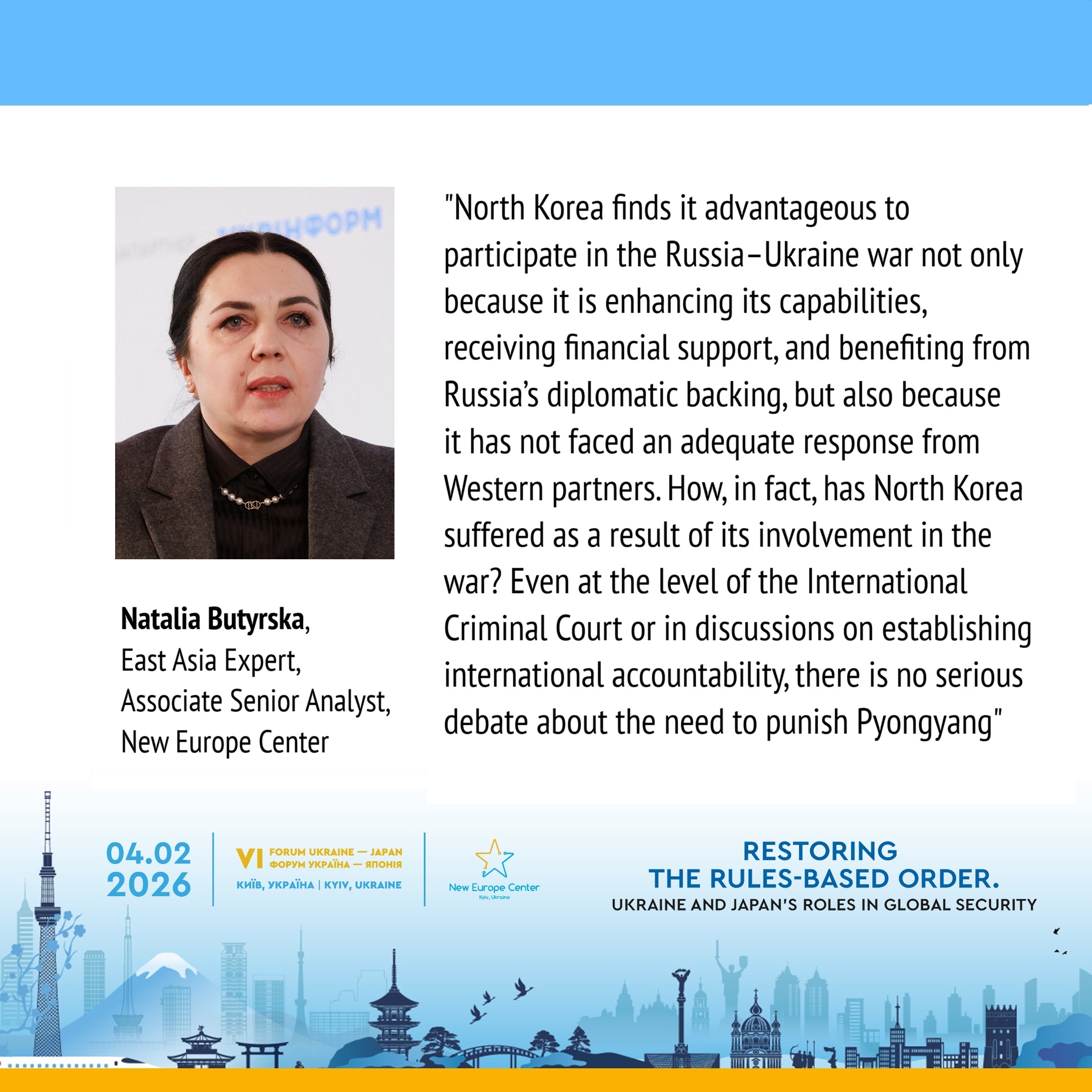
Natalia Butyrska, East Asia Expert, Associate Senior Analyst, New Europe Center
In 2022, then Prime Minister of Japan Fumio Kishida stated: “Ukraine today may be East Asia tomorrow.” This remark helped mobilize support from Japan and South Korea for Ukraine, reflecting not a declarative position but a strategic calculation aimed at strengthening regional security and deepening ties with Europe. Threats in the Indo-Pacific and in Europe are interconnected and cannot be considered separately.
Representatives of East Asia are directly involved in Russia’s war against Ukraine. North Korea and China act as direct and indirect supporters of Russia’s aggression, while Japan and South Korea are among the states supporting Ukraine. The dynamics of the war in Europe have a direct impact on the security situation in the Indo-Pacific region.
North Korea has significantly increased its support for Russia. According to various estimates, around 40% of the ammunition used by Russia has come from North Korea. North Korean units involved in supporting military production and field operations demonstrate a high level of discipline and professionalism, indicating that they have been underestimated both in Europe and globally.
The integration of the Russian and North Korean military-industrial complexes poses a direct threat to Europe. North Korea’s technological capabilities are continuously improving on the battlefield and through cooperation with Russia. Russia is transferring technologies to North Korea, including those related to small nuclear reactors for submarines. Weapons that were previously considered inaccurate are now showing high effectiveness, enhancing North Korea’s global standing.
The lack of effective coordination among international partners, including Western states and international institutions, enables North Korea to expand its military and diplomatic potential. The United States’ refusal to recognize North Korea’s nuclear status has pushed Kim Jong Un to pursue a foreign policy focused on maximizing autonomy and global influence.
The current situation indicates that the threat from North Korea is growing. Without coordinated international deterrence measures, this threat will continue to increase.
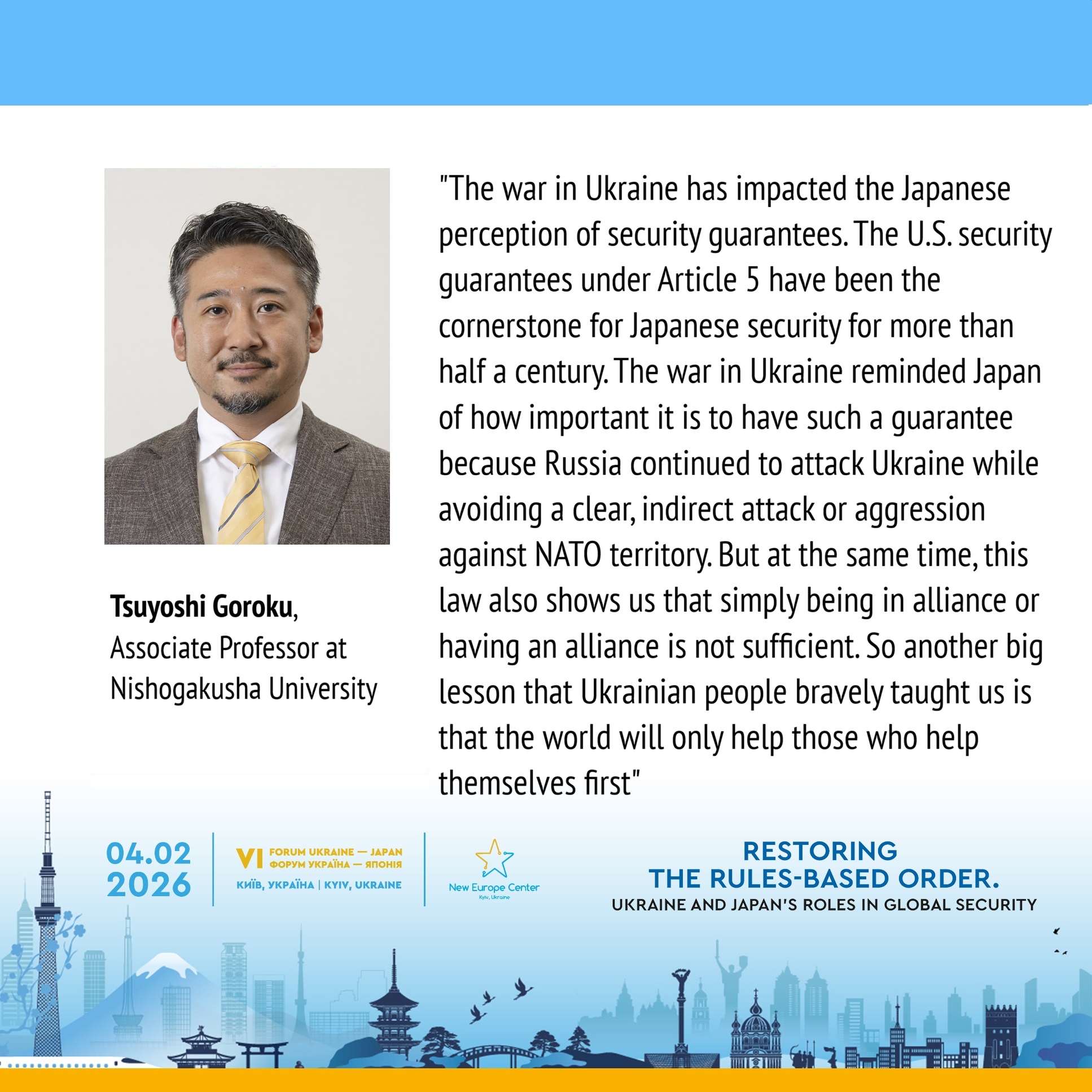
Tsuyoshi Goroku, Associate Professor at Nishogakusha University
The war in Ukraine has impacted the Japanese perception of security guarantees. The U.S. security guarantees under Article 5 have been the cornerstone for Japanese security for more than half a century. The war in Ukraine reminded Japan of how important it is to have such a guarantee because Russia continued to attack Ukraine while avoiding a clear, indirect attack or aggression against NATO territory. But at the same time, this law also shows us that simply being in alliance or having an alliance is not sufficient. So another big lesson that Ukrainian people bravely taught us is that the world will only help those who help themselves first.
Based on the current security strategy document (adopted in 2022), Japan is implementing three types of lines of effort.
The first is granting its own defense capability at an unprecedented level, increasing the defense budget, and historically controversially acquiring counter-strike capability. However, this shift in security policy should not be understood as Japan distancing itself from the United States and going its own way.
Another importance of the alliance is growing, not in terms of Japan’s security but also in maintaining the status quo in the region. So as a second line of effort, Japan is now trying to strengthen the alliance mechanism and transform the alliance in a more integrated way.
Japan has expanded bilateral security and defense cooperation with like-minded countries such as Australia, South Korea, the Philippines, European countries, including Ukraine. These frameworks are not a formal alliance, so they do not constitute security guarantees but they are widely recognized as a deterrent.
So, these three complementary efforts are a very logical response by Japan to the deteriorating security environment now, regarding the question of U.S. security guarantee under the Trump administration.
In this growing doubt about the security guarantee, theoretically, someone calling for pursuing its own indigenous nuclear weapon or seeking other allies as a plan B, but neither is a realistic option for Japan right now. The United States has a crucial role to play, but it cannot be replaced by a formal alliance with the United States. So there is no alternative but to pursue and strengthen the current line of.
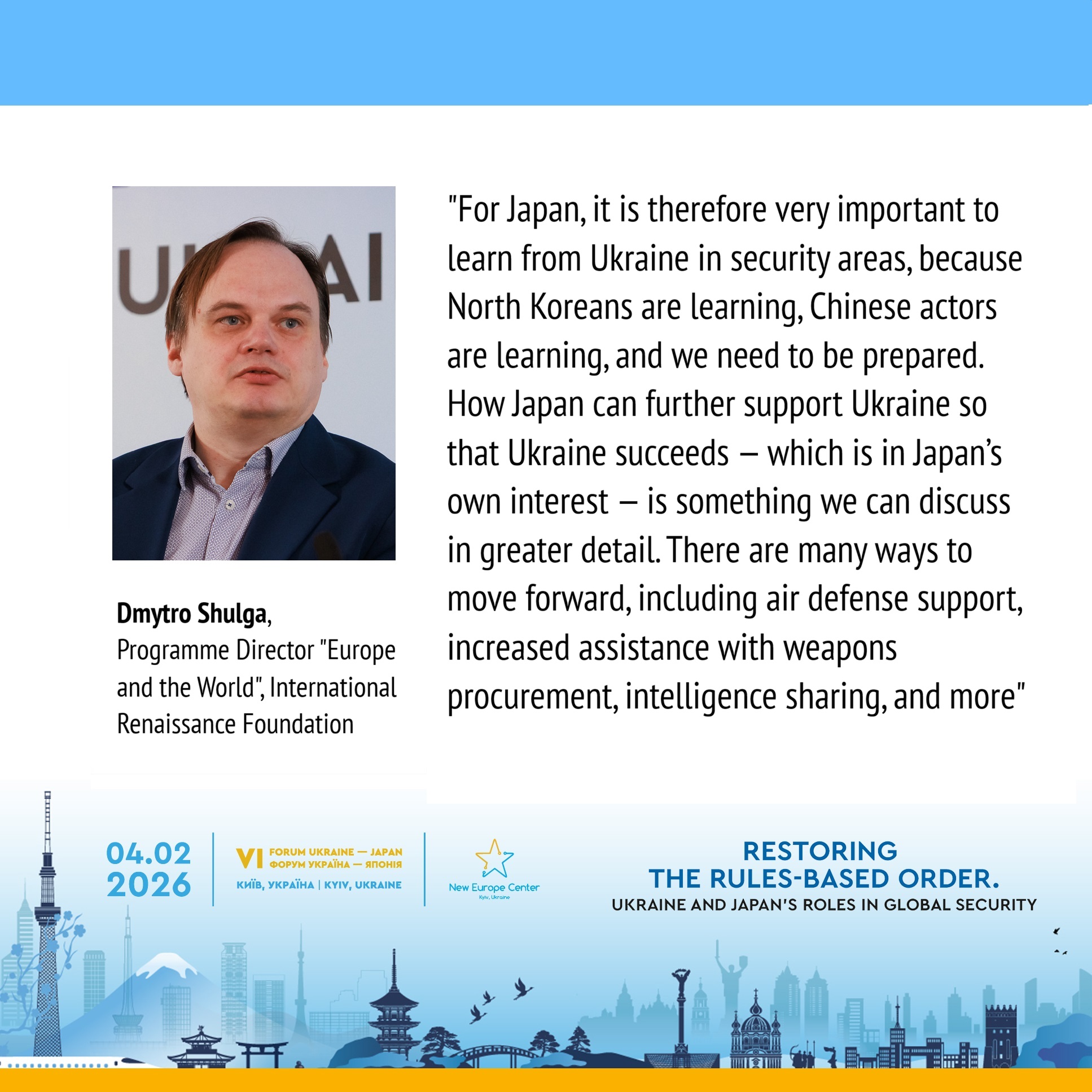
Dmytro Shulga, Programme Director “Europe and the World”, International Renaissance Foundation
Discussion of the United States dominates the Ukraine-Japan Forum because U.S. security guarantees remain the main factor sustaining the international order and global security. The United States possesses unmatched capabilities to project power in any region of the world, making it a key actor for both Europe and Asia. No other state can provide a comparable level of deterrence or security guarantees.
Europe and East Asia can benefit from mutual learning by analyzing the experiences of Ukraine, Russia, Europe, and the United States. Discussions include not only the credibility of existing guarantees but also their long-term effectiveness, which is critical for strategic planning. Japan’s support for Ukraine is not merely ideological; it is a pragmatic calculation based on the understanding that international politics and security are defined by precedents and tangible outcomes rather than declarations.
Future coalition-building and partnership development should be grounded in both realism and ambition. The United States remains an indispensable ally for Japan due to its ability to project power.
European countries and Ukraine can contribute by strengthening mutual capabilities, including knowledge exchange, training, air defense support, weapons procurement, and intelligence sharing. Ukraine’s experience in countering Russia and North Korea provides valuable lessons for Japan, as potential adversaries are also learning from these developments.
Therefore, Ukraine’s success aligns with Japan’s strategic interests, and supporting its defense capabilities must remain a priority, even when U.S. security guarantees cannot be fully substituted at present.
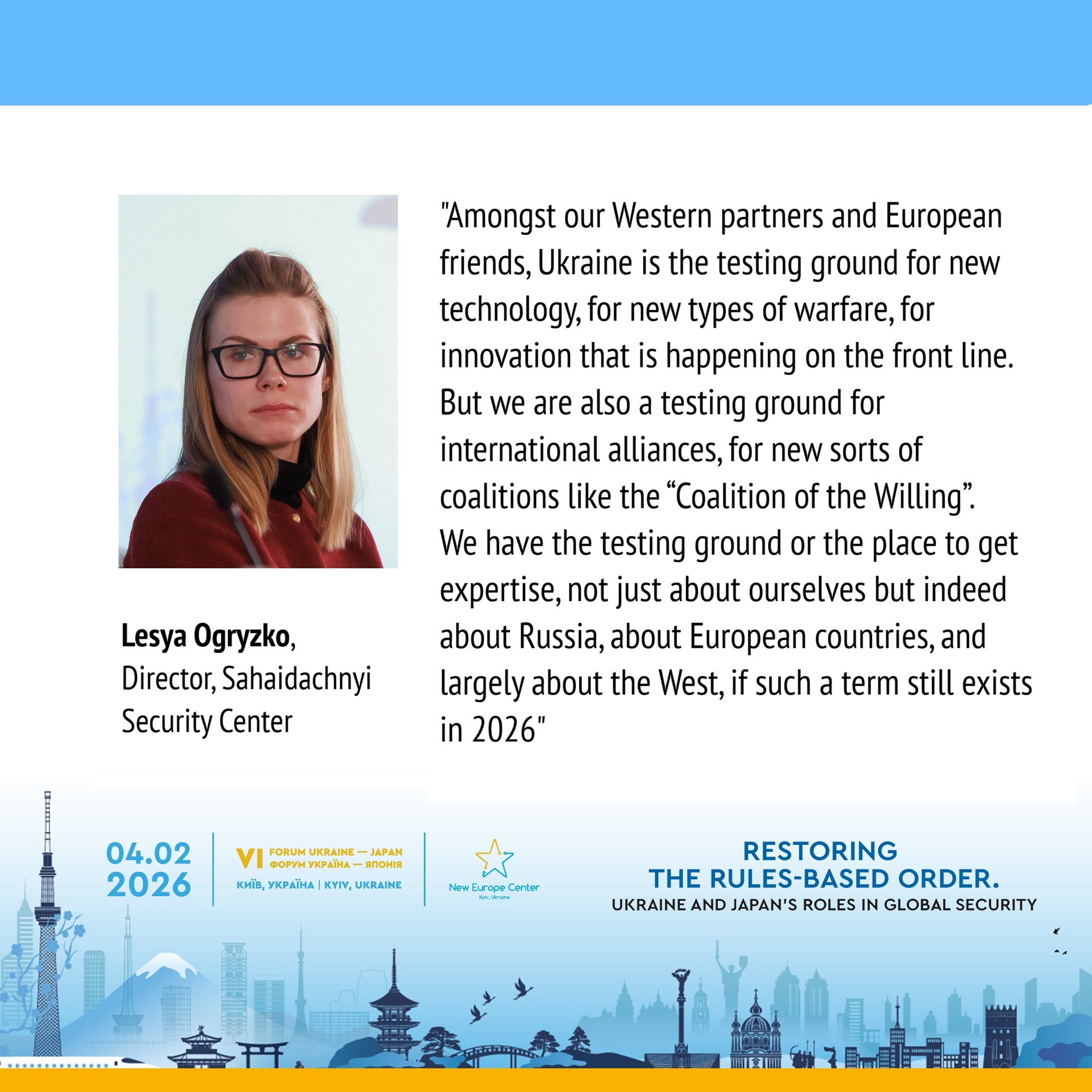
Moderator: Lesya Ogryzko, Director, Sahaidachnyi Security Center
Amongst our Western partners and European friends, Ukraine is the testing ground for new technology, for new types of warfare, for innovation that is happening on the front line. But we are also a testing ground for international alliances, for new sorts of coalitions like the “Coalition of the Willing”. We have the testing ground or the place to get expertise, not just about ourselves but indeed about Russia, about European countries, and largely about the West, if such a term still exists in 2026.
When here in Ukraine we are speculating about 2026, 2027 or some other time in the future, we understand that if something were to happen in Taiwan, it would have a huge impact on us, on our world and on the global stage. And the same goes for our Japanese partners who understand that everything that happens on our frontline is having a direct impact on the security of East Asia, of the Indo-Pacific, and actually all other regions.
Interconnectedness was the red line of our discussion. We’ve been discussing pretty much all global parts of the world, every region. And I think when we’re talking about the interconnectedness between European and Asian countries, I think everybody understands that there is no such thing as “their war”.
Video recordings of the forum are available in Ukrainian and English.
Photo report is here.
Mediapartner: Ukrinform.