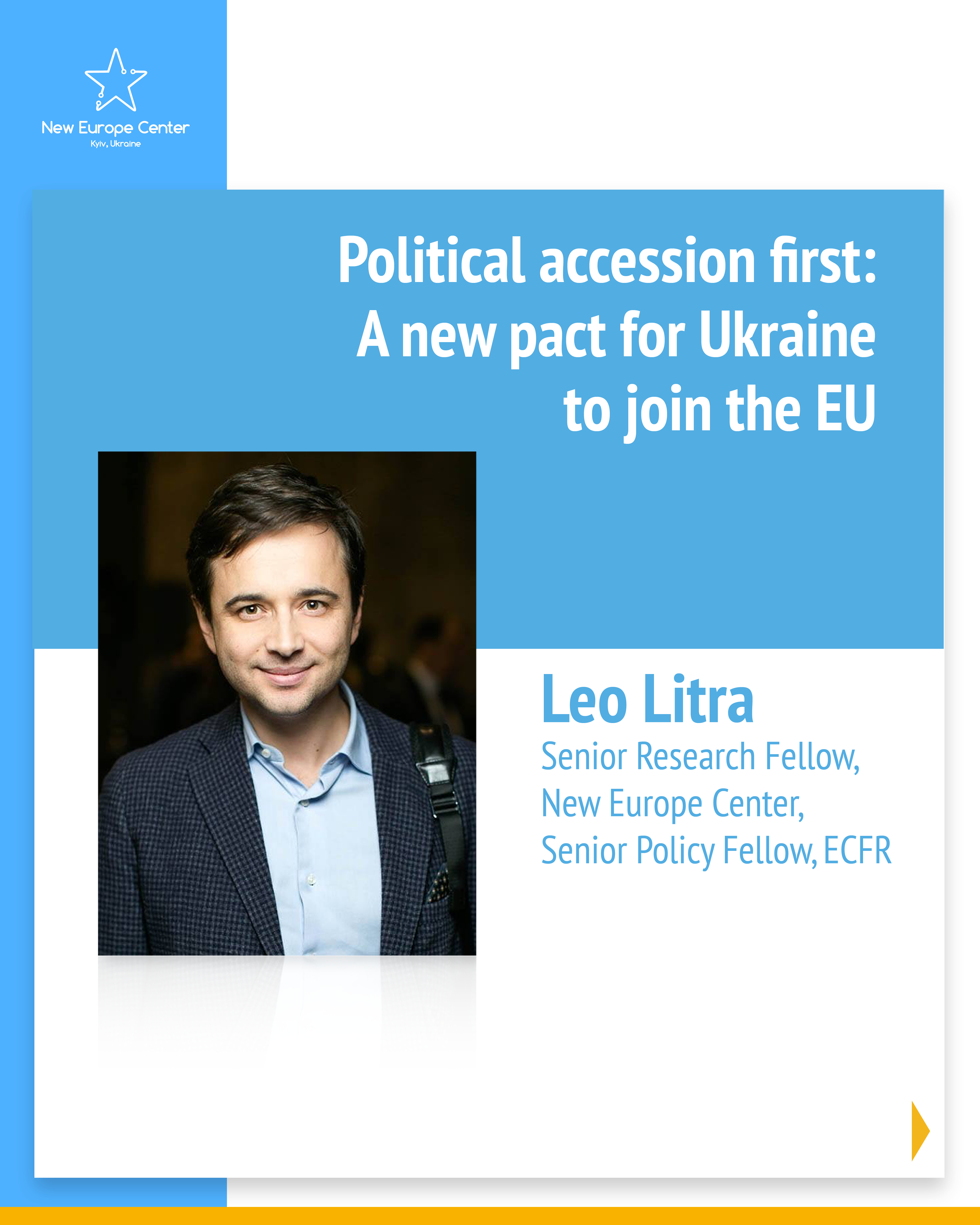
Leo Litra, Senior Research Fellow, New Europe Center, Senior Policy Fellow, ECFR
European leaders should adopt a new approach—the PACT model—for Ukraine’s future accession to the EU. This model will help them facilitate the peace process while also giving confidence to their electorates
Ukraine’s accession to the EU is a central component of negotiations that are—fitfully—under way to bring Russia’s war on the country to an end.
The mutual interdependence between Ukraine and the EU explains the importance of accession to achieving peace. Kyiv seeks membership to increase its security and facilitate post-war reconstruction; the EU needs Ukraine’s military capabilities to secure its eastern flank, deter attacks on EU countries and boost its economic security.
However, ECFR interviews undertaken this March with EU officials and member state diplomats reveal that many member states are still clinging to a “merit-based” approach as the only viable way forward. This would see Ukraine plod along the membership path that was laid out when times were very different. Member states are stuck in this view largely because they believe any newly devised accession models (or, to use the term that has gained currency, “creative” models) ought also to be available to other applicant states.
Debates are intensively taking place within the EU about what to do. Officials have been examining numerous alternative models. In early March, options dubbed the “fast-track” model (like the current process, but speeded up) and the “reverse accession” model were debated in informal discussions in Brussels among member states and EU officials. (Please see the table below to compare and contrast the features of the various models, including the one proposed in this article.)
These were rejected by member state ambassadors. However, as one EU official put it, “this was not a rejection of creative models per se, but rather a reaction to being kept in the dark by EU institutions”.[1] Media leaks portraying new formats as “shortcuts” damaged the credibility of the models discussed.
In fact, despite their outward adherence to the merit-based approach, member state representatives acknowledge the current methodology is obsolete. Indeed, several member state officials caution that “the cost of non-enlargement could be higher than the cost of enlargement”. [2] They want Ukraine to join.
And so, despite the impasse, the prospect of peace means member states are likely to have to make a decision this year on a new model. (Indeed, Viktor Orban’s exit from the European Council now means Hungary’s blocking of Ukraine is no longer the only obstacle to confront.)
Dilemmas on the horizon
Diplomats in several member states foresee (correctly) that EU capitals will find it difficult to reject a peace plan where EU membership serves as the primary stabiliser.[3] For member states, being seen to ease the path to peace is ultimately more important than dry debates about Ukraine’s full adoption of the acquis communautaire.
But political leaders across the EU nevertheless face dilemmas around how to present Ukrainian membership to their voters. These include constituencies like farming sectors, whose members worry about the impact of Ukrainian agricultural goods in the single market, or sections of the electorate concerned at the prospect of increased immigration.
EU leaders need something they can make a strong case for domestically. They want, and need, Ukraine to join the EU; but they need to make sure the country implements rigorous reforms. Member states and voters will want to feel confident they are granting membership to a country that measures up in important areas, from the “fundamentals” cluster (the rule of law, judiciary and the fight against corruption) to political integration (representation in political and executive bodies of the EU, including the European Parliament and European Commission). At the same time, the chosen route to membership must be credible to parties to any eventual negotiated peace, above all to Ukraine and Ukrainian citizens.
The PACT model
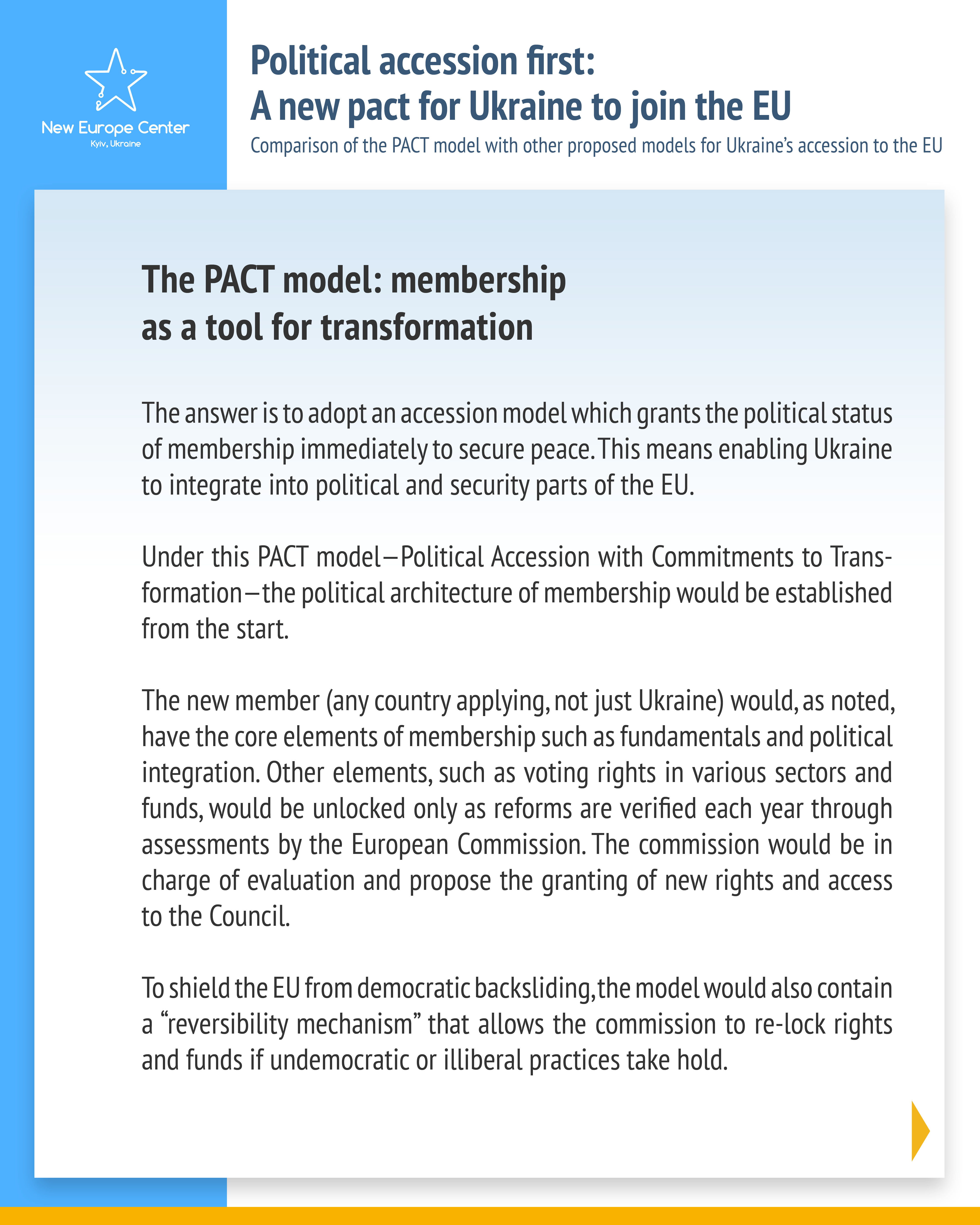
The answer is to adopt an accession model which grants the political status of membership immediately to secure peace. This means enabling Ukraine to integrate into political and security parts of the EU, including immediately applying Article 42(7)—the EU’s mutual defence clause. The model would entail giving Ukraine voting rights in the council when it comes to areas covered by the fundamentals. (This would build on the reverse membership approach, but with significant changes.) Such a prospect would prove highly motivating to Ukraine’s political leaders to conclude a peace deal.
Under this PACT model—Political Accession with Commitments to Transformation—the political architecture of membership would be established from the start. The new member (any country applying, not just Ukraine) would, as noted, have the core elements of membership such as fundamentals and political integration. Other elements, such as voting rights in various sectors and funds, would be unlocked only as reforms are verified each year through assessments by the European Commission. The commission would be in charge of evaluation and propose the granting of new rights and access to the Council. To shield the EU from democratic backsliding, the model would also contain a “reversibility mechanism” that allows the commission to re-lock rights and funds if undemocratic or illiberal practices take hold.
> Compared to the fast-track model, which actually delays entry until all reforms are completed, PACT grants immediate political membership.1
> Compared to the reverse accession model, PACT is exclusively concerned with fundamentals, safeguards and transition periods for funding. It is better tailored to address worries in member states, such as whether Ukraine would gain access to a large part of the common agricultural policy budget.
> Compared to the gradual accession model, Ukraine’s membership would be guaranteed; the question would be only how quickly the country can move through the reform process to acquire rights and powers.
How to conclude PACT
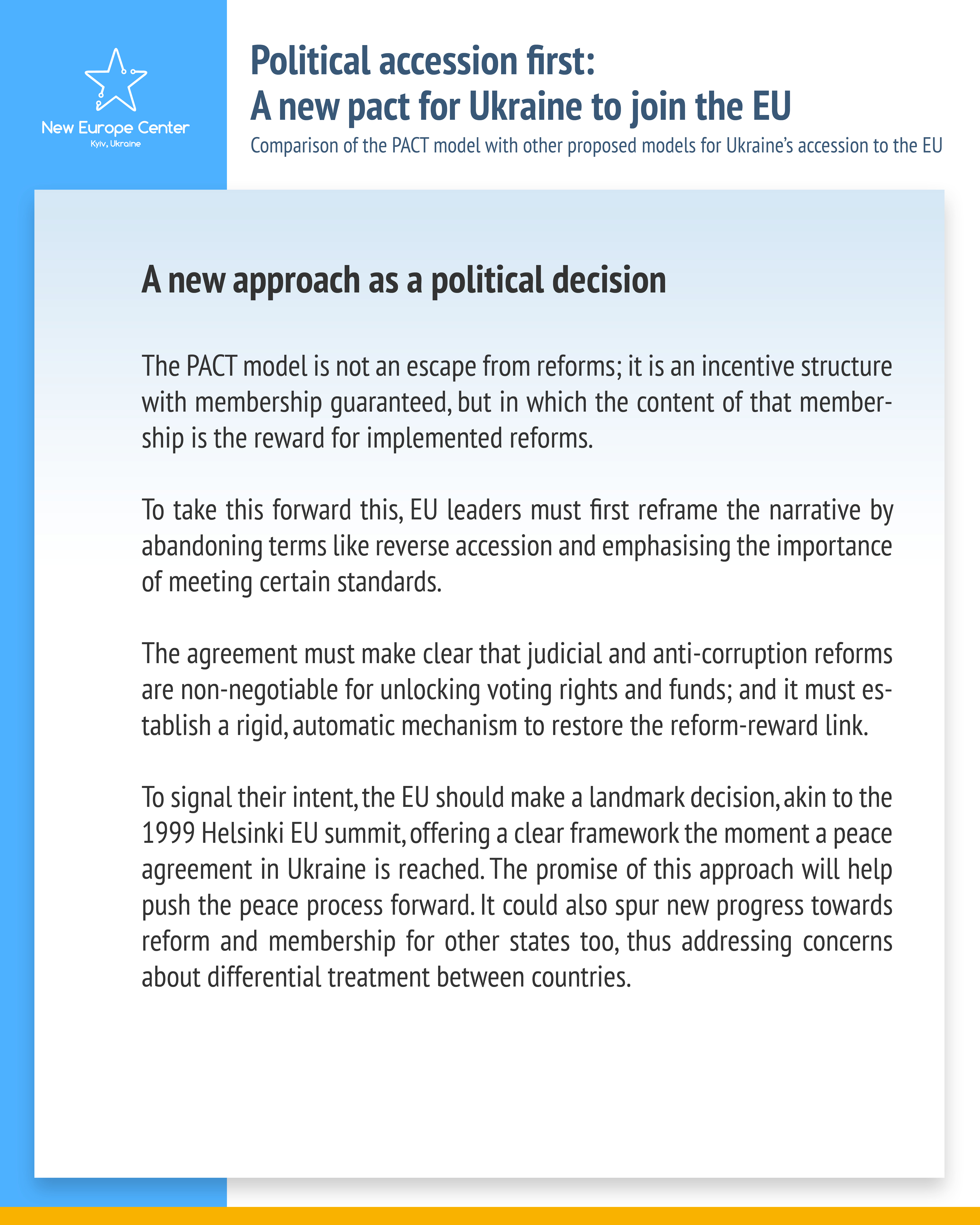
The PACT model is not an escape from reforms; it is an incentive structure with membership guaranteed, but in which the content of that membership is the reward for implemented reforms.
To take this forward this, EU leaders must first reframe the narrative by abandoning terms like reverse accession and emphasising the importance of meeting certain standards.
Once the new framing is established, EU institutions and member states must work closely together to draft an accession agreement that allows derogations while complying with the EU treaty. The agreement must make clear that judicial and anti-corruption reforms are non-negotiable for unlocking voting rights and funds; and it must establish a rigid, automatic mechanism to restore the reform-reward link. The agreement itself will serve as a crucial tool for campaigning for ratification in EU countries. It must therefore also include clear safeguards ensuring that new member states, including Ukraine, will face consequences should they deviate from core principles (a norm that ideally should apply to all EU members).
To signal their intent, the EU should make a landmark decision, akin to the 1999 Helsinki EU summit, offering a clear framework the moment a peace agreement in Ukraine is reached. The promise of this approach will help push the peace process forward. It could also spur new progress towards reform and membership for other states too, thus addressing concerns about differential treatment between countries.
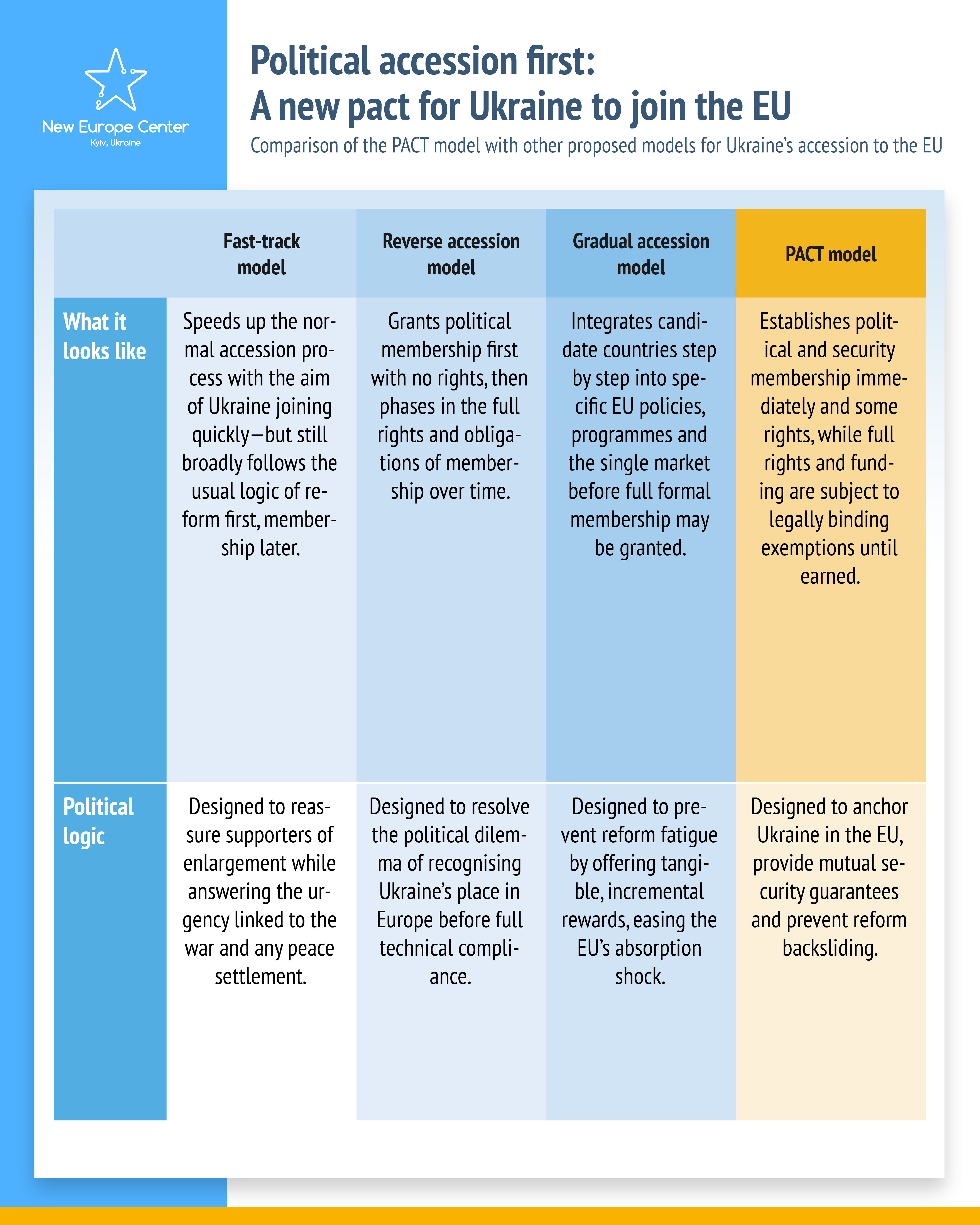
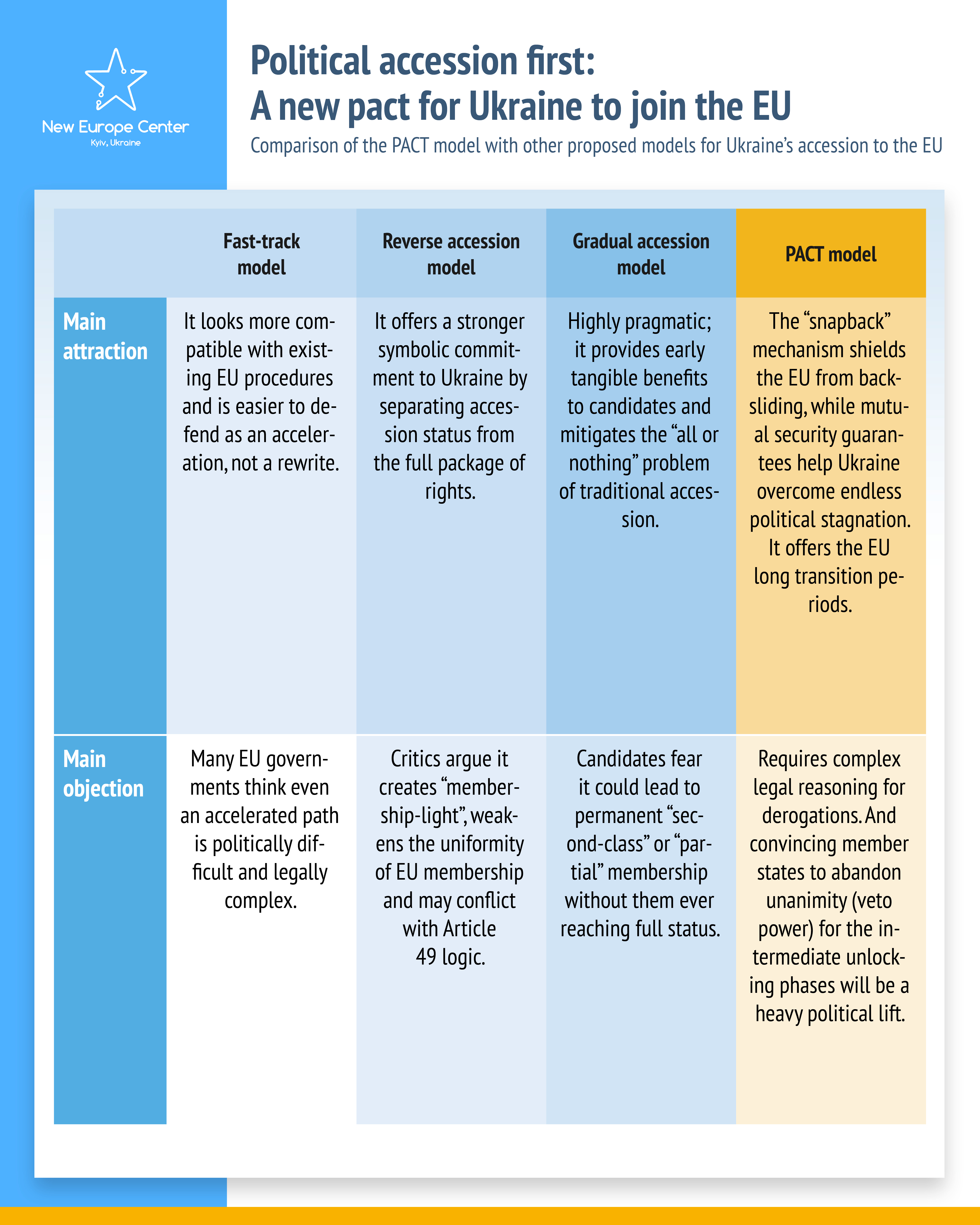
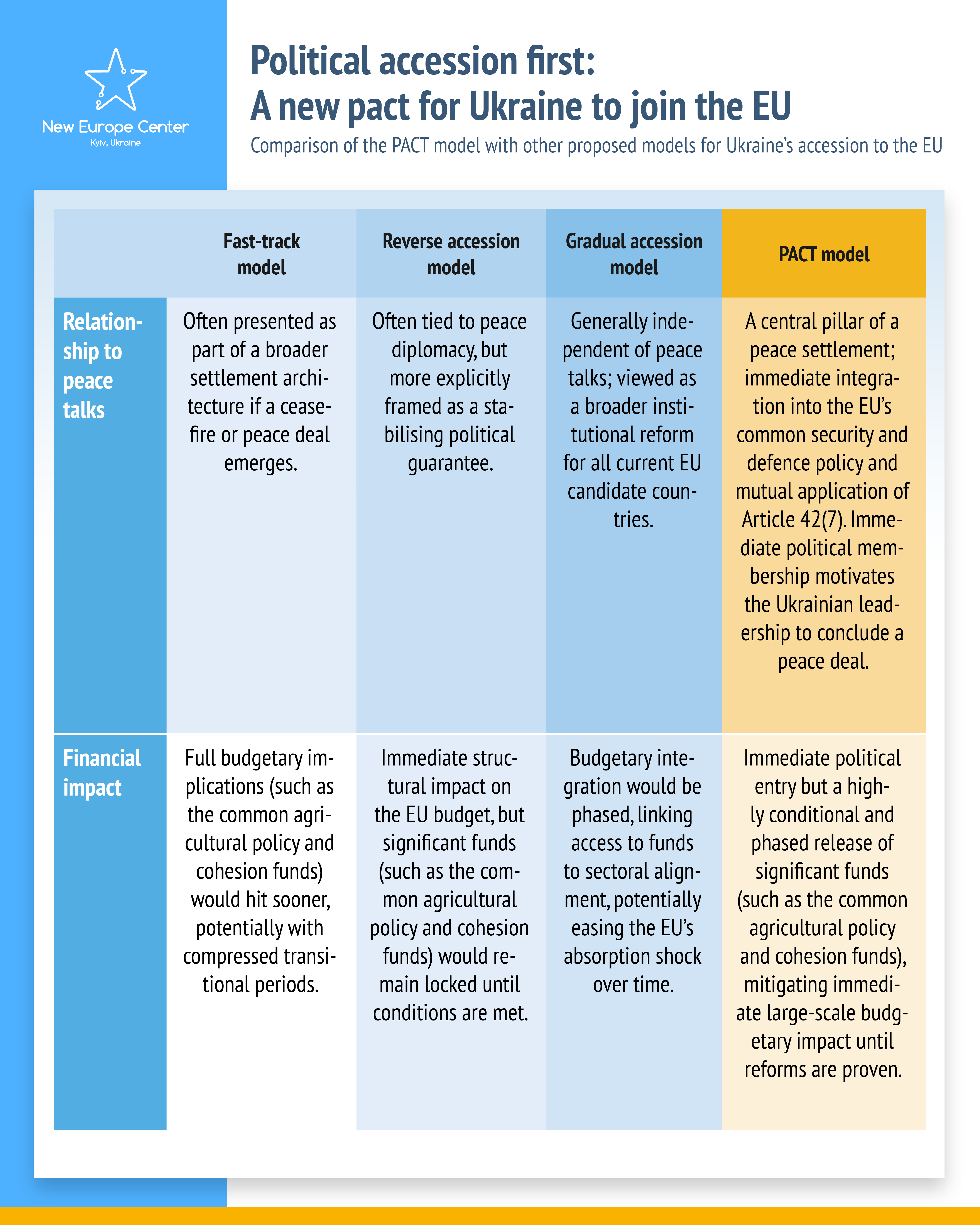
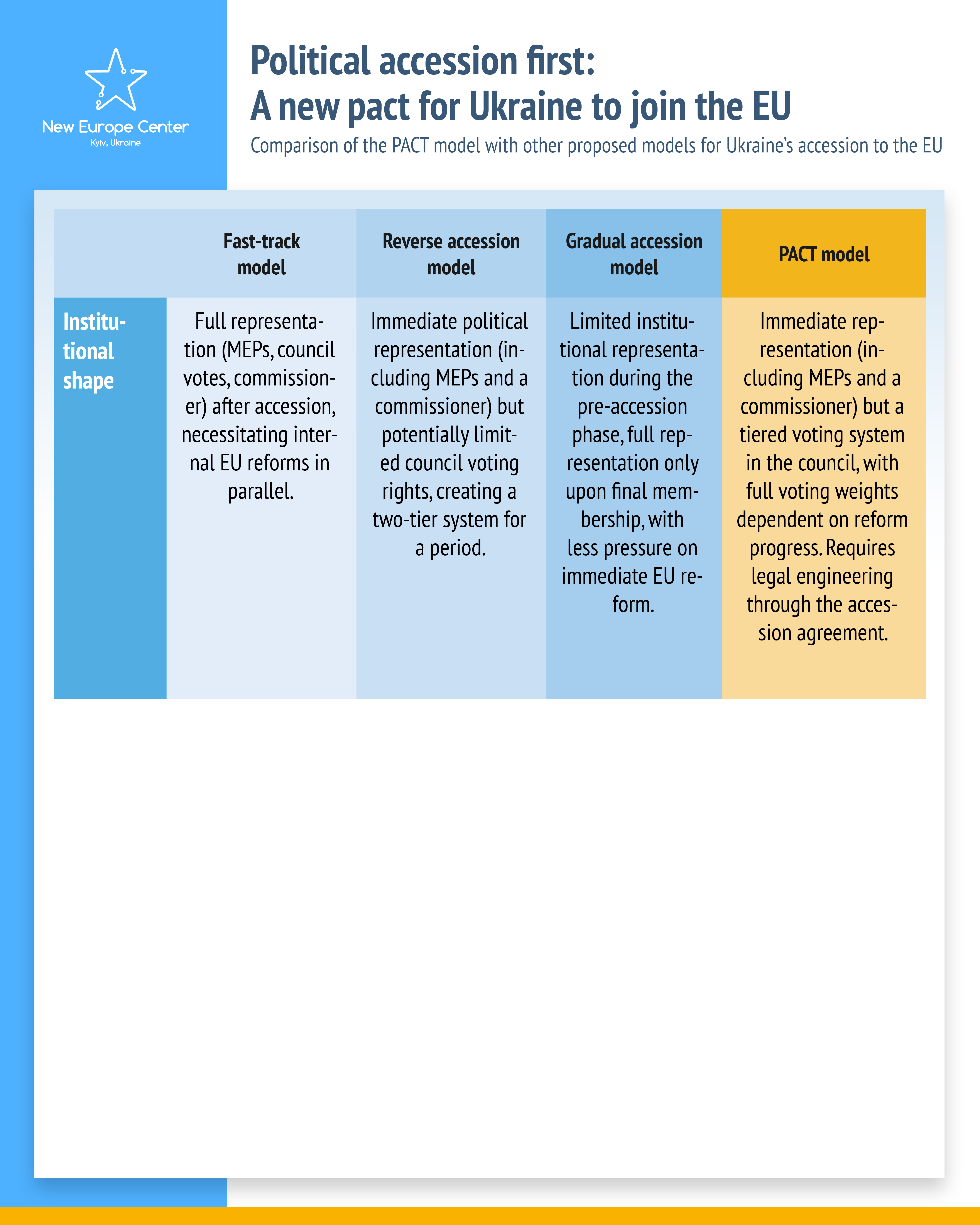
| Fast-track model | Reverse accession model | Gradual accession model | PACT model | |
| What it looks like | Speeds up the normal accession process with the aim of Ukraine joining quickly—but still broadly follows the usual logic of reform first, membership later. | Grants political membership first with no rights, then phases in the full rights and obligations of membership over time. | Integrates candidate countries step by step into specific EU policies, programmes and the single market before full formal membership may be granted. | Establishes political and security membership immediately and some rights, while full rights and funding are subject to legally binding exemptions until earned. |
| Political logic | Designed to reassure supporters of enlargement while answering the urgency linked to the war and any peace settlement. | Designed to resolve the political dilemma of recognising Ukraine’s place in Europe before full technical compliance. | Designed to prevent reform fatigue by offering tangible, incremental rewards, easing the EU’s absorption shock. | Designed to anchor Ukraine in the EU, provide mutual security guarantees and prevent reform backsliding. |
| Main attraction | It looks more compatible with existing EU procedures and is easier to defend as an acceleration, not a rewrite. | It offers a stronger symbolic commitment to Ukraine by separating accession status from the full package of rights. | Highly pragmatic; it provides early tangible benefits to candidates and mitigates the “all or nothing” problem of traditional accession. | The “snapback” mechanism shields the EU from backsliding, while mutual security guarantees help Ukraine overcome endless political stagnation. It offers the EU long transition periods. |
| Main objection | Many EU governments think even an accelerated path is politically difficult and legally complex. | Critics argue it creates “membership-light”, weakens the uniformity of EU membership and may conflict with Article 49 logic. | Candidates fear it could lead to permanent “second-class” or “partial” membership without them ever reaching full status. | Requires complex legal reasoning for derogations. And convincing member states to abandon unanimity (veto power) for the intermediate unlocking phases will be a heavy political lift. |
| Relationship to peace talks | Often presented as part of a broader settlement architecture if a ceasefire or peace deal emerges. | Often tied to peace diplomacy, but more explicitly framed as a stabilising political guarantee. | Generally independent of peace talks; viewed as a broader institutional reform for all current EU candidate countries. | A central pillar of a peace settlement; immediate integration into the EU’s common security and defence policy and mutual application of Article 42(7). Immediate political membership motivates the Ukrainian leadership to conclude a peace deal. |
| Financial impact | Full budgetary implications (such as the common agricultural policy and cohesion funds) would hit sooner, potentially with compressed transitional periods. | Immediate structural impact on the EU budget, but significant funds (such as the common agricultural policy and cohesion funds) would remain locked until conditions are met. | Budgetary integration would be phased, linking access to funds to sectoral alignment, potentially easing the EU’s absorption shock over time. | Immediate political entry but a highly conditional and phased release of significant funds (such as the common agricultural policy and cohesion funds), mitigating immediate large-scale budgetary impact until reforms are proven. |
| Institutional shape | Full representation (MEPs, council votes, commissioner) after accession, necessitating internal EU reforms in parallel. | Immediate political representation (including MEPs and a commissioner) but potentially limited council voting rights, creating a two-tier system for a period. | Limited institutional representation during the pre-accession phase, full representation only upon final membership, with less pressure on immediate EU reform. | Immediate representation (including MEPs and a commissioner) but a tiered voting system in the council, with full voting weights dependent on reform progress. Requires legal engineering through the accession agreement. |
The proposal to use a new model was first presented on March 23, 2026, during the roundtable “The Speed of Ukraine’s EU Accession: How to Overcome the Main Challenges” organized by the New Europe Center in cooperation with the National Interests Advocacy Network (ANTS).
The analytical material was first published on ECFR, on April 16.
[1] Author’s interview in Brussels with an EU Council official, March 2026.
[2] Author’s interviews in Brussels, Berlin, Paris, The Hague, Madrid and Vienna with diplomats and EU officials, March 2026.
[3] Author’s interviews in Brussels, Berlin, Paris, The Hague, Madrid and Vienna with diplomats and EU officials, March 2026.