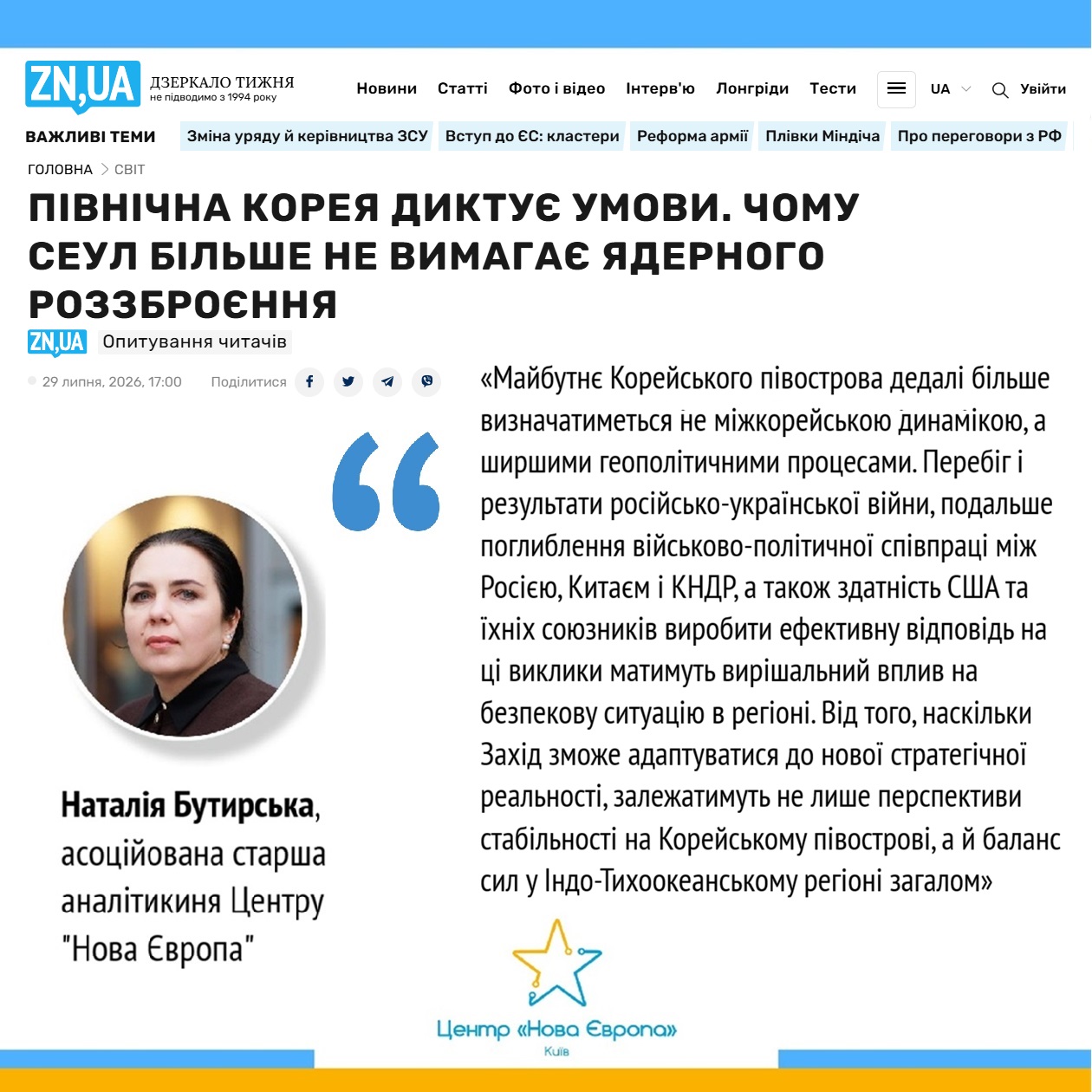
“The future of the Korean Peninsula will increasingly be shaped not by inter-Korean dynamics, but by broader geopolitical developments. The course and outcome of Russia’s war against Ukraine, the deepening military and political cooperation between Russia, China, and North Korea, and the ability of the United States and its allies to formulate an effective response to these challenges will have a decisive impact on regional security. How successfully the West adapts to this new strategic reality will determine not only the prospects for stability on the Korean Peninsula, but also the broader balance of power across the Indo-Pacific”
Nataliya Butyrska, Associate Senior Fellow at the New Europe Center, explains in an analysis for Mirror of the Week why South Korea is moving away from its long-standing policy of insisting on North Korea’s unconditional denuclearization and shifting toward a “peace first” strategy, acknowledging that the previous approach has failed to deliver results. The author argues that the strengthening military alliance between North Korea, Russia, and China, combined with the lessons of Russia’s war against Ukraine, has significantly altered the balance of power on the Korean Peninsula and is forcing Seoul to seek new approaches to deterrence and dialogue.
In the article, the author also examines:
- how Russia, China, and the United States have reshaped the international context surrounding North Korea’s nuclear issue;
- how Russia’s war against Ukraine has strengthened North Korea’s position;
- why President Lee Jae Myung’s policy of “peaceful coexistence” has so far failed to produce tangible results;
- the prospects for renewed US–North Korea dialogue under President Donald Trump;
- why the security of the Korean Peninsula is now inseparable from the course of Russia’s war against Ukraine.
Read more on the pages of Mirror of the Week (in Ukrainian).