“Following all the meetings, Putin held a press conference and reiterated the same conditions Russia had put forward before. He showed absolutely no readiness for compromise or negotiations that could lead to peace. We can therefore say that sitting at the negotiating table with Xi Jinping and Trump did not send Putin a signal that he needed to wind down the war.”
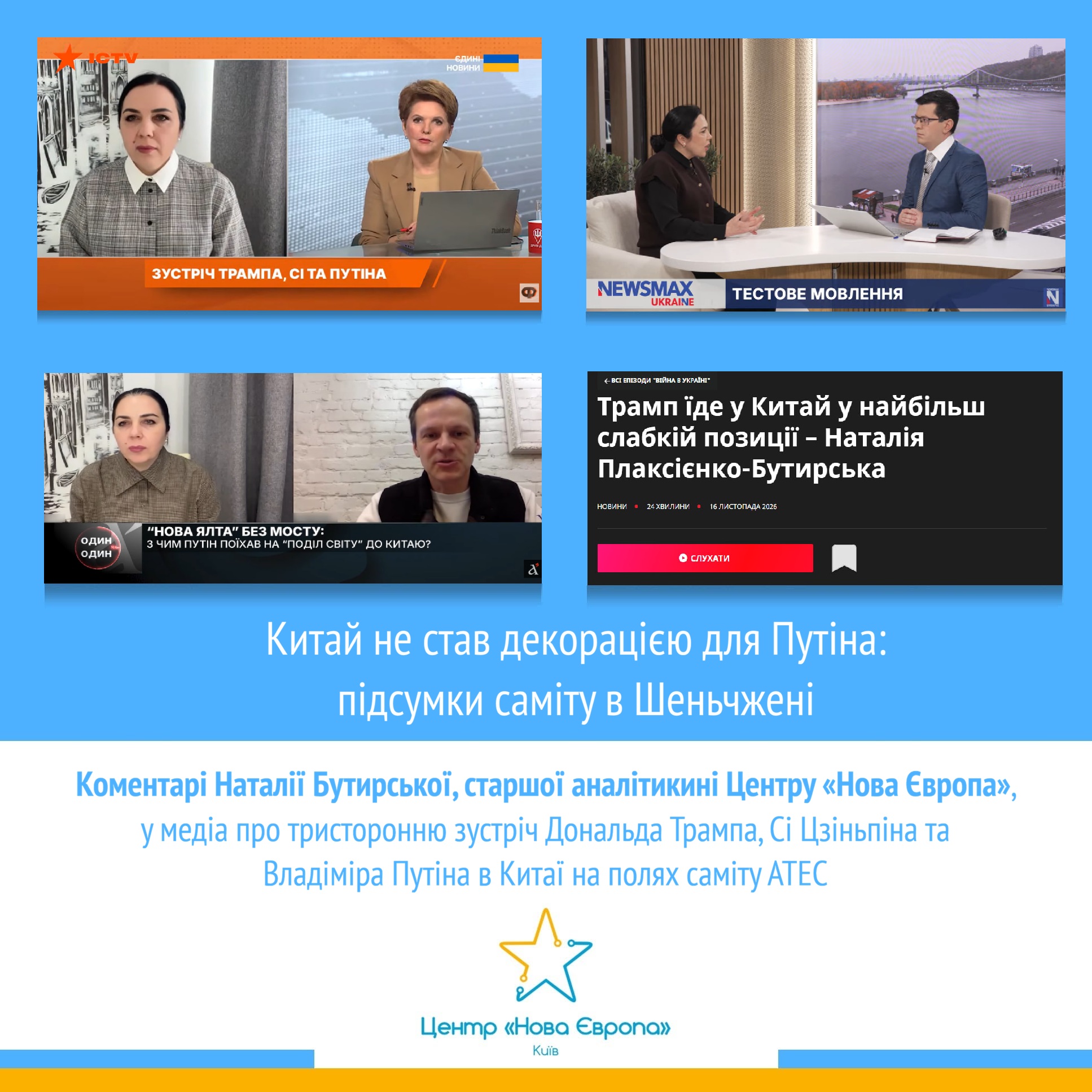
In her comments to Fakty ICTV, Newsmax Ukraine, Radio NV, and Apostrophe, Nataliya Butyrska, Senior Fellow at New Europe Center, explained what the leaders sought to achieve through the trilateral meeting in Shenzhen, why China did not allow Putin to become the central figure of the summit, and what the implications are for Ukraine.
According to the expert, Russia was the initiator of the trilateral format. Moscow was hoping for a “Yalta 2.0” – a new security architecture that would include, among other things, NATO’s withdrawal to its 1997 borders. China had long refrained from confirming the meeting and, during the summit, focused on its own agenda: energy security, supply chains, artificial intelligence, and the digital economy. Beijing sought to use the APEC summit to expand its influence in the Asia-Pacific region. The spotlight was primarily on Xi Jinping’s speeches, while Putin did not become the centre of attention. The trilateral meeting was not a central event for China, and Beijing was not prepared to implement Russia’s scenario.
According to Butyrska, Donald Trump was primarily seeking a media spectacle against the backdrop of setbacks in both domestic and foreign policy. An hour and a half, including interpretation, was hardly enough to redraw the world order. The parties signed a four-point document covering the responsibility of permanent members of the UN Security Council and UN reform, international justice and leaders’ immunity, energy security, and nuclear weapons. However, the document offers little in terms of added value for the international community. Each side interprets these provisions in line with its own interests. At the same time, Xi Jinping’s statement on the need to eliminate nuclear weapons and the unacceptability of waging nuclear war was, according to the expert, an important signal to Russia amid Putin’s threats against Ukraine.
The expert emphasises that Russia is already presenting the summit’s outcome as proof that it has overcome international isolation. In her view, the real problem lies elsewhere: following the Anchorage meeting, Trump strengthened Moscow’s ability to legitimise its international standing, while Russian propaganda portrays the “West” as a small group of European countries unwilling to accept a “compromise”. China has not put pressure on Putin since the beginning of the full-scale invasion, and the current US administration is not doing so either.
As for Ukraine, Nataliya Butyrska cautions against optimism. Following the meetings, Putin reiterated his previous conditions at the press conference and showed no readiness for compromise. The expert expects additional pressure from the United States on Ukraine, as Washington is rushing to secure an agreement before the G20 summit in Miami, while Steve Witkoff and Jared Kushner are speaking of a “narrow window of opportunity”. For Ukraine, strengthening coordination with European partners and presenting a united position in response to Russian demands will be crucial.