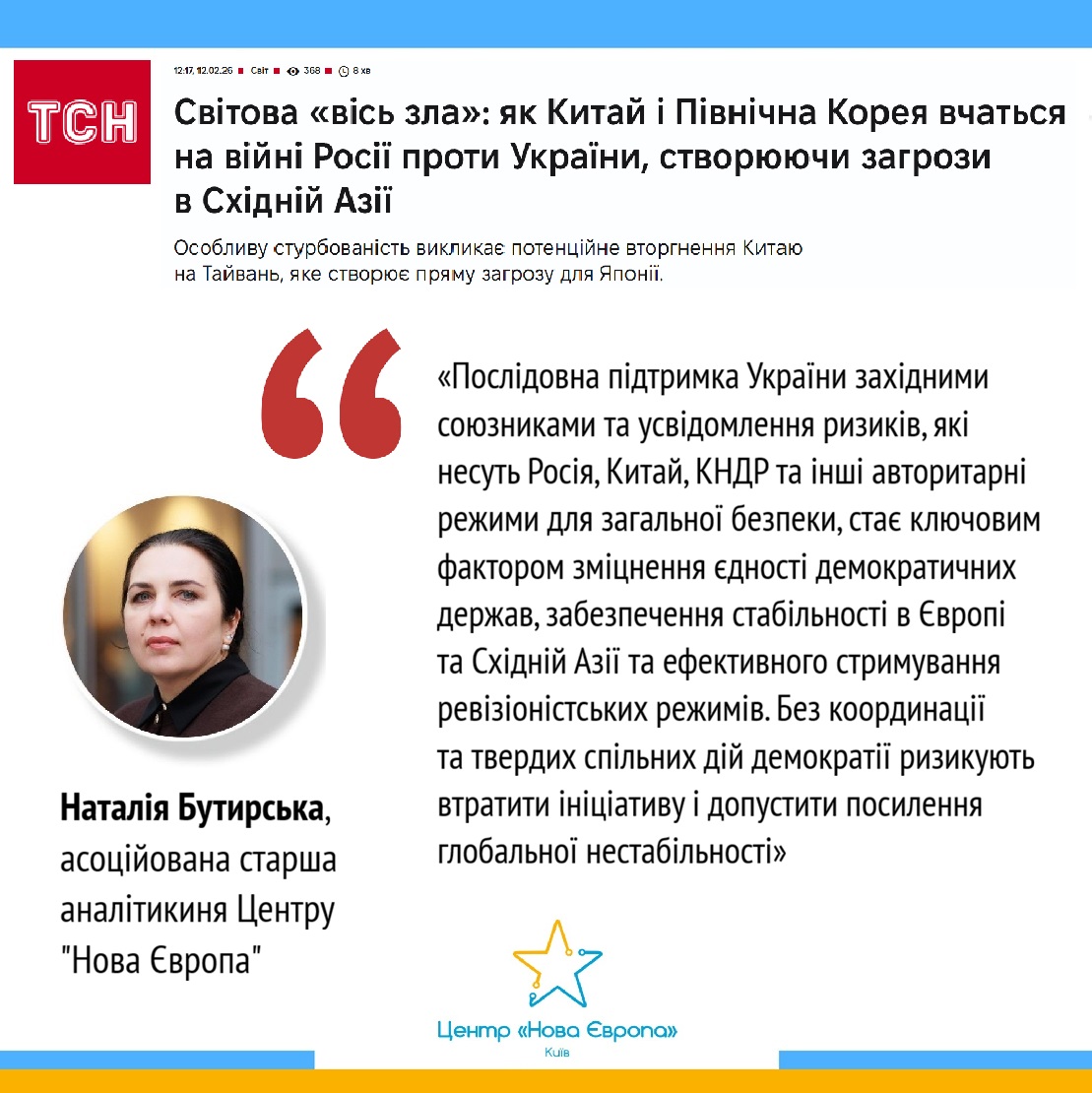
By Nataliya Butyrska, Associate Senior Fellow, New Europe Center
Analytical memo “Global ‘Axis of Evil’: How China and North Korea Are Learning from Russia’s War Against Ukraine, Creating Threats in East Asia”This material was produced with the support of the International Renaissance Foundation. The views expressed are those of the author and do not necessarily reflect the position of the International Renaissance Foundation.
The key findings of this analytical paper were presented during the expert’s remarks at the VI Ukraine-Japan Forum, organised by the New Europe Center on 4 February 2026.
Russia’s full-scale aggression against Ukraine has become a catalyst for deeper shifts in the global security system, exposing the close connection between events in Europe and the strategic situation in East Asia. The warning issued by then-Prime Minister of Japan Fumio Kishida in June 2022 at the Shangri-La Dialogue security summit in Singapore — “Today’s Ukraine could be tomorrow’s East Asia” — has since gained particular relevance, revealing a realistic assessment of the consequences of the Russian invasion for the international order and regional stability.
The further course of the war has not only confirmed this logic. Events in Ukraine are increasingly resonating across East Asia. The Russo-Ukrainian war has gradually transformed into an arena of broader geopolitical confrontation, in which East Asian countries are participating both directly and indirectly.
The memo examines how North Korea’s involvement in Russia’s war against Ukraine has transformed Pyongyang from a regional into a global security actor, and how deepening Russia-China strategic coordination is generating new threats across East Asia. The author analyses China’s multifaceted support for Russia’s war effort, the growing risk of a Chinese invasion of Taiwan, and the challenges facing Western democracies in maintaining unity and effective deterrence against authoritarian regimes. The piece argues that consistent support for Ukraine and a clear-eyed recognition of the interconnected threats posed by Russia, China, and North Korea are essential to preserving stability in both Europe and the Indo-Pacific.
This material was prepared with the support of the International Renaissance Foundation. The views expressed are those of the author and do not necessarily reflect the position of the International Renaissance Foundation.