“Failure to enlarge would only increase instability on the European continent, encourage Russia to continue its aggression and raise the European Union’s costs. For the EU, Ukraine’s full membership could become a strategic investment in its own security, less costly than leaving Ukraine in a ‘grey zone’.”
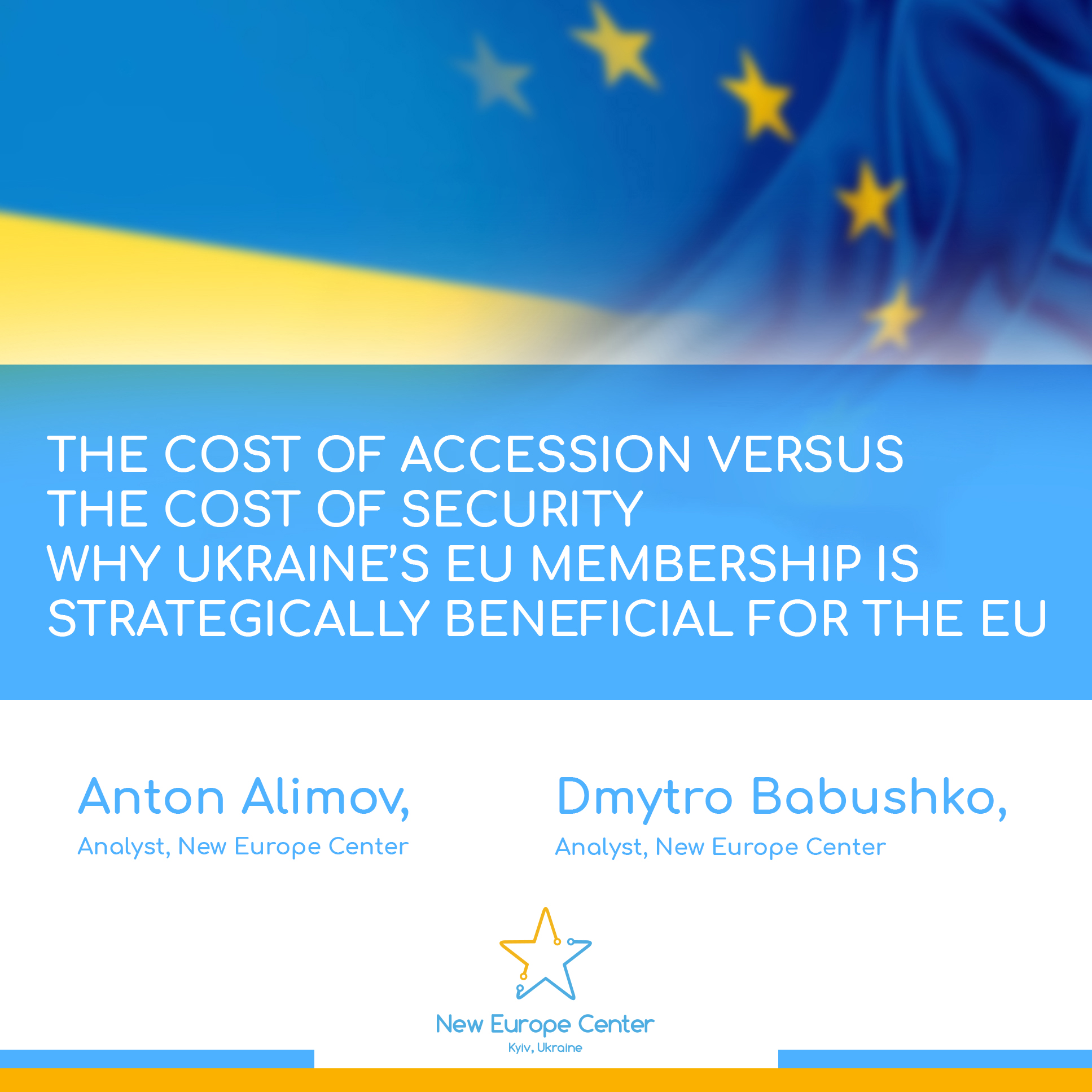
Anton Alimov and Dmytro Babushko, analysts at the New Europe Center, have prepared a discussion paper entitled “The Cost of Accession Versus the Cost of Security”. In the paper, the authors examine the main economic and security concerns surrounding Ukraine’s EU membership and explain why these concerns should not serve as grounds for rejecting further enlargement.
Some key findings from the paper:
- Ukraine is not only a recipient of security but also one of the EU’s most significant potential defence assets. Its large Armed Forces, combat experience, defence industry and ability to rapidly introduce technological innovations would strengthen European deterrence.
- The greatest danger lies not in Ukraine’s membership but in keeping it in a “grey zone”. The experiences of Ukraine, Georgia and Moldova demonstrate that uncertainty about a country’s future status encourages Russian aggression and hybrid pressure.
- Membership would transform today’s ad hoc support into long-term institutional cooperation. Ukraine would be able to participate in joint planning and decision-making, while EU assistance would become more predictable and integrated into the Union’s multiannual budgetary framework.
- The security obligations arising from membership would be mutual. Article 42(7) of the Treaty on European Union would extend the principle of mutual assistance to Ukraine, while Ukraine itself would contribute military capabilities that Europe currently lacks.
- According to scenario-based estimates, keeping Ukraine outside the EU could prove considerably more expensive for Europe. A partial Russian victory, with Ukraine remaining outside the EU, would cost Europe EUR 1,205–1,633 billion over four years, compared with EUR 522–838 billion under a scenario of Ukrainian resilience followed by EU integration.
- Ukraine’s accession would not be cost-free for the EU, but its projected costs are often overstated. Additional expenditure could be mitigated through transition periods, gradual access to EU funds, budgetary compensation mechanisms and adjustments to EU policies.
- The budgetary implications of enlargement are manageable. According to Bruegel, the simultaneous accession of nine candidate countries would increase the EU budget from 1.12% to 1.23% of the Union’s GDP, while the net additional cost for current member states would amount to approximately 0.17% of EU GDP.
- Ukraine would bring the EU not only costs but also economic opportunities. These include an expanded Single Market, a larger workforce, IT and defence technologies, access to critical minerals, agricultural production and substantial investment opportunities in reconstruction.
- Agriculture would be one of the most challenging areas of integration, but it does not pose a catastrophic threat to European farmers. The gradual introduction of payments, transition periods and Ukraine’s alignment with EU standards could significantly reduce potential risks.
- The EU’s central choice is between managed enlargement and unmanaged instability. The costs of integration can be planned, distributed and contained in advance, while the consequences of renewed aggression, migration and prolonged instability are far more difficult to predict.
This discussion paper was prepared with the support of the International Renaissance Foundation. The document reflects the views of the authors and does not necessarily represent those of the International Renaissance Foundation.