Read PDF version here.
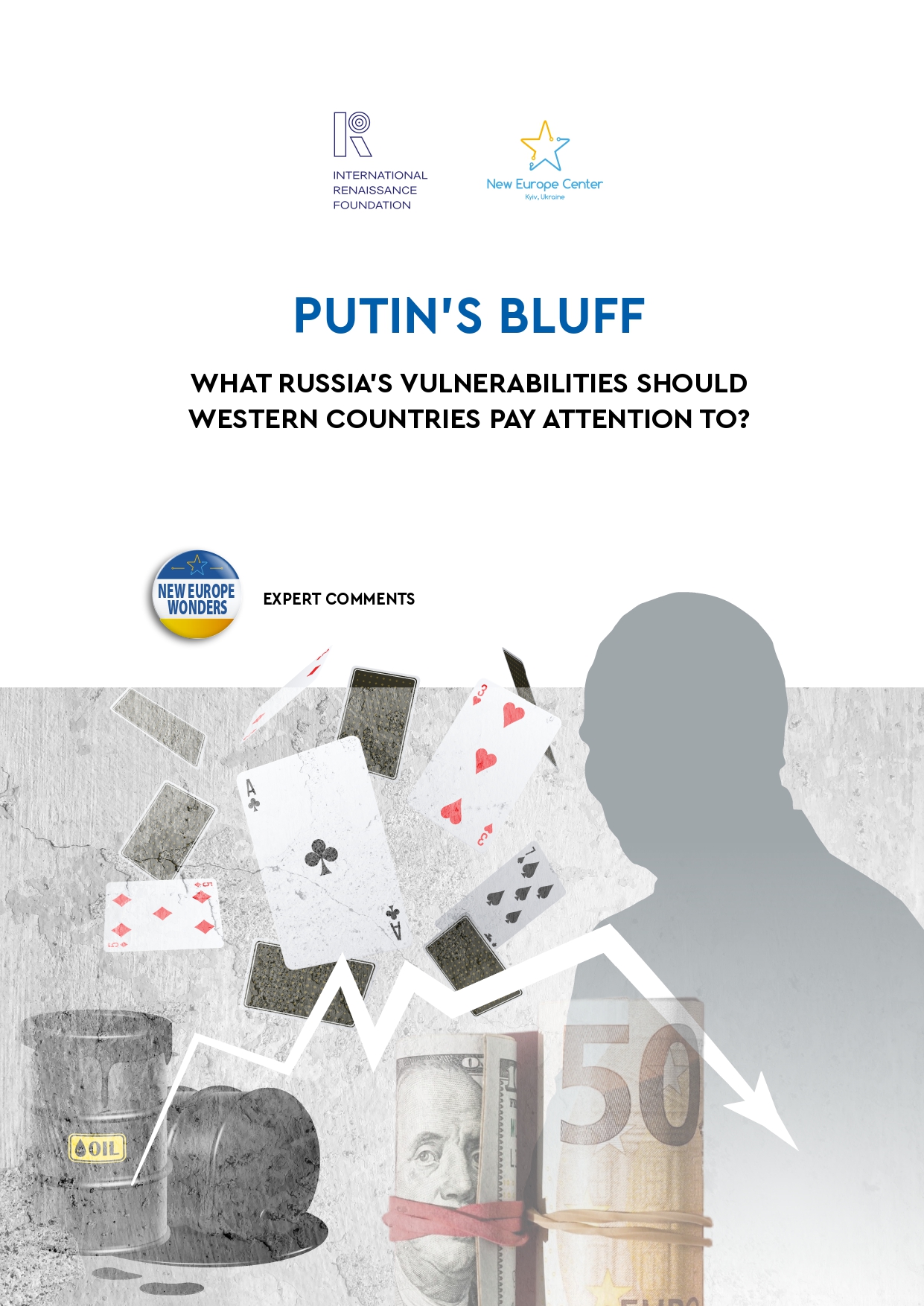
“Ukraine does not have the cards”. This quote will probably go down in history as one of the most telling illustrations of false predictions about Russia’s quick victory in the war against Ukraine. Four years of Ukrainian resistance became a verdict for many Realpolitik supporters, who constantly overestimated the power of the Russian “colossus”. Despite this, some foreign partners still believe that Ukraine should make one-sided concessions, as Russia allegedly retains a decisive advantage and is about to launch a new, this time successful, offensive. Russian ultimatums and excessive claims during negotiations are considered and looked on seriously. The current leadership of the United States has proven to be particularly inclined to adopt the Russian narrative as the most likely scenario and buy the Russian bluffing. Although, some European politicians can also be heard making comments calling on Ukraine to make painful concessions. And such statements are not only coming from the Kremlin’s traditional mouthpieces. That is why the New Europe Centre decided to turn to leading security experts from Europe and the United States to question established approaches to assessing Russia’s potential. As part of a new expert survey, we asked the following questions: Why do Western governments often overestimate Russia’s military and economic resilience? What policy approaches could help recalibrate Western assessments? Which of Russia’s weaknesses and vulnerabilities would you identify as the most critical?
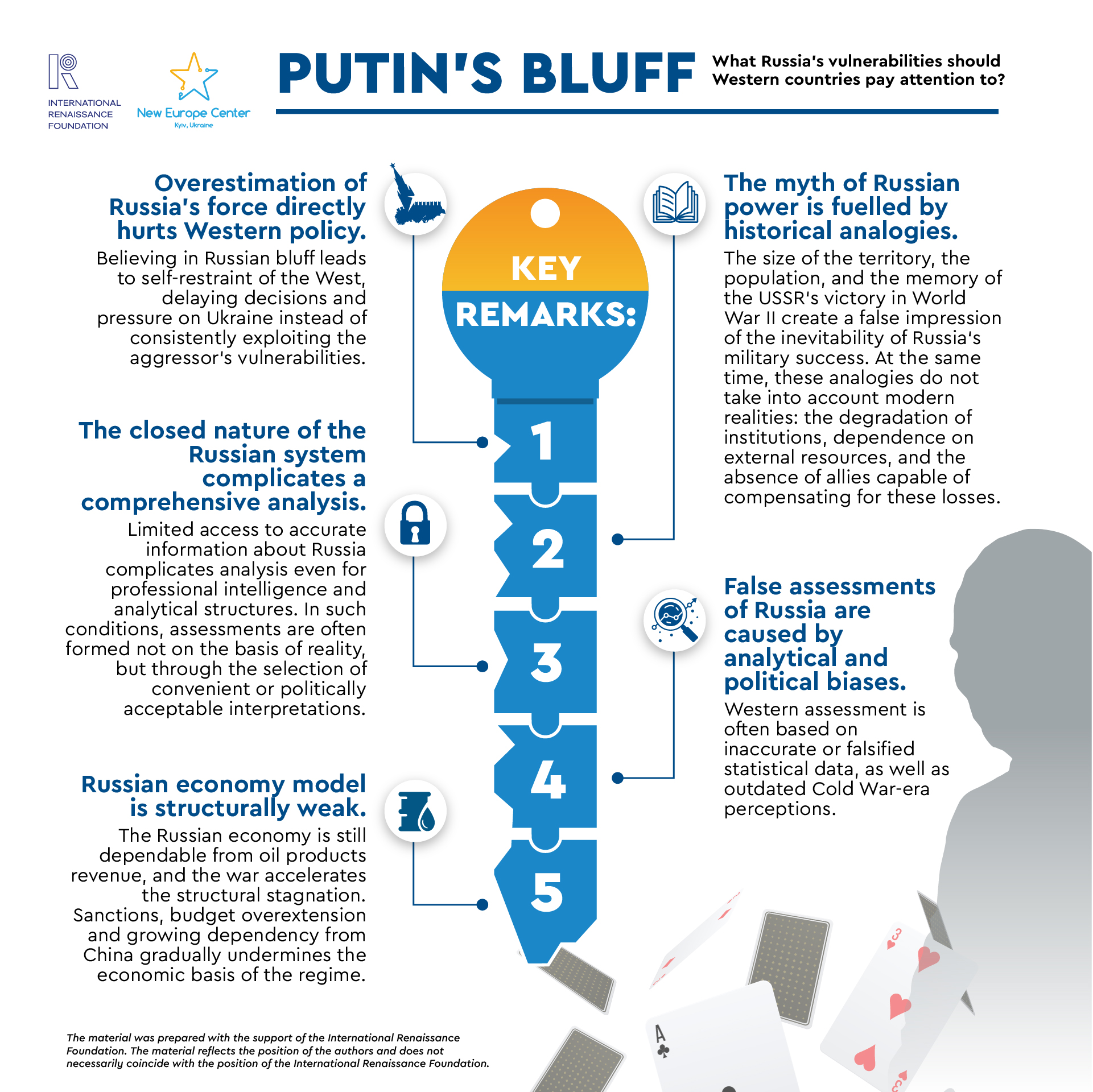
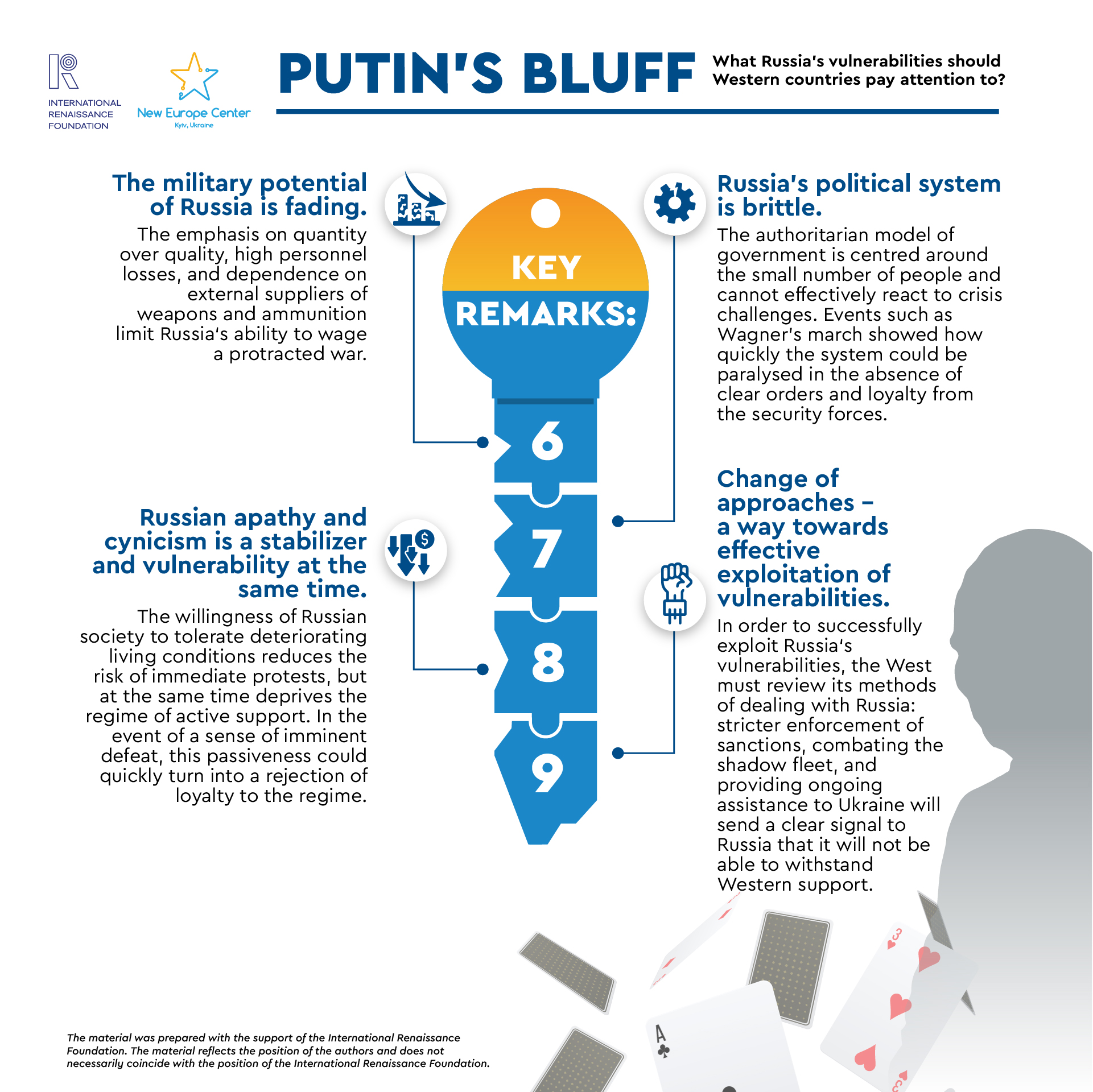
Key remarks:
- Overestimation of Russia’s force directly hurts Western policy. Believing in Russian bluff leads to self-restraint of the West, delaying decisions and pressure on Ukraine instead of consistently exploiting the aggressor’s vulnerabilities.
- False assessments of Russia are caused by analytical and political biases. Western assessment is often based on inaccurate or falsified statistical data, as well as outdated Cold War-era perceptions.
- The closed nature of the Russian system complicates a comprehensive analysis. Limited access to accurate information about Russia complicates analysis even for professional intelligence and analytical structures. In such conditions, assessments are often formed not on the basis of reality, but through the selection of convenient or politically acceptable interpretations.
- The myth of Russian power is fuelled by historical analogies. The size of the territory, the population, and the memory of the USSR’s victory in World War II create a false impression of the inevitability of Russia’s military success. At the same time, these analogies do not take into account modern realities: the degradation of institutions, dependence on external resources, and the absence of allies capable of compensating for these losses.
- Russian economy model is structurally weak. The Russian economy is still dependable from oil products revenue, and the war accelerates the structural stagnation. Sanctions, budget overextension and growing dependency from China gradually undermines the economic basis of the regime.
- The military potential of Russia is fading. The emphasis on quantity over quality, high personnel losses, and dependence on external suppliers of weapons and ammunition limit Russia’s ability to wage a protracted war.
- Russia’s political system is brittle. The authoritarian model of government is centred around the small number of people and cannot effectively react to crisis challenges. Events such as Wagner’s march showed how quickly the system could be paralysed in the absence of clear orders and loyalty from the security forces.
- Russian apathy and cynicism is a stabilizer and vulnerability at the same time. The willingness of Russian society to tolerate deteriorating living conditions reduces the risk of immediate protests, but at the same time deprives the regime of active support. In the event of a sense of imminent defeat, this passiveness could quickly turn into a rejection of loyalty to the regime.
- Change of approaches – a way towards effective exploitation of vulnerabilities. In order to successfully exploit Russia’s vulnerabilities, the West must review its methods of dealing with Russia: stricter enforcement of sanctions, combating the shadow fleet, and providing ongoing assistance to Ukraine will send a clear signal to Russia that it will not be able to withstand Western support.
James Jay Carafano, Senior Counselor to the President and E.W. Richardson Fellow, Heritage Foundation
Most people don’t understand the nature of strategic intelligence. They think the job of the intelligence community is to provide clear, concise, and unimpeachable answers to hard questions. In most cases, even very good strategic intelligence in ambivalent, contradictory, and tentative. This is particularly true when the targets are closed societies like Russia where even many elites don’t know what is going on, information is hidden, and lies are more common than the truth. So part of the answer to the question of why assessments are wrong is because it is hard to be right. When information is uncertain, many feel free to “cherry pick” among the available information to get the answer they like. That’s a problem of judgment and politics—not intelligence assessments. Still, you can complain about Western leaders and observers, but the Russians have done no better. In fact, the Russians have done way worse. No leader has made greater strategic misreads than Putin. Indeed, compared to the Russians, most Western analysts and commentators, even those that have missed the mark by a wide margin, look like Nostradamus compared to Putin. All that said, battlefield results and real economic activity can’t be hidden. The reality is Russia is not winning and cannot win this war and the longer Moscow fights the weaker its economy gets and the more its geopolitical influence will decline. These are facts that we don’t need spies to tell us.
Leo Litra, Senior Research Fellow at the New Europe Center, Visiting Fellow at ECFR, Ukraine
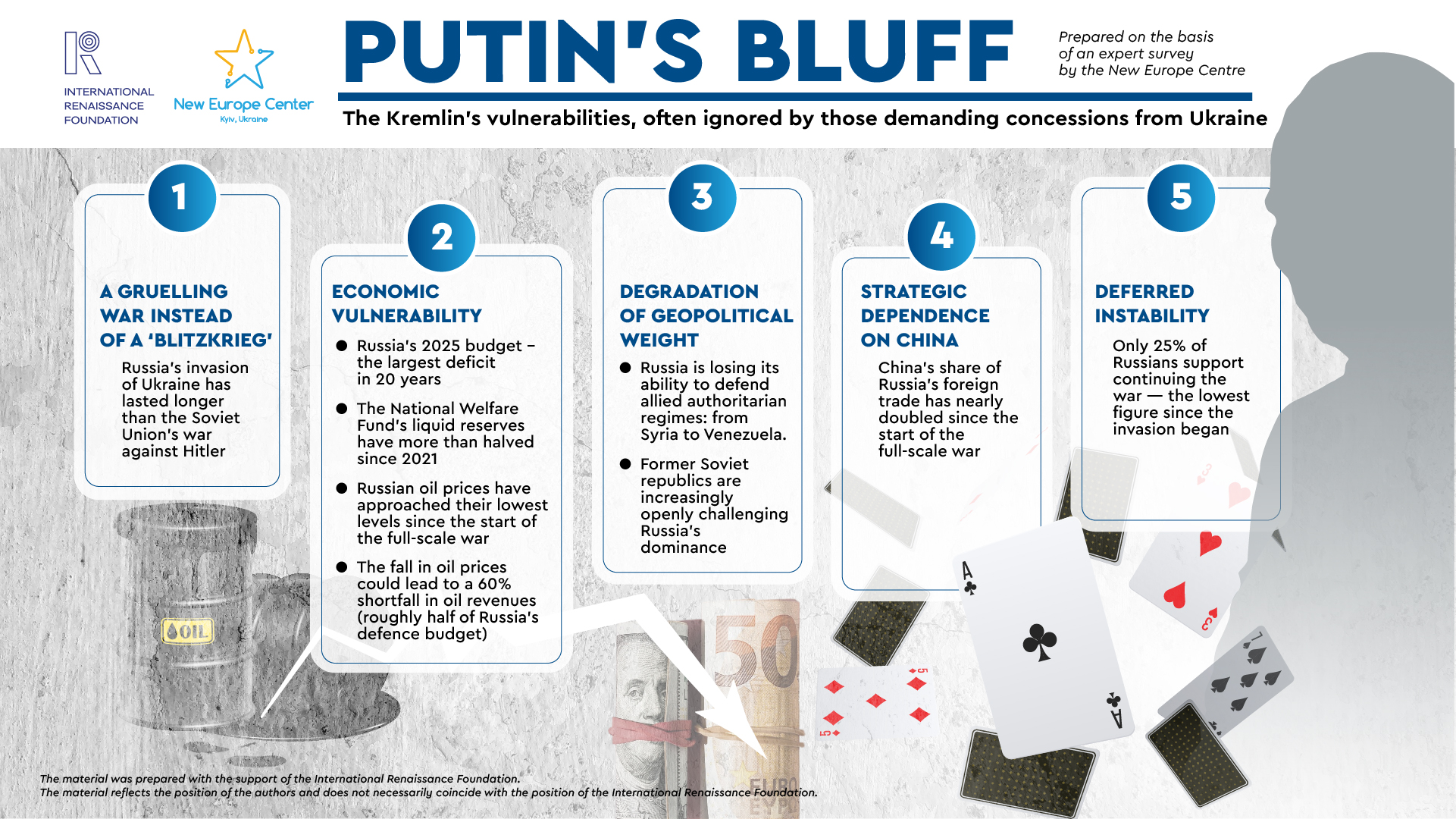
Western governments often overestimate Russia’s resilience because they accept Moscow’s “bluff” of invincibility and the misleading narrative that “time is on Russia’s side.” This perspective reveals a lack of strategic patience, ignoring the fact that Putin’s current war has now lasted longer than the so-called Great Patriotic War (1941-1945) yet yielded incomparably smaller territorial gains. This reality clearly demonstrates that Russia’s endurance is more myth than reality.
To recalibrate these assessments, the West needs to shift its policy from incremental sanctions to enforcement-driven measures. This involves rigorously cracking down on sanctions evasion, specifically regarding high-end dual-use components and Russia’s shadow oil fleet. Furthermore, the West must provide sustained and predictable assistance — such as the EU’s €90bn package — and integrate Ukraine into long-term European defence production. Such an approach would signal to the Kremlin that waiting out Western support is futile, though this strategy faces increasing complications due to rising tensions between the US and Europe.
Russia’s most critical vulnerability is its economy, which remains fragile. If the drop in global oil prices maintains, this could lead to a 60% revenue shortfall in oil income, an amount roughly equivalent to half of the Russian defence budget. This potential shock comes as the economy overheats and the sovereign wealth fund depletes at a rapid rate; it is projected to be fully exhausted by 2026. Militarily, Russia is burning through its vast Soviet stockpiles, slowing its operational tempo, and suffering manpower losses on a scale never seen before in modern history. Moreover, domestic stability is fracturing: regional budgets are collapsing under war costs, and Ukrainian strikes on Russian soil are shattering the Kremlin’s promise of safety at home.
Ukraine’s partners are genuinely interested in Kyiv’s ability to repel the Russian invasion. However, it is possible that the West is susceptible to Russian narratives and overestimates Moscow’s endurance because they fear the uncertainty of a Russian internal collapse. This presents a dilemma for which Western policymakers have yet to find an answer.
Daniel Fried, Former US Ambassador to Poland and Weiser Family Distinguished Fellow, Atlantic Council
Western analysts, government and otherwise, have frequently overestimated Russia’s (and the USSR’s) military and economic strength. Reasons are multiple but two principal ones deserve note.
One includes over focus on statistics (military and economic) without factoring in the frequent distortion and outright falsehoods in statistics generated by the Soviet or Putinist systems. Serious USG analysts in the 1970s held that the Soviet economy was competitive and might surpass the U.S. economy.
Another is what I term the “Realist’s fallacy,” by which I mean an almost unconscious bias to regard Russia (or the USSR) as a great power possessing enormous capacity for suffering in the national cause (a sort of internalization and extension of the Kremlin narrative about the Soviet victory against Nazi Germany) and a corresponding dismissal of the importance and strength of countries near Russia. This bias seems related to a version of foreign policy “realism” which holds that countries like Ukraine are properly part of Russia’s sphere of domination and cannot be expected to resist such fate. Before 1989, this view was applied to Poland and other Satellite countries; adherents regarded Soviet domination of them as permanent and democratic resistance movements, such as Poland’s Solidarity, were futile and destabilizing. In 2022, holders of what I term “faux realism,” predicted that Russia would swiftly overrun Ukraine.
Such views are already fading in response to real world events, such as Ukraine’s successful resistance to Russian aggression, though only with a time lag.
Russia’s weaknesses include economic vulnerability (as an extractive economy, Russia depends on oil and gas revenues) and political rigidity. The Kremlin does not adapt easily; it blusters abroad and brutalizes closer at hand and, when needed, at home. Overextension strategically and economic stagnation doomed the Soviet Union and may do the same for Putin’s Russia.
Lucian Kim, Senior Ukraine Analyst, International Crisis Group
I would not say that Western governments consistently overestimate Russia’s potential. Yes, the Russian military was highly overrated at the beginning of the 2022 invasion, but many in the West also expected Russia’s economy to collapse after a few months of sanctions. The main problem is that Westerners use their own experience to base assumptions on how the Russian military, economy or people “should” behave — and that’s why they are often so wrong. Russia’s vulnerabilities are clear: it has a brittle political system with an aging leader at the top; the government is pouring enormous resources into the war while neglecting economic development; the economy is highly dependent on the price of natural resources; and sanctions have caused Russia to become overly reliant on China as a trade partner. The Kremlin has been largely successful at projecting the image of Russia as a colossus. The question is how long this giant can be held up by its clay feet.
Daniel Kochis, Senior Fellow in the Center on Europe and Eurasia, Hudson Institute
The sheer size of Russia, both in terms of population and territory, serves as a kind of anesthetic, numbing policymakers into believing the countries scale will inevitably produce a grinding victory. President Trump in March stated, “We should be dealing with Russia. They have the largest piece of land by far, bigger than China… You can fly through eleven time zones from one side to the other.” Historical memory reinforces this view. Despite massive losses, the Soviet Union eventually ground down the Nazi war machine on the eastern front and reached Berlin. Won’t Russia’s mass eventually allow it to carve a pathway to Kyiv built on corpses?
Russia did indeed suffer significant casualties in WWII, but Soviet casualty numbers encompass losses from nations subsumed by the USSR, including nations like Ukraine, which lost a larger percentage of its population in the war than did Russia. It is also rarely mentioned in Moscow that the Soviet Army fought and advanced in large part in American planes (14,000 of them) tanks (13,000) and trucks (400,000).
Fast forward to today and the Kremlin continues to rely upon men from its impoverished hinterlands, where ethnic Russians are scarce, as well as on North Korean forces and mercenaries from Africa or Cuba. Russia is also highly dependent upon outside suppliers to continue its campaign of aggression against Ukraine. It could not continue the war without the material support of China but also Iran and North Korea.
Size does not necessarily equate with strength; Russia faces serious vulnerabilities that western governments can and should exploit – from key transit points and military units to the effects of sinking oil prices and its inability to rescue tottering allies. Shattering the myth of Russia’s inevitable subjugation of Ukraine may give western governments greater confidence to act.
Fredrik Wesslau, Distinguished Policy Fellow, Stockholm Centre for Eastern European Studies (SCEEUS)
There is a deep bias in Western capitals about Russia’s strength that stems from the Cold War when the Soviet Union was considered a superpower largely on par with the United States. This antiquated view lives on in many capitals.
Russia’s way of war — relying on quantity over quality — also means the number of troops Russia has seems high, especially compared to European states, even though European troops are generally of better quality.
But the real problem is that Russians are willing to take more pain than Europeans. The apathy and cynicism in Russian society mean that the economic consequences of the sanctions and the war do not lead to protests but silent acceptance. This is a challenge for Western countries since societies are not willing to make the same sacrifices.
A better understanding of Russian capabilities and intentions, but also society, is needed in the West. There is scant understanding of Russian imperialism as a driver of its foreign policy and what this means for Europe.
Russian cynicism is a real vulnerability for the regime. The siloviki and security structures would quickly drop Putin if they felt that his game was up — a bit like they evaporated from Yanukovych’s side when they concluded that he had lost. Then everything unraveled very quickly. The same could happen in Russia.
I suspect Wagner’s march on Moscow in June 2023 was closer to dethroning Putin than we realised. The lack of resistance from Russian forces along the way — since they had not received orders to stop Wagner — shows how the system can be paralysed.
This document was prepared with the support of the International Renaissance Foundation. The material reflects the position of the authors and does not necessarily coincide with the position of the International Renaissance Foundation.