Ukraine-NATO Relations Cannot Be the Subject of Deals with Russia
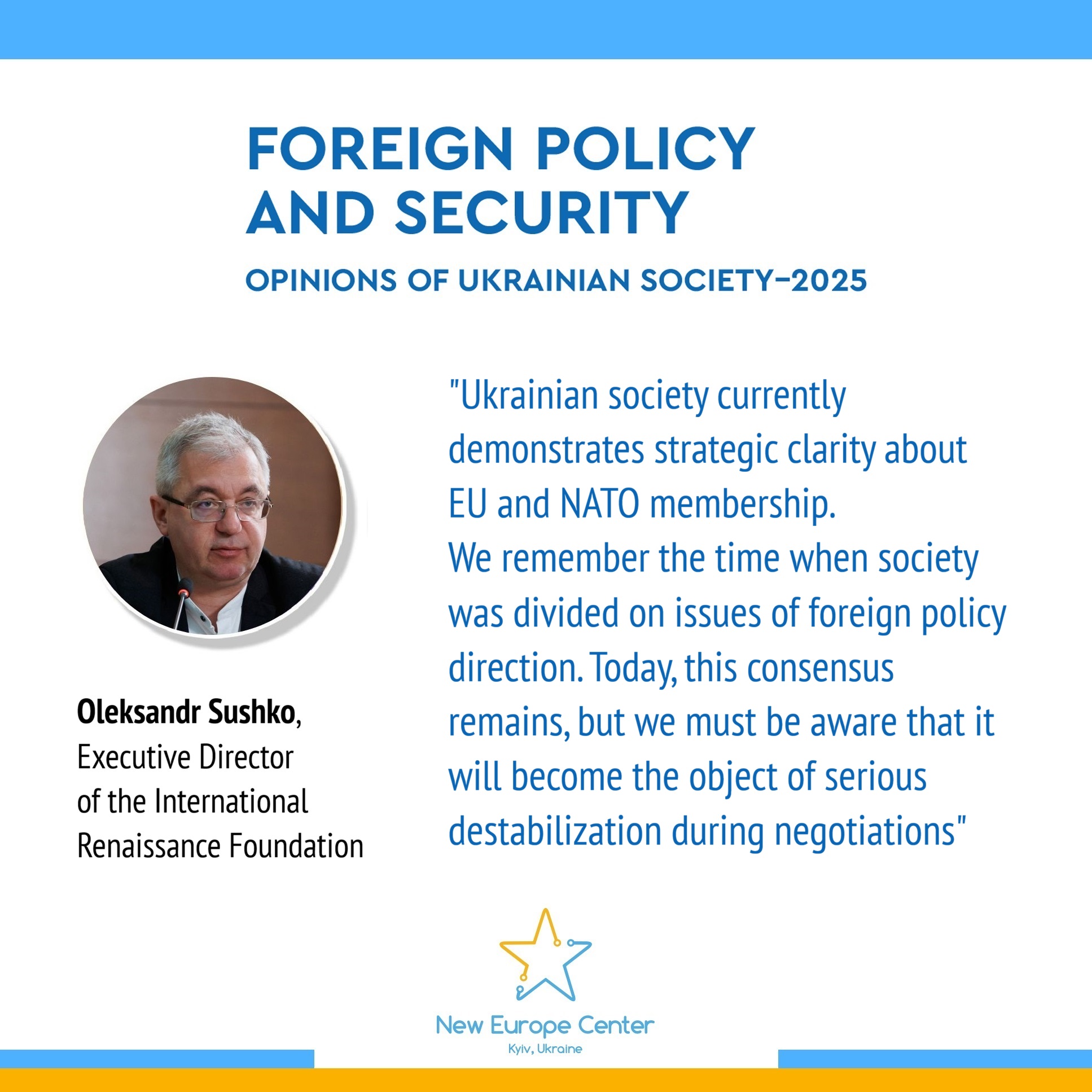
Oleksandr Sushko, Executive Director of the International Renaissance Foundation, during the presentation “Foreign policy and security – 2025” outlined the key “red lines” of Ukrainian society regarding the end of the war, emphasizing that the price of peace cannot entail the loss of sovereignty, defence capability, or the right to determine security orientations independently.
He drew attention to the acute sensitivity surrounding the issues of reducing the Armed Forces of Ukraine and NATO membership, which are increasingly being embedded into the logic of negotiations with Russia, in contradiction to the fundamental principles of international law and of the Alliance itself. Sushko stressed the need for honest communication with society about the limits of possible compromises:
- Ukrainian society treats the issue of the price of peace with considerable seriousness. There is a clear willingness to ensure that the cost of exiting the war is not critical for Ukraine’s sovereignty, independence, and the basic characteristics that make the country capable of defending itself;
- For Ukraine’s future survival, a sufficient size and quality of the Armed Forces is a fundamentally important issue. Therefore, when it comes to reducing the number of personnel in the Armed Forces of Ukraine, there is little enthusiasm in society for such a scenario. At the same time, the response in opinion poll to this issue appears even more uncompromising because the reduction is placed on the same level as the Russian slogan of “demilitarization,” which in practice means depriving Ukraine of its ability to resist;
- The size of the Armed Forces in peacetime cannot be the same as during a full-scale war. However, the issue here is perceived not as technical defence planning. But as an element of reducing sovereignty, when the size of the army is determined not by internal needs, but by an international agreement. This is an extremely rare and problematic practice in international law;
- Any end to the war will, in one way or another, entail demobilization. However, the very fact that this could be part of a hypothetical peace agreement provokes a strong reaction, in particular due to the lack of symmetry. After all, no one is talking about reducing the Armed Forces of the Russian Federation;
- Signals are beginning to emerge about alternative security formats. The issue of Ukraine’s NATO membership is starting to be treated not as a matter of bilateral relations between Ukraine and the Alliance, but as an element of negotiations with Russia. This is fundamentally flawed logic. Fixation of such a model is enshrined in a peace agreement, it will create serious challenges for NATO itself, as it contradicts its fundamental principles and procedures;
- Ukrainian society currently demonstrates strategic clarity about EU and NATO membership. We remember the time when society was divided on issues of foreign policy direction. Today, this consensus remains, but we must be aware that it will become the object of serious destabilization during negotiations;
- Support for the EU and NATO membership is higher than the level of trust in these institutions. This is a paradox, but it exists. After the end of the war, which is likely not to meet all expectations, part of societal resentment will be directed not only at the Ukrainian authorities, but also at Western partners. This may lead to a rise in Eurosceptic sentiments;
- It is critically important to reduce the shock effect of possible decisions through timely and honest communication. I hope that these data will be carefully examined by both the Ukrainian authorities and international partners in order to better understand the constraints that Ukrainian society places on possible compromises.
The recording of the broadcast in Ukrainian is available on our Facebook page, and in English – on the New Europe YouTube channel.