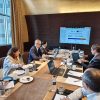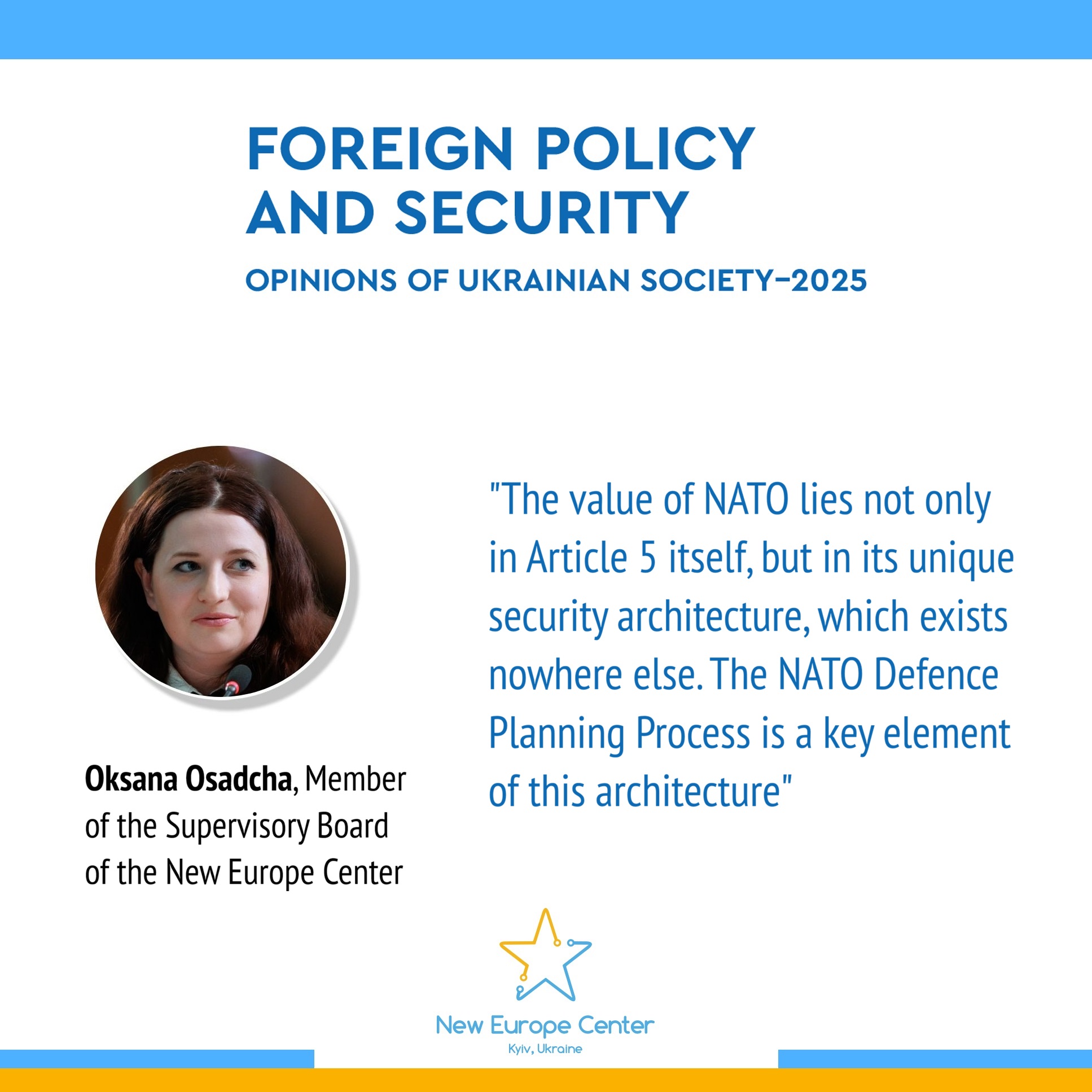
Oksana Osadcha, Member of the Supervisory Board of the New Europe Center, during a recent presentation of the results of opinion poll “Foreign policy and security – 2025” spoke about the gap between the emotional atmosphere in the public space and the actual strategic attitudes of Ukrainian society.
She emphasized the continued importance of strong Armed Forces, national sovereignty, and Euro-Atlantic integration, highlighting the complexity of security guarantees after the war, the risks of manipulative interpretations of compromises, and the need for honest communication with society to avoid shocks and divisions during potential negotiations:
- Opinion poll results indicate that the strategic direction is clearly defined and consistently reflected in both public discourse and societal awareness;
- Regarding nuclear weapons, the discussion focuses more on the perception of the need to rely on one’s own national deterrent. This directly relates to the question of what the Armed Forces of Ukraine will be after a possible, hypothetical peace stage. In this context, nuclear weapons are less about the weapons themselves and more about the idea of a “magical” capability that could deter Russia, and the feeling of having lost something that was once supposedly ours;
- There is much discussion now about “on-paper” guarantees, which have legal force and resemble NATO’s Article 5. It foresees assistance within the capabilities of each member state but does not specify the exact format of that assistance. The value of NATO lies not only in Article 5 itself, but in its unique security architecture, which exists nowhere else. The NATO Defence Planning Process is a key element of this architecture;
- Ukrainian society often perceives the EU primarily as a welfare-focused organization. At the same time, a positive trend is the development of joint defence capabilities and defence industry projects. Both the European Defence Industry Programme (EDIP) and the European Defence Industrial Strategy (EDIS) have significant potential. If Ukraine can achieve joint work with the EU in the defence industry sector, this could effectively serve as a form of security guarantee;
- “Coalition of the Willing” could form the architectural basis for alternative security guarantees outside NATO;
- Since the war began in 2014, many trigger words have entered common usage. Initially, the term was “concern”; now it has become “defining.” If this period indeed proves defining, one can hope that the attitudes captured in the survey will contribute to achieving lasting peace, or at least prepare for the possibility of its violation.
The recording of the broadcast in Ukrainian is available on our Facebook page, and in English – on the New Europe YouTube channel.