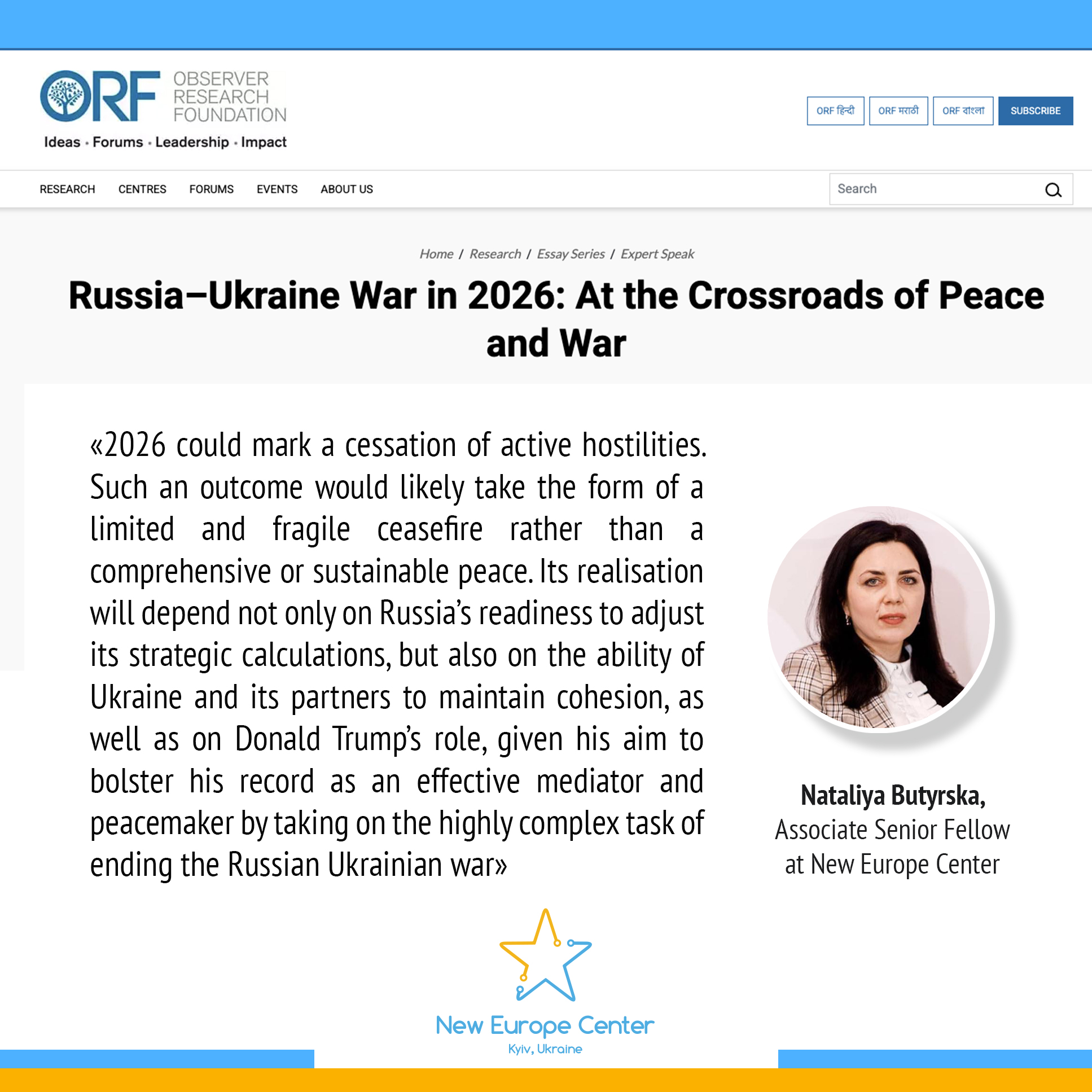
An essay prepared by Nataliya Butyrska, Associate Senior Fellow of the New Europe Center
Published on Observer Research Foundation – one of the most influential think tanks in South Asia based in India.
2026 may bring a fragile ceasefire as Trump’s diplomacy clashes with Russia’s maximalist demands and Ukraine’s security needs, making a frozen conflict more likely than a lasting peace
This year could prove decisive for ending the Russia-Ukraine war. Since returning to the office for his second term, United States (US) President Donald Trump has invested significant diplomatic capital in pursuing peace. However, his underestimation of the conflict’s complexity—which he had hoped to resolve within “24 hours”—has led to repeated disappointment for the US President. Negotiations to conclude the Russia–Ukraine war have intensified amid Trump’s push to accelerate the process, but remain constrained by deep divergences over the terms of peace.
Russia’s Maximalist Peace Framework
Developments over the past year have shown that the Trump administration’s attempts to press Ukraine into rapid concessions, while presenting them as a ‘realistic’ approach to peace, failed to produce results. These initiatives faced resistance from Ukraine and from President Volodymyr Zelensky personally, while in the Kremlin, they were seen as an opportunity to push for maximalist terms favourable to Russia.
In Russia’s strategic logic, the prospect of peace depends on compliance with its predetermined demands rather than on mutual concessions.
Moscow has not publicly rejected the idea of a negotiated settlement and continues to engage with the United States; however, its stance does not suggest a willingness to compromise. In his year-end remarks last December, President Vladimir Putin stated that, in Russia’s interpretation, ending the conflict by peaceful means depends on the implementation of the conditions he outlined in 2024. If these conditions are not accepted, the Kremlin signals its readiness to continue military operations to achieve its objectives. In Russia’s strategic logic, the prospect of peace depends on compliance with its predetermined demands rather than on mutual concessions.
Russia has rejected proposals to freeze the conflict along the current line of contact or to agree to a cessation of attacks on energy infrastructure as an initial, limited step toward de-escalation. Instead, Russian forces continue a gradual advance along the front while deliberately targeting Ukraine’s energy and gas infrastructure. These actions are intended to disrupt civilian life, particularly during the winter. Through this approach, Moscow appears to seek greater domestic pressure on the Ukrainian authorities to induce more flexibility in the negotiation process.
From Kyiv’s perspective, Russia’s conditions are unacceptable. They call for Ukrainian forces to withdraw entirely from four regions — Donetsk, Luhansk, Kherson, and Zaporizhzhia — currently under Ukrainian control. The conditions also demand formal recognition of Crimea and other occupied territories as Russian, a significant reduction of Ukraine’s armed forces, and additional limits on strengthening national defence capabilities or cooperating with allies. Taken together, these demands would substantially narrow the scope of Ukrainian statehood and are seen by Kyiv not as a basis for compromise, but as a framework for capitulation.
Trump’s Peace Initiative and Its Strategic Stakes
In recent months, the Trump administration has adopted a more assertive diplomatic approach, proposing a 28-point peace plan developed by the White House envoy for Russia and Ukraine, Steve Witkoff, in coordination with Russia’s representative, Kirill Dmitriev. The plan largely reflected Russian interests and faced significant opposition within Ukrainian society. During negotiations between President Zelensky and President Trump in Miami last December, the Ukrainian side succeeded in removing the most overtly pro-Russian provisions, revising the original 28-point plan into a 20-point framework. At the same time, no agreement was reached on key issues concerning territorial concessions by Ukraine or control over Europe’s largest nuclear power facility—the Zaporizhzhia Nuclear Power Plant—which remains under Russian occupation. Under a US-proposed compromise, the plant would be jointly managed by Russia, Ukraine, and the United States. To facilitate a compromise regarding the territory of the Donetsk region, the US has proposed establishing a free economic zone there and freezing the conflict along the front line in other areas. These proposals remain under discussion and have not yet been agreed upon by the parties.
These demands would substantially narrow the scope of Ukrainian statehood and are seen by Kyiv not as a basis for compromise, but as a framework for capitulation.
For Ukraine, however, the Donetsk region holds substantial military and strategic significance. It represents the most heavily fortified area in the country, and its transfer would offer Russia operational depth, significantly weakening Ukraine’s defensive capabilities and opening potential avenues for Russian advances toward the Dnipro River, Kharkiv, and Kyiv.
President Zelensky faces additional challenges from domestic opposition—including within the military—against territorial concessions. Recent surveys by the Kyiv International Institute of Sociology show that 69 percent of Ukrainians would support a peace plan that freezes the current front line, provided it includes security guarantees and avoids formal recognition of occupied territories. At the same time, 74 percent oppose plans that entail troop withdrawals from Donbas, limits on Ukraine’s armed forces, or the absence of concrete security guarantees.
Security Guarantees at the Core of Ukraine’s Diplomacy
Since a frozen conflict represents the most realistic way to halt the Russia–Ukraine war at this stage, security guarantees form the cornerstone of Kyiv’s negotiating position. Firstly, this imperative stems from the enduring shadow of the ineffective 1994 Budapest Memorandum, which guaranteed Ukraine’s security in exchange for its renunciation of nuclear weapons but ultimately failed to prevent an attack by one of its guarantors. Secondly, a persistent belief exists within Ukrainian society that, in the event of a frozen conflict, Russia would resume hostilities after a brief pause. According to a December 2025 survey conducted by the New Europe Center, 86.7 percent of Ukrainians share this view.
President Zelensky is seeking legally binding security guarantees from the United States and European partners to protect Ukraine from renewed Russian aggression. Ukraine and the United States are currently finalising a bilateral security guarantees agreement, with Kyiv insisting on ratification by the US Congress to ensure formal legitimacy and a clear legal framework. In parallel, the two sides plan to conclude a post-war reconstruction agreement envisaging up to US$ 800 billion in assistance. On the European front, a “Coalition of the Willing” meeting held in Paris on 6 January 2026, involving 35 countries, resulted in the Paris Declaration on Security Guarantees for Ukraine following a ceasefire. The declaration provides for ceasefire monitoring, long-term military and financial support, multinational forces, coordinated responses to renewed aggression, and enhanced defence cooperation. Additionally, Ukraine, France, and the United Kingdom signed a trilateral declaration of intent to deploy multinational forces on land, at sea, and in the air to enforce the ceasefire.
For Ukraine, the outcome of the war is fundamentally a question of state survival: the ability to exist as a sovereign political entity, independently determine its developmental trajectory, and guarantee the security of its citizens.
However, the agreements reached in Paris can only be implemented under two conditions: the support of the United States and backing of President Trump, whose views do not always align with those of Europe, and the establishment of a ceasefire, which requires Russia’s consent. The Kremlin has not officially rejected the US 20-point plan, wary of damaging relations with Trump, but has indicated its intention to propose amendments. At the same time, Russia is categorically opposed to the deployment of a European peacekeeping contingent in Ukraine; any presence of Western troops or facilities is considered external interference and a target for strikes. Following the “Coalition of the Willing” summit, Russia conducted a strike with the intermediate-range ballistic missile Oreshnik in the Lviv region near the border with Poland. By escalating the situation, Russia seeks to pressure European countries to reduce support for Ukraine and to influence Trump to exert greater pressure on Kyiv.
Fragile Ceasefire Dynamics in 2026
According to Kyrylo Budanov, head of Ukraine’s Presidential Office and former head of Ukraine’s Main Directorate of Intelligence (HUR), Russia’s interest in engaging in a negotiating process is not indicative of a willingness to compromise, but rather reflects the growing exhaustion and escalating costs of the war against Ukraine. At the same time, Budanov notes that negotiations constitute only one of several instruments for achieving strategic objectives—and that these objectives diverge fundamentally for each side.
The conflict is existential for both Ukraine and Russia. For Vladimir Putin, continuing the war is a rational choice: it maintains domestic legitimacy, mobilises society, and reinforces Russia’s image as a ‘great power’. Ending hostilities without achieving declared objectives would represent a strategic defeat for the Kremlin. The stakes for Russian leadership have grown significantly, as the war has now lasted longer than the Great Patriotic War. Unlike the Union of Soviet Socialist Republics (USSR) during World War II, which ultimately captured Berlin with allied support, Russia has failed to secure even the Donetsk Region despite extended combat operations. Given Russia’s reliance on the narrative of historical continuity in the fight against the “neo-Nazi regime in Kyiv” to legitimise the war against Ukraine, its failure to achieve comparable success has generated significant disappointment and criticism among Russian military bloggers and journalists, who have highlighted that the actual outcomes over nearly four years of war have not met expectations or the Kremlin’s stated objectives.
Russia’s failure to achieve its objectives in Ukraine has also exposed its broader strategic limitations, as it has constrained Moscow’s ability to support its allies. Countries such as Armenia, Venezuela, Syria, and Iran have faced uncertainty regarding Russian backing, thereby weakening Moscow’s global influence and undermining its credibility as a reliable partner. The diversion of resources and attention to the Ukrainian front has not only limited Russia’s regional reach but also highlighted the consequences of its overstretched military commitments.
Against this backdrop, the prospects for a comprehensive and sustainable peace in Ukraine in the near term remain limited.
For Ukraine, the outcome of the war is fundamentally a question of state survival: the ability to exist as a sovereign political entity, independently determine its developmental trajectory, and guarantee the security of its citizens. At this stage, neither side has achieved its strategic objectives, and the conflict has entered a phase of protracted confrontation. Russia remains confident it can achieve its goals through military means, while Ukraine relies on its capacity to endure. A key factor sustaining Kyiv’s confidence is the support provided by European countries, both military and financial, totalling US$ 90 billion for 2026–2027, as well as efforts to counterbalance unilateral pressure from US President Donald Trump regarding peace negotiations.
Against this backdrop, the prospects for a comprehensive and sustainable peace in Ukraine in the near term remain limited. At the same time, several factors could contribute to a reassessment of Russia’s strategic calculus and increase the likelihood of a ceasefire. First, Russia is facing a gradual deterioration of its economic position, driven by declining oil prices and reduced export revenues due to sanctions. Second, mounting social pressures—exacerbated by persistent deficits in regional budgets—have begun to affect public attitudes toward the war. According to data from Russia’s independent Levada Center, in December 2025, public support for continuing the war fell to its lowest level since 2022, at 25 percent, while the share of respondents favouring a transition to peace negotiations rose to 66 percent. Third, the risk of intensified pressure and additional sanctions from the Trump administration—particularly ahead of the upcoming congressional midterm elections and the need to consolidate Republican electoral positions—adds further uncertainty to Russia’s strategic outlook.
Collectively, these factors indicate that 2026 could mark a cessation of active hostilities. Such an outcome would likely take the form of a limited and fragile ceasefire rather than a comprehensive or sustainable peace. Its realisation will depend not only on Russia’s readiness to adjust its strategic calculations, but also on the ability of Ukraine and its partners to maintain cohesion, as well as on Donald Trump’s role, given his aim to bolster his record as an effective mediator and peacemaker by taking on the highly complex task of ending the Russo‑Ukrainian war.