As Ukraine moves closer to EU membership, resistance to enlargement will grow, and populists will make increasingly active use of fears about war, migration, agriculture, corruption, and the cost of accession. Already today, in ten member states fewer than half of citizens support Ukraine’s accession. That is why it is important for Ukraine and its partners not to ignore these fears, but to offer honest, convincing responses tailored to each country well in advance.
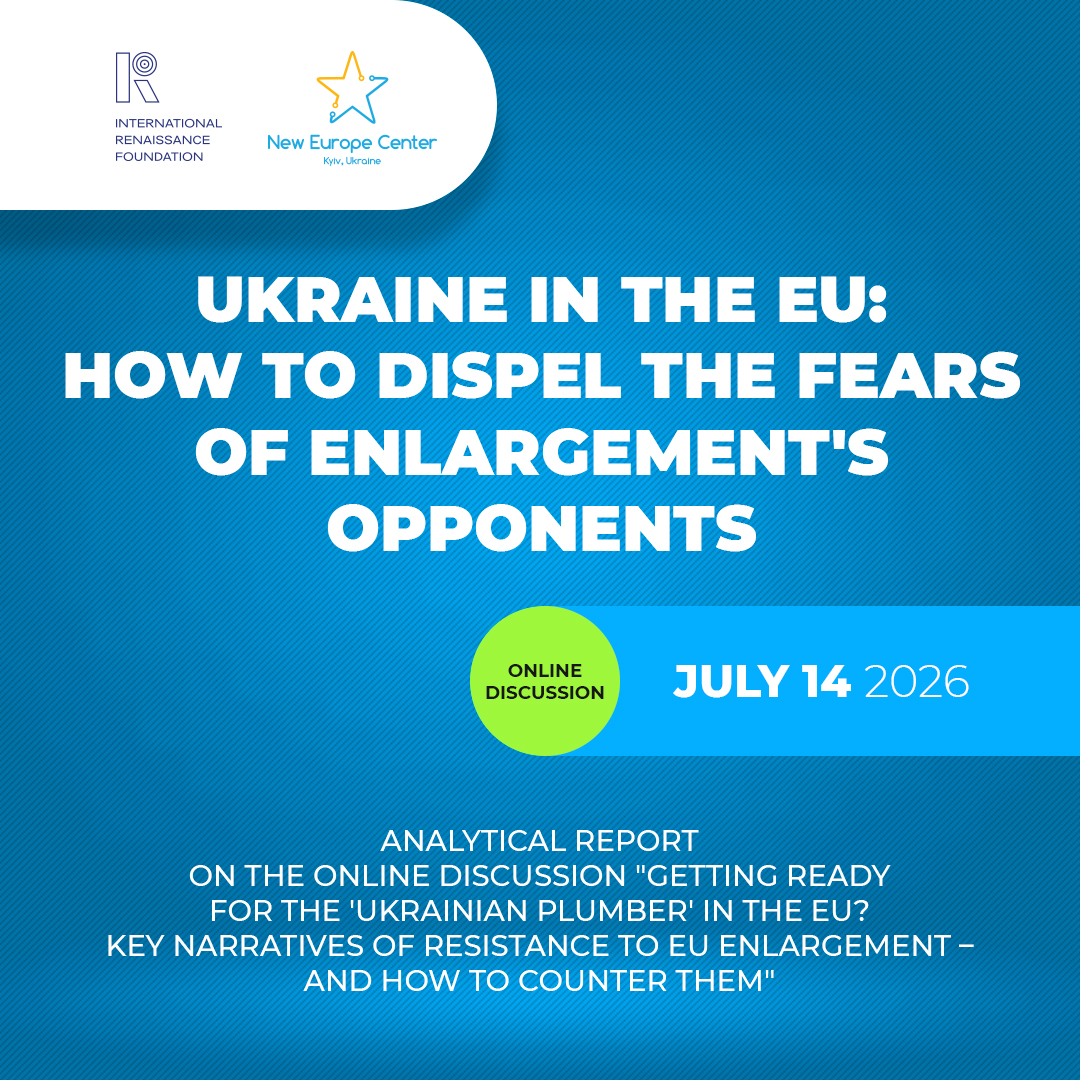
This analytical report, prepared following the New Europe Center’s discussion on July 14, 2026, shows that a significant part of this resistance rests not so much on realistic assessments of the consequences of Ukraine’s membership as on persistent myths about previous enlargements. Much like the image of the “Polish plumber,” which once embodied exaggerated French fears about an influx of cheap labour from Central European countries, new myths are taking shape today – this time around Ukraine. Countering them requires a broad set of approaches, and a communications campaign without evidence may not be enough. The success of our arguments will depend on the success of the reforms Ukraine is obliged to implement during the accession stage. What is needed are real results of reform, an open conversation about the difficulties of accession, the involvement of friendly stakeholders in EU member states in advocacy work, and a clear explanation that Ukraine is not only a candidate in need of support, but also a future source of security, economic opportunity, and strategic resilience for the EU.
Key Conclusions:
1. Resistance to enlargement stems more from misconceptions about previous enlargement waves than from Ukraine itself.
The public tends to notice what went wrong in past enlargements while overlooking their far greater benefits. Debunking these myths – and communicating the positive record of previous enlargements – is key to moving toward a more trust-based debate about Ukraine’s membership. Data from the European Commission on the 20 years since the 2004 enlargement bear this out:
- The EU economy grew by 27%, with the Polish and Maltese economies more than doubling in size and the Slovak economy growing by 80%.
- Of the 26 million new jobs created in the EU over 20 years, 6 million emerged in the ten new member states.
- Long-standing EU members benefited too: Spanish exports to the ten new countries doubled, while Italian trade in goods with them grew by 77%.
- Thanks to a larger single market, the EU’s global trade has grown by €3 trillion since 2004, reaching €5 trillion in 2023.
2. Ukraine adds a unique dimension to the enlargement debate – security.
Unlike any previous candidate, Ukraine can argue that the European Union becomes safer with it and significantly more vulnerable without it. This argument is reinforced by the battlefield experience and defence innovation that Ukraine has brought to Europe even before joining.
3. Ukraine’s security contribution is important, but it cannot be the only argument.
While the thesis that “the EU is safer with Ukraine” is strong and unique, overemphasising it creates the impression that Ukraine is joining on a “security in exchange for membership” logic. Ukraine must back this argument with a commitment to shared European values and consistent reforms, so that its membership is perceived as a matter of belonging to the community rather than merely an exchange of security services for accession. This addresses one of the key reservations held by partners within the EU.
4. The cost of non-enlargement must become a central theme of the discussion.
Postponing strategic decisions may ultimately prove more expensive than enlargement itself, as NATO’s 2008 hesitation over Ukraine demonstrated. Framing enlargement as a strategic necessity rather than a concession moves the debate onto more productive ground.
5. Elites in EU member states must explain shifts in their policy on enlargement to voters.
In countries such as France, the political leadership has grown more favourable toward Ukraine’s accession, but this change of position has not been explained to citizens or brought into public discussion. Because of this lack of open debate, public perception has remained almost unchanged for 20 years, while the enlargement course itself remains vulnerable to swings in electoral sentiment and populist narratives.
6. Fears must be addressed honestly rather than dismissed – including “positive fears”.
Alongside concerns about war and corruption, member states also fear that Ukraine could become too successful a competitor in defence and agriculture. Effective advocacy acknowledges the real impact of accession, links it to reforms such as the Common Agricultural Policy, and emphasises the transitional periods that soften it.
7. The success of enlargement depends not only on rational arguments but also on the emotional level.
Many fears about Ukraine are irrational and cannot be dispelled by facts alone. To convince Europeans to support Ukraine’s accession, appeals on the emotional level will be no less important than rational arguments. A significant instrument of Ukraine’s soft power here is Ukrainian migrants: in Germany, they can speak directly and authentically with society about the causes and consequences of the war and appeal more effectively to people’s emotions.
8. Communication must be tailored and honest about the EU’s own gaps.
Ukraine should show how it can complement the EU’s structural needs – labour shortages, food security, critical raw materials, defence capabilities – by becoming not a competitor but part of the solution to these problems. Ukrainian stakeholders should conduct this communication together with European partners, so that Ukrainian voices are not perceived as biased or emotional.
9. Countering Russian disinformation must become a distinct line of work.
Russia systematically spreads narratives against Ukraine’s accession in member states – in particular the claim that Ukraine’s membership would drag the EU into war. These narratives require a targeted response, and this is most effective when done together with European partners inside the member states themselves.
10. Successful international advocacy is impossible without real reforms at home.
The persuasiveness of external communication depends directly on how compelling the evidence of Ukraine’s commitment to its European course is. Without successfully doing the “homework” – the genuine implementation of reforms, above all in the area of the rule of law – no message at the international level will be convincing. It is reforms that remove the sceptics’ key argument about an “unreformed Ukraine” and form the foundation on which all advocacy for accession rests.
11. It is impossible to convince everyone on our own – the focus should be on local opinion leaders in EU countries.
Resources and efforts of Ukraine are limited, so they should be concentrated on those who can further spread the arguments in favour of Ukraine’s accession in their own countries. Ukrainian voices are trusted less than local opinion leaders, so arguments about the benefits of enlargement are more effectively conveyed through European partners, experts, and public figures who enjoy trust in their own societies.
In his opening remarks, Sergiy Solodkyy, Director of the New Europe Center, noted that last year’s Eurobarometer survey showed that, overall, 52% of citizens in EU member states support Ukraine’s accession to the European Union, yet this support is unevenly distributed – in at least ten countries fewer than half of the population supports Ukraine’s membership, with Germany and France in particular falling below the 50% threshold (47% and 48% respectively). He also pointed out that certain groups are less supportive of Ukraine’s accession – notably people over 55 and residents of rural areas. At the same time, many European countries are seeing growing support for parties and movements critical of future EU enlargement, with France and Germany raising particular concern. This is why the Center decided to hold a discussion on how Ukraine’s future EU membership is perceived in member states: what fears exist, how justified they are, and how they can be addressed and dispelled.
During the discussion, Leo Litra, Senior Fellow at the New Europe Center and Senior Policy Fellow at (European Council on Foreign Relations) ECFR, argued that much of the current resistance to EU enlargement stems from misconceptions about past accession waves rather than from Ukraine itself. He noted that these misinterpretations – often projected onto future members – fuel unfounded fears, pointing to agriculture as a telling example: despite widespread anxiety that Ukraine would flood the EU market, the country exports roughly half as much as Belgium, a state comparable in size to a single Ukrainian oblast. In his view, the wider public tends to notice what went wrong in previous enlargements while overlooking the far greater benefits they brought, both for individual member states and for the stability of the continent as a whole.
The expert stressed that Ukraine changes the very logic of this debate, adding a dimension no other candidate country brings to the table: “Ukraine has an extra argument that other countries don’t – a contribution to European security. With Ukraine, the European Union becomes safer; without Ukraine, it is significantly more vulnerable.” He also warned that Russian influence operations actively distort these narratives, feeding simplistic claims that Ukraine’s membership would drag the EU into war – arguments that resonate precisely because they offer the easy answers that pro-enlargement voices have struggled to counter.
At the same time, Leo Litra urged greater attention to the cost of non-enlargement, observing that postponing strategic decisions may ultimately prove more expensive than enlargement itself – as NATO’s 2008 hesitation over Ukraine demonstrated. He underscored, however, that Ukraine must back its security contribution with a genuine commitment to shared European values and the consistent continuation of reforms, so that its accession is understood as a matter of belonging rather than a purely transactional exchange. To sustain trust once a country is inside the Union, the analyst also suggested building reversibility mechanisms into the accession framework – safeguards applied equally to all members – so that enlargement is seen not as an irreversible leap of faith, but as a process that citizens on both sides can feel remains under control.
Susan Stewart, Senior Fellow at the German Institute for International and Security Affairs (SWP), explained that reservations about Ukraine’s EU accession in Germany extend well beyond the Ukrainian question and reflect a broader debate about the future of enlargement. In her view, public perception is shaped by a cluster of concerns – economic factors, the rule of law, migration and security – as well as by persistent Russian disinformation, which in the German context feeds lingering beliefs that relations with Russia must be preserved even at the expense of support for Ukraine.
The expert stressed the need to communicate the positive results of previous enlargement waves far more actively to citizens of member states: “We need to convey that previous enlargements brought not only challenges but, above all, significant benefits – not only for the countries that joined the EU, but for the European Union itself.” She argued that this larger enlargement debate cannot be reduced to Ukraine alone; each member state’s perception of past accessions must be addressed on its own terms if fears are to be dispelled.
Turning to specifically Ukrainian issues, Susan Stewart emphasized the importance of making Ukraine appear “integratable” – a partner that delivers tangible benefits rather than a source of risk. She welcomed the shift in German perceptions from viewing Ukraine as a security threat to seeing it as a security provider, and suggested that giving Ukraine a greater presence in EU institutions, even without a vote, would allow both sides to socialize, test ideas and build the trust needed for eventual membership.
Separately, Susan Stewart drew attention to the role of the Ukrainian diaspora as an important component of Ukraine’s soft power. In her view, in Germany Ukrainian migrants can speak directly with society about the causes and consequences of the war and appeal more effectively to people’s emotions, which is particularly important for a large part of the population. She stressed that in order to convince Europeans to support Ukraine’s EU accession, appeals on the emotional level will be no less important than rational arguments.
Benjamin Couteau, Research Fellow at the Jacques Delors Institute, drew attention to the fact that, although France’s political leadership has grown more favourable toward EU enlargement since 2022, this shift has yet to be reflected in public opinion. He characterised President Macron’s move – from asking whether the EU should enlarge to asking how and when – as a positive but essentially top-down signal, one that remains fragile and potentially volatile, especially with a presidential election approaching. “The shift we see at the political level in France is not reflected in the public debate and has not been properly explained. Because of this lack of open debate, attitudes toward EU enlargement have remained almost unchanged for 20 years,” he noted, pointing to the enduring legacy of the “Polish plumber” and the 2005 referendum as forces that still shape French perceptions of the Union.
The expert stressed that the public discussion should devote far more attention to Ukraine’s contribution to European sovereignty: “For France, the question of sovereignty is decisive. Ukraine can strengthen the EU through defence, technology and food security.” He argued that framing Ukraine as an asset for the continent’s collective sovereignty – its territorial defence against Russia, the innovation forged by its military, and its capacity to underpin European food security – resonates more deeply with French society than any other narrative, particularly at a time when the cost of supporting Ukraine’s fight far exceeds what its membership would require.
At the same time, Benjamin Couteau insisted that difficult questions surrounding agriculture and the economic consequences of enlargement must be addressed openly rather than dismissed. He acknowledged that Ukrainian agriculture will have a real impact, but suggested this could serve as a catalyst for a much-needed reform of the Common Agricultural Policy, and reminded the audience that every accession comes with transitional periods that soften the effect on existing members. He also warned that delaying enlargement carries a high strategic price for Europe itself, and cautioned against advocating shortcuts – the more EU citizens see Ukraine progressing through a genuine, effort-based process, the more they will believe in its readiness to join.
Marianna Fakhurdinova, Coordinator of the EU-Ukraine Partnership Program at the Transatlantic Dialogue Center, proposed distinguishing between different categories of concern associated with Ukraine’s accession. Beyond the familiar skepticism about the war or corruption – what she termed “negative fears” – she drew attention to what she called “positive fears”: “People who deal closely with EU enlargement and Ukraine also talk about so-called ‘positive fears.’ This is about competition, about Ukraine potentially becoming too much of a success story on the EU market.” She illustrated this with defence and agriculture, where the worry is not Ukraine’s weakness but its prospective strength, alongside a third, purely transactional set of concerns tied to budgets, cohesion funds and the temptation to use enlargement vetoes for domestic political ends.
The expert noted that many of these fears are irrational, under-communicated and readily exploited by populists, citing the EU-Canada trade agreement – opposed by farmers and still unratified in some member states despite its demonstrable benefits – as proof that facts alone rarely dispel anxiety. She also described a “vicious circle” in which politicians justify their caution by pointing to public concern, while the public draws its concerns from what politicians and the media tell them, leaving open the difficult question of where advocates of enlargement should intervene first.
Marianna Fakhurdinova added that Ukraine should communicate not only the benefits of its accession but also how it can help resolve the EU’s own internal structural problems – labour shortages, food security, critical raw materials and defence capabilities: “It is important not just to speak about the benefits of Ukraine’s EU accession, but also to speak honestly about the EU’s own gaps and about how Ukraine can complement them, becoming not a competitor but an integral part of its development.” She stressed that Ukraine has already reshaped the EU’s security thinking even before joining, and argued for tailored communication in each member state, delivered jointly with local advocates so that Ukrainian voices are not dismissed as biased or emotional.
The analysis presented by experts from the Transatlantic Dialogue Center illustrates these arguments with concrete data. Among the potential benefits of Ukraine’s accession:
- Labour force. By 2050, the EU’s working-age population (20–64) is projected to shrink by 57 million, while 58% of Ukrainians aged 30–34 hold a tertiary education – above the EU average (40%) – which would help ease acute workforce shortages.
- Food security. The EU produces only 3 million tonnes of soybeans against a demand of 35 million tonnes; Ukraine’s annual soybean output of over 6 million tonnes makes it a strategic partner in addressing this deficit.
- Critical raw materials. Ukraine holds deposits of 25 of the 34 minerals on the EU’s critical raw materials list and could become a reliable and proximate source of supply, reducing dependence on China.
- Defence. Since 2022, Ukraine’s arms output has grown 12-fold and its production capacity 50-fold; deeper integration of Ukraine’s defence industry would strengthen the strategic autonomy of the EU, which currently sources around 80% of its arms from outside the Union.
- Digital technologies. The Diia platform offers over 70 services to more than 23 million users and has propelled Ukraine to 1st place globally in the E-Participation Index, while Ukraine’s IT sector can strengthen the EU’s competitiveness vis-à-vis the U.S. and China.
This document was prepared with the support of the International Renaissance Foundation. The material reflects the position of the authors and does not necessarily coincide with the position of the International Renaissance Foundation.