Commissioned by the New Europe Center INFO SAPIENS conducted the study, in which the opinions of Ukrainians regarding security issues, in particular:
- In your opinion, is the United States doing everything possible to help Ukraine win?
- In your opinion, are European countries (the EU member states, the United Kingdom, Norway) doing everything possible to help Ukraine win?
- What do you consider the best “security guarantee” for Ukraine?
- Should Ukraine enter negotiations with Russia if Ukraine does not receive security guarantees from the West?
- Do you believe that in the event of a freezing of the frontline, Russia will attack Ukraine again after a short pause?
- Which compromises in peace negotiations with Russia do you consider acceptable?
- Will you participate in protest actions if Ukraine, during negotiations with Russia, makes compromises that, in your opinion, are unacceptable?
- What, for you personally, indicates or would indicate that European integration is being successfully implemented in Ukraine?
- Do you support Ukraine’s membership in the EU?
- Do you support Ukraine’s membership in NATO?
- In your opinion, how should Ukraine respond if Hungary continues to block the start of EU accession talks and Ukraine’s future accession to the EU?
- Let us imagine that the preparations for EU membership and the first years after accession may be accompanied by certain negative consequences (for example, higher prices for specific goods and services, or additional administrative procedures when accessing some public services). How would this affect your support for Ukraine’s membership in the EU?
- In order to join the EU, Ukraine must bring its legislation into line with EU law. How do you think this should be done?
- In your opinion, when will Ukraine become a member of the European Union?
- What comes to your mind when you hear EU and US representatives pointing to corruption in Ukraine?
- Ukraine and its partners are considering deploying a military contingent of partner states (the ‘Coalition of the Willing’) in Ukraine. Details are still being finalised. How much do you generally support or oppose such a decision?
- What is closer to your opinion?
- Please assess the level of trust to each of these international organizations / associations
- Which foreign leaders do you trust the most?
- Which foreign leaders do you distrust the most?
Read the results of the survey via the following link.
SUMMARY
Europe is the favorite in terms of Ukrainian sympathies and trust. The strategic orientation of Ukrainian society is clear: the absolute majority of citizens support Ukraine’s membership in the EU and NATO. Ukrainians want to join the European Union so strongly that most are ready to withstand the possible negative consequences of preparing for EU membership – rising prices, additional regulations. Respondents demonstrate a rather targeted and nuanced view of international support. Among the leaders of public trust are the heads of Western European, Scandinavian, and Baltic states. Notably, this includes not only the leaders of EU member states but also those of other European countries that play an important role in the continent’s security initiatives. Respondents expressed particular respect for the leaders of the Coalition of the Willing – the United Kingdom, Germany, and France. For Ukrainians, it is extremely important to see Ukraine reformed, regardless of obstacles. In their view, Hungary’s blocking cannot be an excuse for slowing down European integration reforms. Successful European integration is associated above all with an effective fight against corruption and the rule of law. At the same time, Ukrainians do not perceive the EU as a reliable security guarantor. Society continues to prefer sovereign, autonomous approaches to guaranteeing its own security. Accordingly, among the proposed guarantees, respondents prioritized the development of nuclear weapons. At the same time, Ukrainians remain steadfast in the conviction that negotiations with the Russians without security guarantees are not a reliable path to peace. Every second Ukrainian is ready to join protests if Ukraine agrees to unacceptable compromises. Among the most unacceptable concessions are: reducing Ukraine’s army, legally recognizing the occupied territories as Russian, and granting the Russian language official status.
KEY FINDINGS
Europe is ahead
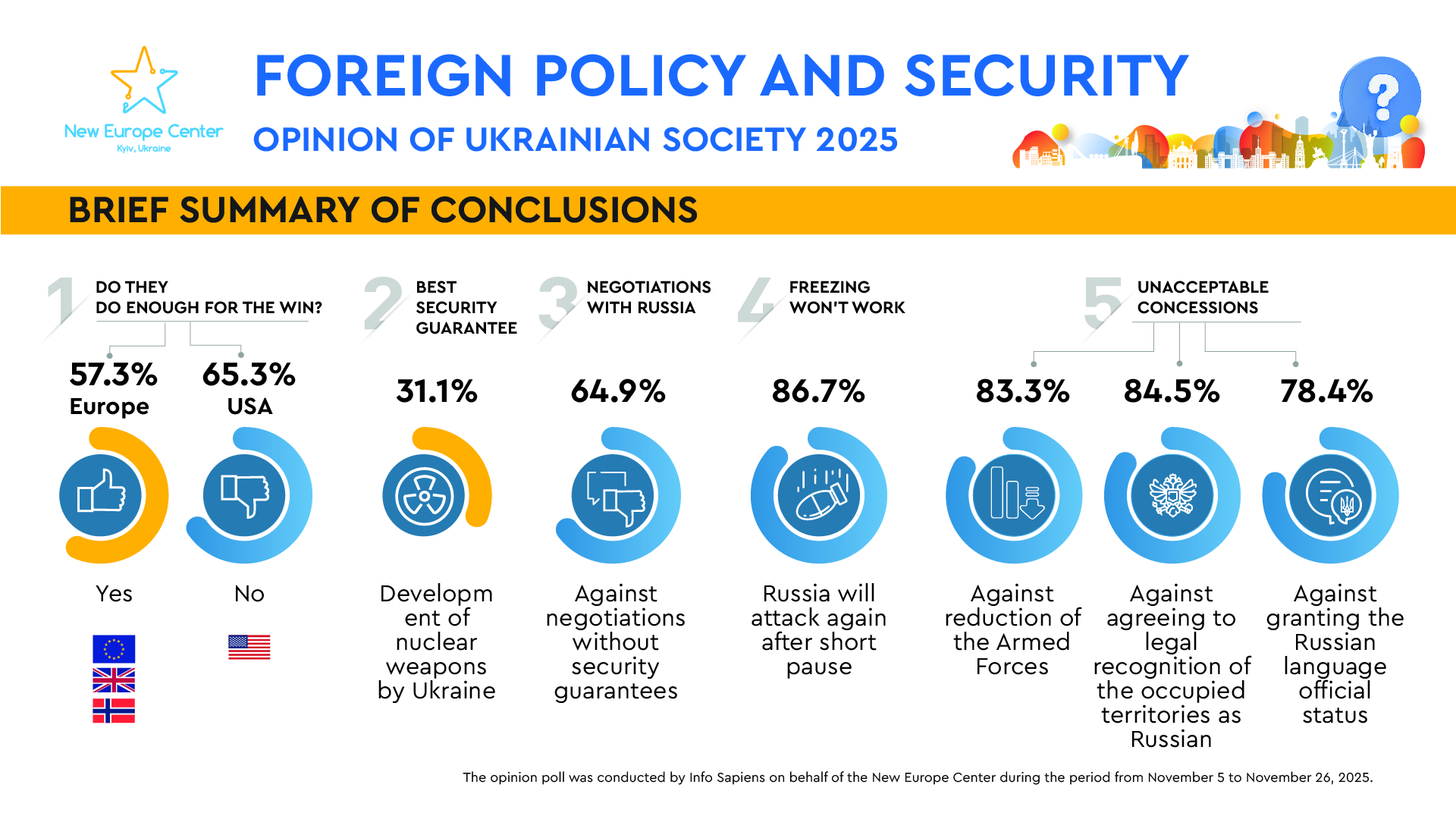
The results of the opinion poll show a rather critical attitude of Ukrainians toward the support of the United States: 65.3% of Ukrainians believe that the U.S. is not doing enough for Ukraine’s victory. In contrast, the contribution of European countries (EU member states, the United Kingdom, Norway) is assessed positively: 57.3% of respondents consider European efforts sufficient. These indicators reflect the main trends in the perception of international support from key partners. With Donald Trump’s arrival to power, disappointment in the dynamics of U.S. assistance has deepened, especially against the backdrop of delays in military aid packages, the shift to commercial terms for the supply of critically needed weaponry, as well as contradictory political statements from Washington. Europe stands out noticeably against the background of the United States, but there is an important nuance here: almost 40% of Ukrainians consider the efforts of European partners insufficient.
“Nuclear” guarantee
Ukrainians continue to consider Ukraine’s development of its own nuclear weapons the best security guarantee – 31.1%, which practically coincides with last year’s indicator (31.3%). This indicates, on the one hand, Ukrainians’ disappointment in international support, in external security guarantees, and on the other hand reflects the understanding that it was precisely nuclear weapons that allowed Russia to play on the fears of the West, and this, in turn, affected the slow, hesitant military assistance to Ukraine.
This same trend of disappointment in external guarantees is reflected in the decline in support for Ukraine’s accession to NATO as one of the security guarantees – by 10% (from 29.3% to 19.4%). Despite this, the support for NATO is still high (more on this below). Other possible options for guaranteeing security have moderate or low support. 10.2% of respondents believe in the effectiveness of a defence alliance with the United States, 6.4% rely on a UN peacekeeping mission.
A notable trend is the increase in support for the option of deploying European countries’ troops on the territory of Ukraine – the indicator has almost doubled: from 6.4% to 11.7%. A new option – the provision of nuclear protection guarantees by another country – is supported by only 7.8% of respondents.
A noticeable general trend remains the desire for self-sufficient and maximally reliable security mechanisms: in the Ukrainian hierarchy of guarantees, the priority remains Ukraine’s own Armed Forces, and only then – the capabilities of partners. It is important to mention that respondents could only select one answer to this question.
Negotiations without guarantees – a bad idea
Ukrainian society remains unwavering in its conviction that negotiations without security guarantees are not a reliable path to peace, and that without external safeguards, any compromise will only postpone a new aggression by Russia.
The position of Ukrainians regarding negotiations with Russia remains stable: almost two-thirds of respondents (64.9%) believe that Ukraine should not enter negotiations if it does not receive security guarantees from the West. This indicator has practically not changed compared to 2024 (64.1%). Almost a third of respondents (30.7%) view negotiations positively even without security guarantees. Overall, as we can see, sceptical attitudes toward “negotiations for the sake of negotiations” continue to prevail among Ukrainians.
Freezing the frontline will not stop Russia from attacking
Ukrainian society expresses a unanimous forecast regarding Russia’s behavior in the event of a possible freezing of the frontline: 86.7% of respondents believe that after a short pause, Russia will attack Ukraine again. Only 9.5% of respondents assume that freezing could secure a longer peace. The “freeze” scenario is not perceived by society as a realistic path to lasting peace.

Unacceptable concessions
Most Ukrainians reject key political and security compromises that Russia traditionally tries to impose as conditions for negotiations. Although Ukrainians’ positions regarding certain issues have somewhat softened in recent years, the overall logic of public sentiment remains unchanged. Record indicators regarding the inadmissibility of compromises concern the following issues: reduction of Ukraine’s army (83.3%), legal recognition of the occupied territories as Russian (84.5%), granting the Russian language official status (78.4%).
The EU through the lens of peacetime
Domestic transformations are more important for Ukrainians than security issues in the context of European integration. Ukrainian society continues to perceive the EU through the lens of peacetime. The main indicators of successful European integration for respondents are predominantly non-military in nature. The top three indicators are: the fight against corruption as the key criterion of successful progress toward the EU (for 19.2% of respondents), followed by improvements in the standard of living (12%), and the rule of law (8.4%). In contrast, indicators related to the security and defence sphere amount to only 14.7% in total: 6.8% consider the end of the war a sign of successful integration, 6% see military or financial assistance in the fight against the enemy as an indicator of success, 1% consider NATO membership as an indicator of successful integration, and only 0.9% of Ukrainians identify security guarantees as an element of successful integration. Thus, we can speak of an absolute majority of citizens who associate successful movement toward the EU with internal, non-military modernisation. At the same time, Ukrainians themselves often complain that the EU is too slow and indecisive in its approaches to supporting Ukraine in its fight against Russia. Against the backdrop of the declining role of the United States in assisting Ukraine, there has been no radical shift in perceptions of the EU: Europe’s normative power, rooted in peacetime values, continues to shape a positive image of the EU among Ukrainians. Meanwhile, the EU itself is actively searching for approaches that would strengthen its defence capabilities. Ukraine’s experience is seen as a key driver for Europe’s new transformational efforts in the field of security and defence. For now, Ukrainians still seem to have a limited perception of the EU as a security guarantor.
The EU and NATO as the unwavering choice of the majority of Ukrainians
Support for Ukraine’s membership in the EU and NATO has remained record-high for the fourth year in a row. 85.5% of Ukrainians favour EU accession, and 71.3% support joining NATO. These figures demonstrate stable public backing for Ukraine’s European and Euro-Atlantic course.
Ukrainians are ready for the challenges of EU integration
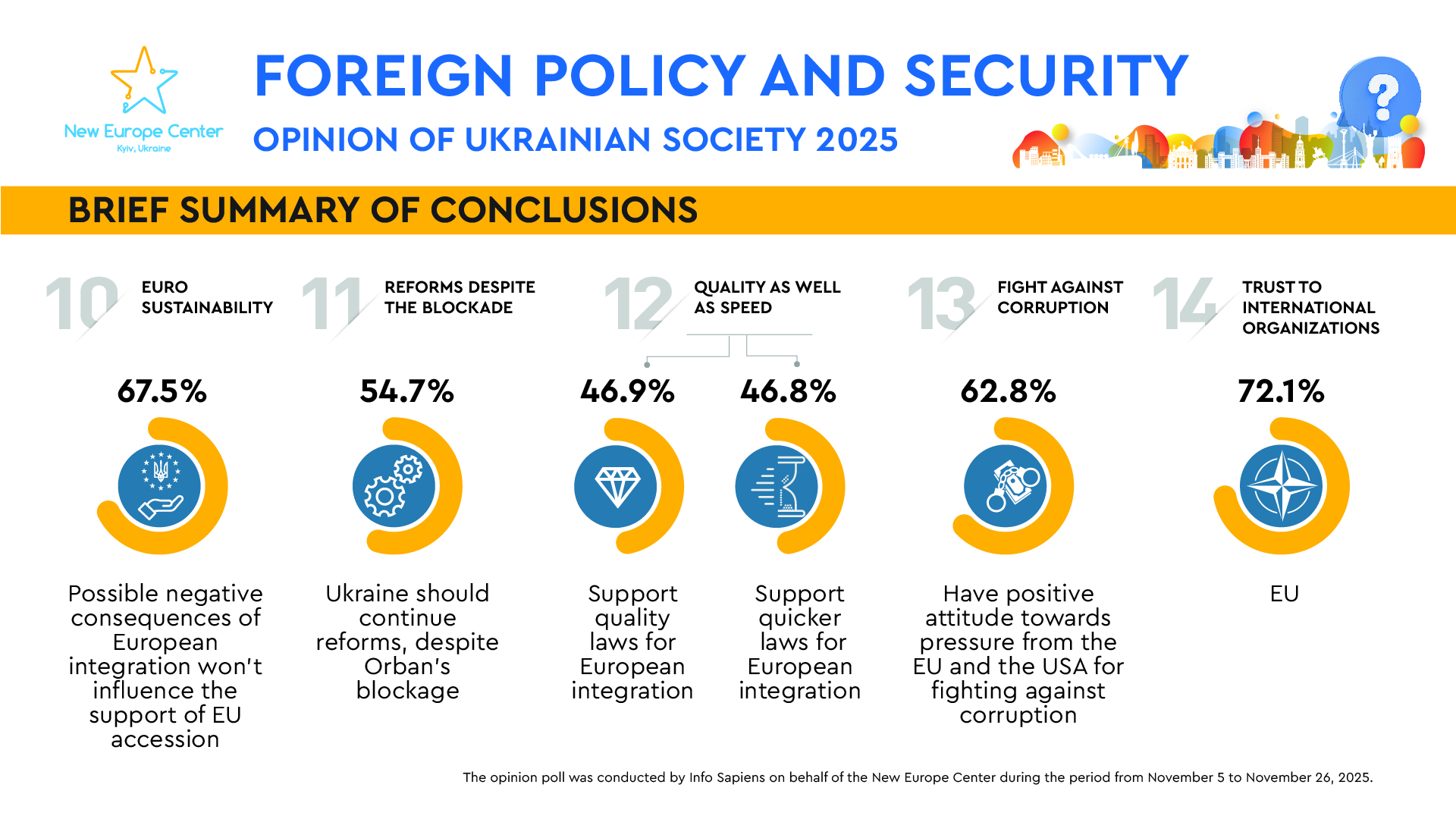
67.5% of Ukrainians believe that the possible negative consequences of preparing for EU membership – rising prices, additional regulations – will not affect their support for joining the European Union. Only 20.3% expect that their attitude may change. These data indicate that the overwhelming majority of Ukrainians are prepared to accept potential difficulties as a natural part of the integration path. EU diplomats sometimes caution that the record-high support for European integration in Ukraine may be temporary: the experience of previous enlargements shows that in many candidate countries, the level of public support for integration temporarily declined at the stage of implementing reforms. It cannot be ruled out that similar dynamics may occur in Ukraine. However, it is worth remembering that Ukrainian society has repeatedly demonstrated its ability to withstand far more difficult challenges.
Every second Ukrainian will protest
51.4% of respondents answered that they would participate in protest actions if Ukraine, during negotiations, makes compromises that respondents consider unacceptable.
Reforms separately, Orban separately
The majority of respondents (54.7%) believe that Ukraine should continue its reforms and progress toward the EU, regardless of Hungary’s actions. This indicates a stable societal commitment to fulfilling Ukraine’s own obligations and a reluctance to allow individual EU members to influence the pace of internal transformations. At the same time, Ukrainians show almost equal support for seeking compromises with Hungary (31%) and for maintaining pressure on Budapest through the EU and other partners (35%). The relatively low level of support for a policy of pressure toward Hungary does not mean that Ukrainians fail to recognise the hostile nature of the current policy of the Hungarian leadership. The level of public distrust toward Viktor Orban is approximately the same as towards Vladimir Putin and Alexander Lukashenko.
Quality versus speed: the search for balance
When it comes to Ukraine’s European integration, the “turbo-mode” is not an unequivocal priority for Ukrainians. The results of the opinion poll show that Ukrainians value high-quality legislative preparation (46.9%) just as much as the speed of reforms (46.8%). For Ukrainian officials, this means the need to maintain a strategic balance: on the one hand, doing everything possible to meet the public demand for high-quality and well-grounded reforms, and on the other hand, sustaining a high pace of these changes, particularly in the adoption and implementation of updated legislation.
Between fighting corruption and providing weapons
Most Ukrainians view pressure from the EU and the United States aimed at combating corruption in Ukraine positively. This indicator began to decline last year – and the trend has continued in 2025. In 2023, the share of supporters of a strict approach from partners stood at 70.4%; it now amounts to 62.8%. At the same time, the proportion of those who expect military assistance from partners above all else is increasing. The number of respondents who react with irritation to anti-corruption statements from the EU and the U.S. is also growing each year: the option “They have no right to teach us; we will handle our own affairs” has risen from 6.5% to 9.5%.
The Coalition of the Willing contingent: supported by the majority
The results of the opinion poll show a high level of support for the idea of deploying in Ukraine a military contingent of partner states within the framework of the Coalition of the Willing. In total, 72.7% of respondents expressed support for such a decision, while only 23.9% were opposed. This may serve as an additional argument in favour of advancing the idea of sending multinational deterrence forces, primarily from the most reliable partners – France and the United Kingdom. Public legitimacy is important to prevent potential manipulation on this issue. For citizens, both the security component and the political symbolism are clearly significant. The presence of a foreign European contingent may be perceived as a signal of the seriousness of partners’ intentions to support Ukraine. In this context, it is telling that 50.7% of Ukrainians believe that even the deployment of a contingent without a mandate to participate in combat operations CARRIES political significance and can be seen as part of security guarantees. The main argument of critics of deploying such a contingent was that troops without authorization to take part in combat would be unable to influence Russia’s aggressive actions.
The EU as the trust leader among international institutions
Among international organisations, Ukrainians trust the EU the most (72.1%), followed by the G7 (67.5%) and NATO (53.7%). At the same time, we observe a decline in trust toward NATO (last year it was 64.4%). Such a decline does not, of course, mean that Ukrainians have changed their view of the importance of NATO membership – more than 70% of respondents support the country’s accession to the Alliance. Ukrainians would like to see NATO act more decisively, yet they do not doubt that the Alliance remains the most effective organisation providing collective security. Other important trends: more than half of Ukrainians (53.7%) trust the Coalition of the Willing. Meanwhile, international organisations responsible for supporting global security and maintaining peace are seen as completely discredited in the eyes of Ukrainians: the UN enjoys 35.6% trust, and the OSCE – 41.1%. In both cases, distrust exceeds 50%, demonstrating deep disappointment in their effectiveness against the backdrop of Russian aggression.

Trust rating of world leaders: the UK Prime Minister ranks first, while the presidents of the United States and Poland hit a record low
Leader of trust among Ukrainians in 2025 – Prime Minister of the United Kingdom Keir Starmer (76.1%). The level of public trust is also above seventy percent for the following heads of state and government: President of Latvia Edgars Rinkēvičs (73.5%), President of France Emmanuel Macron (73.4%), Prime Minister of Sweden Ulf Kristersson (73%), President of Lithuania Gitanas Nausėda (72.8%), Federal Chancellor of Germany Friedrich Merz (72.7%), President of Finland Alexander Stubb (72.7%), President of the European Commission Ursula von der Leyen (72.4%), and Prime Minister of Canada Mark Carney (71.8%). However, taking the margin of error into account, the circle of public-trust champions also includes Prime Minister of Norway Jonas Gahr Store (69.9%), President of Estonia Alar Karis (69%), Prime Minister of the Netherlands Dick Schoof (68.2%), and Prime Minister of Italy Giorgia Meloni (67.9%). It is worth noting that the head of the German government demonstrated the greatest increase compared with last year — trust grew by 35.8 percentage points. A high rate of growth in trust is also visible for the head of the British government (up by 24.1%) and the President of France (up by 15%).
In contrast, the greatest decline in trust occurred among the leaders of the countries that topped our ranking in previous years. Trust in the President of Poland fell by 20.6% (stands at 44%), and trust in the President of the United States dropped by 20.2% (stands at 24.4%). At the very bottom of the ranking are the leaders of Hungary, the People’s Republic of China, Belarus, and the Russian Federation.