Reformation of Ukraine is a cornerstone of the European integration process and one of the key factors that defines the speed of Ukraine’s accession towards the European Union. Considering this, leading think tanks and civil society organizations that have expertise in European integration, anti-corruption reforms and the rule of law decided to carry out independent monitoring of Ukraine’s implementation of reforms related to its European integration commitments (a full list of organisations is provided below).
The goal of this expert monitoring is to to support Ukraine’s successful progress towards European Union membership through an independent assessment of the implementation of key reforms. Timely and efficient fulfilling of these commitments will demonstrate Ukraine’s ability to implement systemic changes. An independent positive assessment will help to dispel existing concerns among EU politicians, experts and citizens more convincingly, proving that Ukraine is implementing the necessary reforms on its path to the European Union, particularly in the areas of the rule of law and the fight against corruption. At the same time, we are convinced that European integration reforms are needed first and foremost by the Ukrainian people themselves.
At the current stage, the expert coalition based its research on the 10 key reform priorities set out in the Joint Statement between Marta Kos, European Commissioner for Enlargement, and Taras Kachka, Deputy Prime Minister for European and Euro-Atlantic Integration of Ukraine, on 11 December 2025 (further referred to as the “Kachka–Kos plan”). More about methodology below.
At the same time, the expert coalition leaves the possibility of expanding the monitoring via other topics and benchmarks, in case they become critical for the European integration process of Ukraine, as well as declares its intention to continue monitoring other documents setting out reforms in this area – once Ukraine has implemented the “Kachka–Kos plan” or even before the completion of its implementation..
The first assessment aimed at capturing a baseline for implementation of reform, in particular before the start of “Kachka-Kos plan” realization. The following monitoring will allow to track the dynamic of the reforms. Follow-up assessments are set to be published approximately once in two months.
This initiative is based on the former experience of independent monitoring of European integration reforms. In June 2022 Ukraine received the candidate country status, together with 7 recommendations from the European Commission, which were necessary for further progress towards membership. As a response, New Europe Center, together with the coalition of leading think tanks and civil society organizations initiated “Candidate Check” – independent expert monitoring of recommendations’ implementation. The initiative proved itself as a useful tool for public oversight of the fulfilment of European integration commitments. The current monitoring exercise continues this tradition: the key organisations involved in ‘Candidate Check’ are also participating in the new ‘Membership Check’ assessment phase.
EXTENDED EXPERT ASSESSMENT
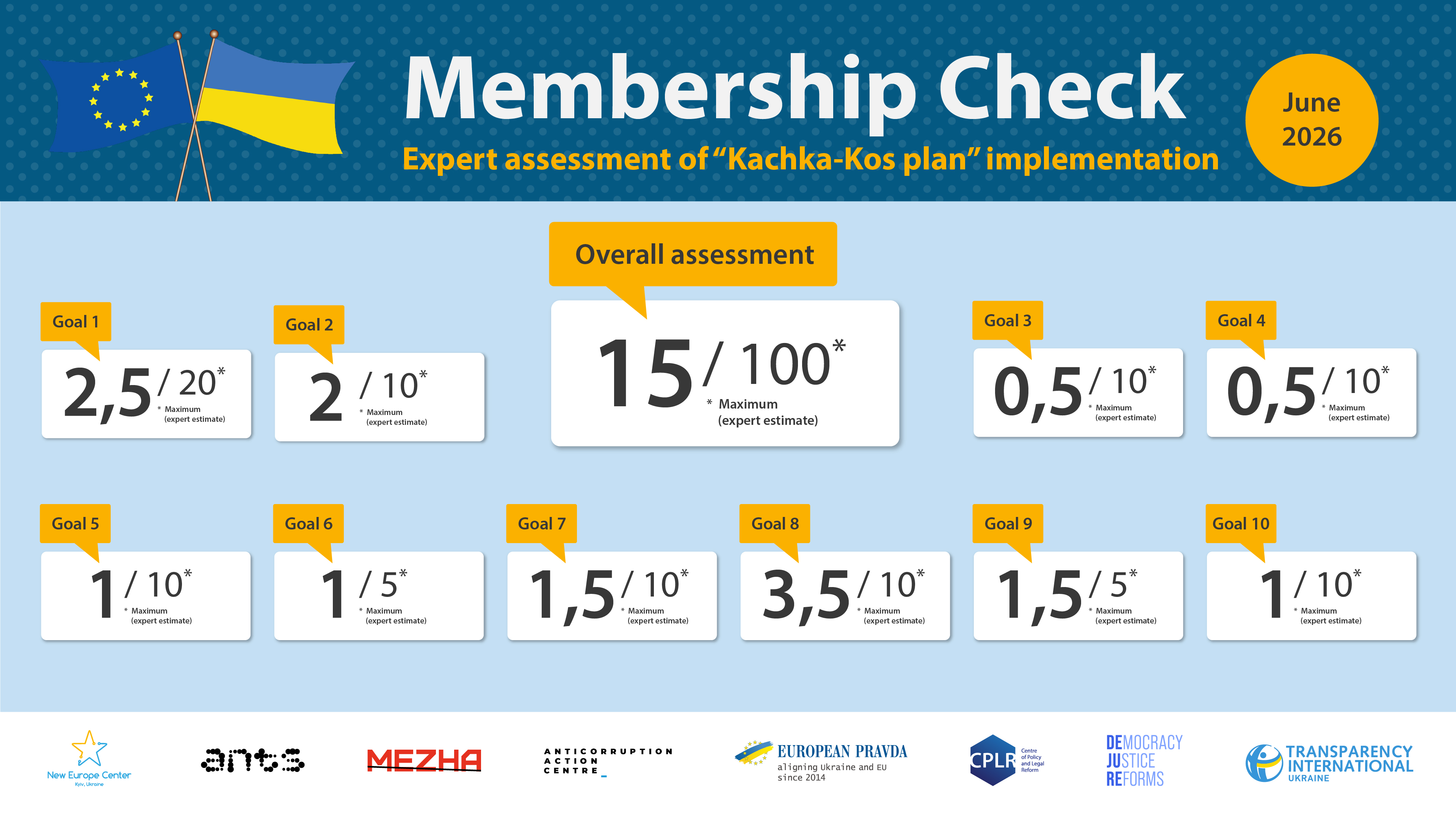
Overall assessment – 15 out of 100
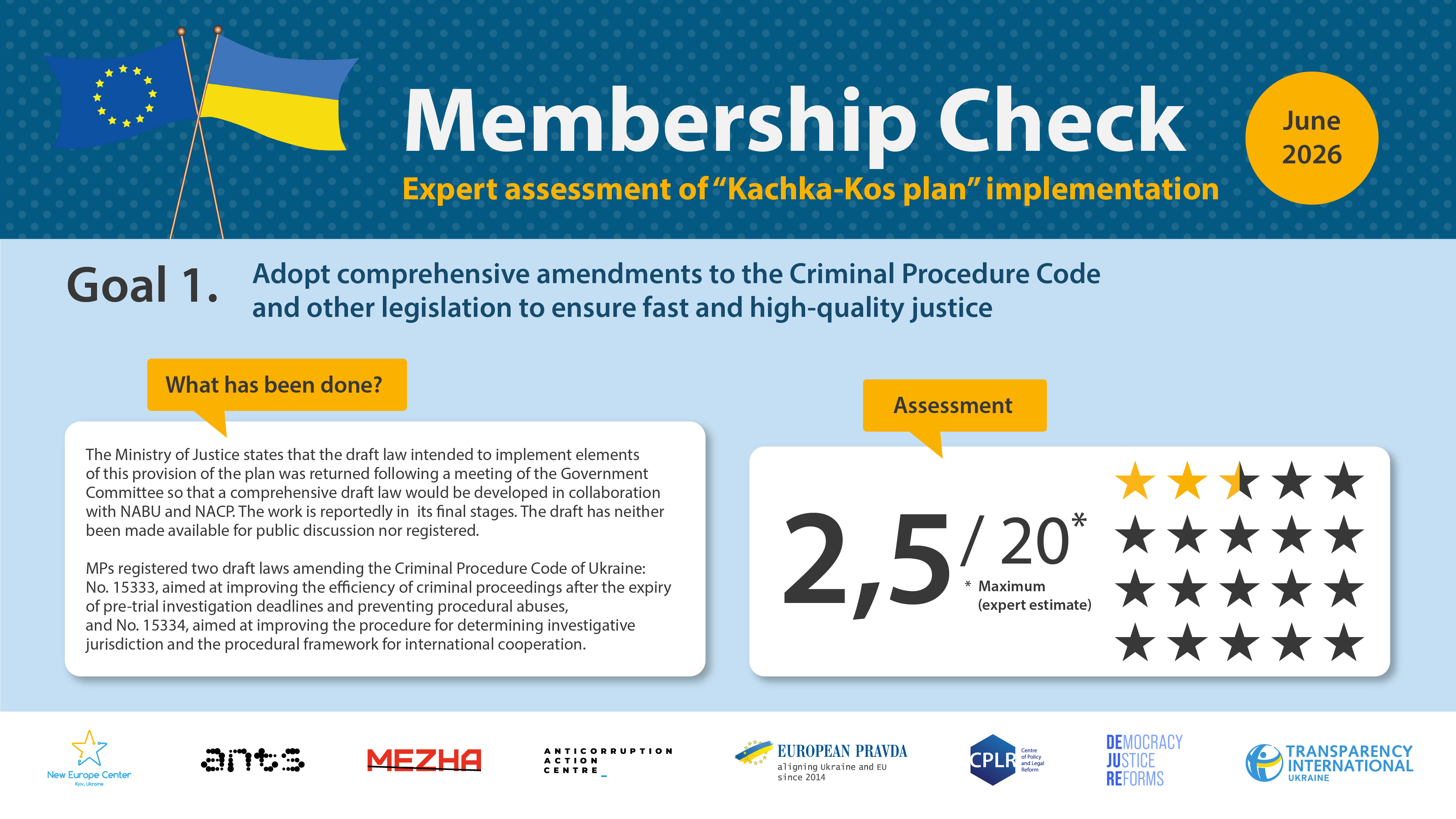
1.Adopt comprehensive amendments to the Criminal Procedure Code and other legislation to ensure fast and high-quality justice
Assessment – 2,5 out of 20
What should be done? Interim benchmarks, success indicators.
In line with the interim benchmarks, Ukraine is expected to achieve the following results:
IBM[1] 23.6 – Institutional capacity
Enhanced independence, mandate effectiveness and operational capacity of the specialised anti-corruption institutions (for both the prevention and repression of corruption), including by extending the jurisdiction of the National Anti-Corruption Bureau of Ukraine (NABU) to cover all high-risk public positions and by granting the Specialised Anti-Corruption Prosecutor’s Office (SAPO) the necessary powers to start criminal proceedings against Members of Parliament without prior approval of the Prosecutor General.
IBM 23.6.1 Enhance the independence, mandate effectiveness and operational capacity of the specialised anti-corruption institutions.
IBM 23.6.2 Extend the jurisdiction of the National Anti-Corruption Bureau of Ukraine (NABU) to cover all high-risk public positions.
IBM 23.6.3 Grant the Specialised Anti-Corruption Prosecutor’s Office (SAPO) the necessary powers to start criminal proceedings against Members of the Verkhovna Rada without prior approval of the Prosecutor General.
IBM 23.8 – Track record against corruption
Made tangible progress towards a solid track record of investigations, prosecutions and convictions in corruption cases, in particular final convictions at high level and increased the number and overall value of seized, frozen and confiscated assets, including by removing from legislation the provision on automatic closure of criminal cases due to expiry of pre-trial investigation time limits and by reviewing existing time limits.
IBM 23.8.3 Remove from the legislation the provision on automatic closure of criminal cases due to expiry of pre-trial investigation time limits after the notification of suspicion and review existing time limits.
Expert indicator: Adoption of a draft law introducing amendments to the Criminal Procedure Code.
What has been done?
To address the issues outlined above, the Government is currently considering several draft laws that partially overlap—one drafted by the Ministry of Justice and another by NABU.
By the instruction from the Prime Minister of Ukraine, a draft law was developed “On Amendments to the Criminal Code of Ukraine and the Criminal Procedure Code of Ukraine to strengthen the institutional capacity of the National Anti-Corruption Bureau of Ukraine (NABU) and the Specialised Anti-Corruption Prosecutor’s Office (SAPO), and to remove procedural obstacles to the effective pre-trial investigation of criminal offences.”
The provisions of the draft law are aimed, in particular, at expanding the scope of subjects under NABU’s jurisdiction by introducing relevant amendments to Article 216 of the Criminal Procedure Code of Ukraine, as well as at legislatively establishing the powers of the Deputy Prosecutor General — Head of the Specialised Anti-Corruption Prosecutor’s Office to form joint investigative teams, send extradition requests in NABU cases, and take over criminal proceedings in compliance with the requirements of Ukraine’s international treaties, the provisions of current legislation, and the principle of SAPO’s independence in procedural decision-making (amendments to Articles 571, 574, and 575 of the Criminal Procedure Code of Ukraine).
At the same time, the draft law is not publicly available, and some of the key amendments outlined in the benchmarks were not addressed at all.
In parallel, NABU developed its own draft law to introduce the necessary amendments to strengthen its capacity, in particular, excluding the automatic closure of criminal proceedings upon the expiry of pre-trial investigation time limits after notification of suspicion, expanding NABU’s jurisdiction, resolving disputes over investigative jurisdiction, etc. In April 2026, this bill was sent to the relevant agencies for approval. According to information provided by NABU in response to a request from MEZHA, procedures to resolve the discrepancies are currently underway, in particular taking into account the findings of the anti-corruption review conducted by the National Agency on Corruption Prevention (NACP). The review identified a number of corruption-prone factors, as a result of which the bill was sent back for revision.
As a result, the Ministry of Justice reported that on April 15, 2026, their draft law was returned following a meeting of the Government Committee on European and Euro-Atlantic Integration, International Cooperation, Law Enforcement, Legal Policy, and Water Management Development, held on April 8, 2026, for the purpose of developing a comprehensive draft law in collaboration with the NABU and NACP.
Certain benchmarks under this provision were included in draft laws №15230 and №15230-2 “On the Principles of State Anti-Corruption Policy for 2026–2030.” The draft laws are currently awaiting consideration by the relevant committee.
On June 16, 2026, a number of Members of Parliament, including Anastasia Radina and Yaroslav Zhelezniak, registered draft laws No. 15333 on amendments to the Criminal Procedure Code of Ukraine to improve the effectiveness of criminal proceedings following the expiry of pre-trial investigation deadlines and to prevent abuse of procedural rights by participants in criminal proceedings and No. 15334 on amendments to the Criminal Procedure Code of Ukraine to improve the procedure for determining investigative jurisdiction and the procedural framework for international cooperation.
A more detailed analysis is available in AntAC’s brief.
Responsible for analysis: Anti-Corruption Action Center (AntAC), Anti-Corruption Center MEZHA and Transparency International Ukraine.
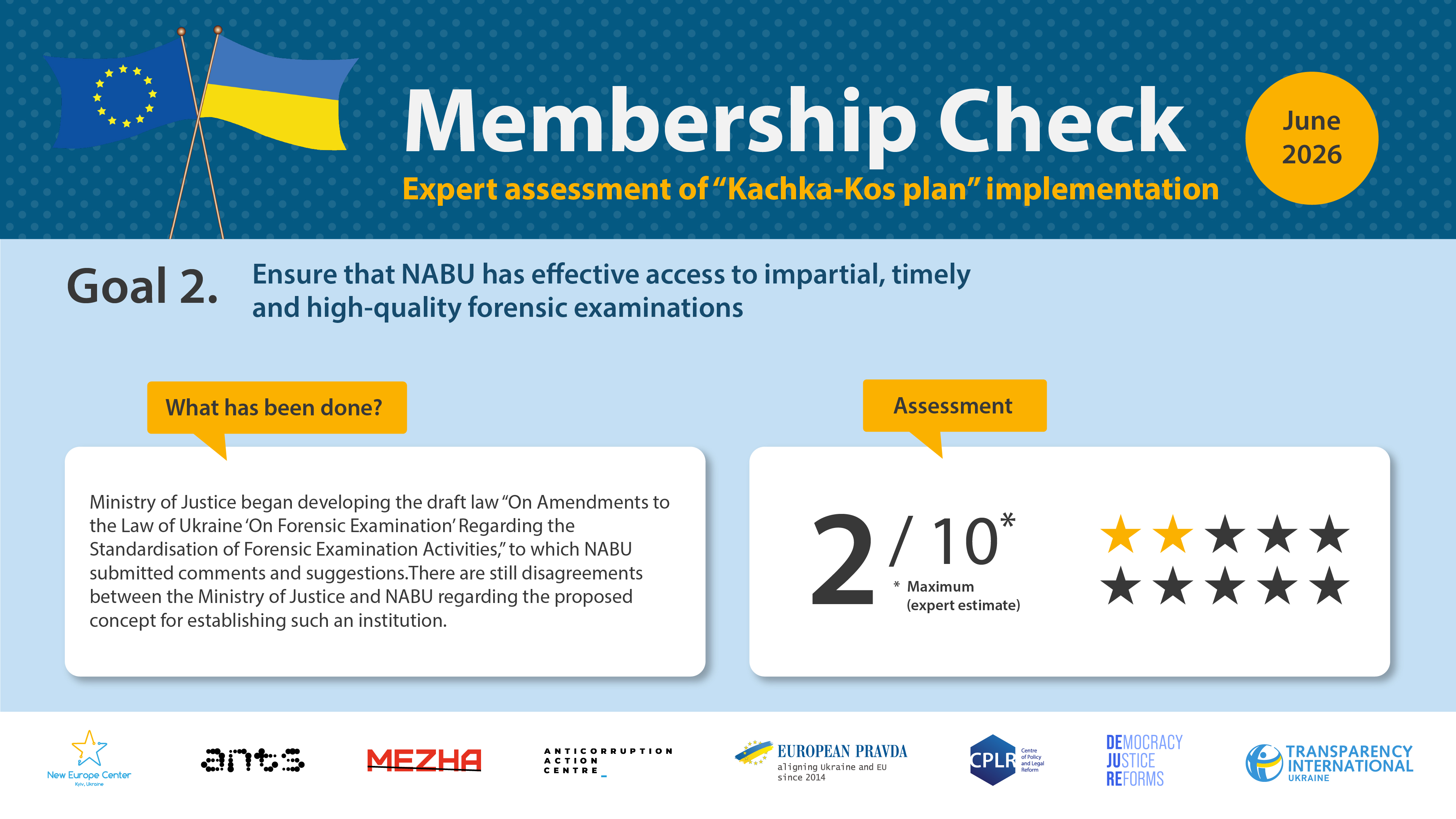
2. Ensure that NABU has effective access to impartial, timely and high-quality forensic examinations
Assessment – 2 out of 10
What should be done? Interim benchmarks, success indicators.
In line with the interim benchmarks, Ukraine is expected to achieve the following results:
IBM 23.6 – Institutional capacity
Enhanced the independence, mandate effectiveness and operational capacity of the specialised anti-corruption institutions (for both the prevention and repression of corruption), including by extending the jurisdiction of the National Anti-Corruption Bureau of Ukraine (NABU) to cover all high-risk public positions and by granting the Specialised Anti-Corruption Prosecutor’s Office (SAPO) the necessary powers to start criminal proceedings against Members of Parliament without prior approval of the Prosecutor General.
Expert indicator: Adoption of a draft law introducing amendments to the Law of Ukraine “On Forensic Examination,” as well as secondary legislation, with the aim of establishing a new independent expert institution with a competitive selection of its head, defining safeguards for the head’s independence from politically motivated dismissal, and ensuring the competitive selection of forensic experts.
What has been done?
In 2024, under the Resolution of the Cabinet of Ministers of Ukraine №798-р dated September 8, 2023, “On the Establishment of the Research Centre for Independent Forensic Examinations,” the Research Centre for Independent Forensic Examinations (hereinafter — the Centre) was established as part of Ukraine’s commitments to the IMF to ensure NABU’s access to independent and competent forensic experts. Such a Centre was intended to enable NABU to exercise its investigative powers effectively. In the process of establishing the Centre, safeguards for its independence were to be introduced, including a supervisory board composed primarily of representatives from international organisations, the appointment of the Centre’s head by the supervisory board, and so on. As of June 12, 2026, the Ministry of Justice has not implemented the previously announced guarantees of the center’s independence.
The issue becomes deeper partially because of the fact that the Ministry of Justice and NABU still have not reached a common position. NABU emphasises the need for the institutional independence of such an expert body, specifically its establishment directly under the Cabinet of Ministers, without subordination to any specific ministry, as well as the introduction of an independent, competitive selection process for the head of the institution. This requires amendments to the Law of Ukraine “On Forensic Examination.” Thus, NABU’s position is that this Center can be used only as a technical facility, while the expert institution itself must be separate from the Ministry of Justice and have the necessary guarantees of independence.
Nevertheless, some progress has been made—the Ministry of Justice has begun drafting a bill titled “On Amendments to the Law of Ukraine ‘On Forensic Examination’ Regarding the Unification of Forensic Activities.” In response to a request from MEZHA on June 4, 2026, the National Anti-Corruption Bureau of Ukraine (NABU) reported that in March 2026, comments and proposals regarding the aforementioned draft law were submitted to the Ministry of Justice, and during April–May 2026, several working meetings were held to discuss the conceptual foundations for the creation and operation of an independent expert institution. At the same time, there remain disagreements regarding the proposed concept for establishing such an institution.
Responsible for analysis: Anti-Corruption Action Center (AntAC), Anti-Corruption Center MEZHA and Transparency International Ukraine.
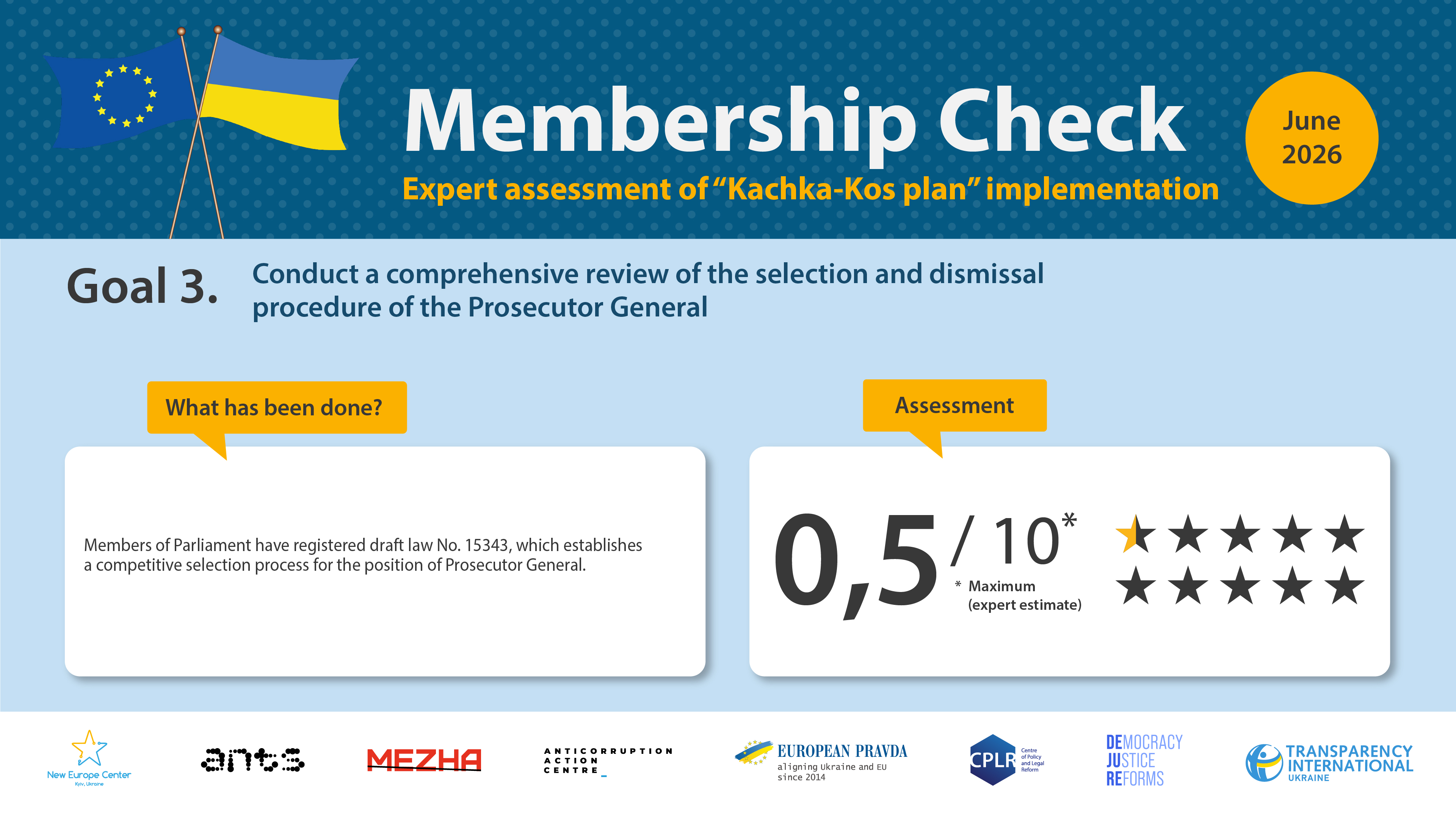
3. Conduct a comprehensive review of the selection and dismissal procedure of the Prosecutor General
Assessment – 0,5 out of 10
What should be done? Interim benchmarks, success indicators.
In line with the interim benchmarks, Ukraine is expected to achieve the following results:
IBM 23.2 – Independence, Accountability and Integrity
Further enhanced structural independence, integrity and accountability sustained at all levels of the judiciary, notably through improving merit-based selection processes; […] rendering the selection and dismissal procedure for the Prosecutor General and high-level prosecutors more transparent and merit-based.
IBM 23.2.1 Improved merit-based selection processes.
IBM 23.2.3 Enhanced structural independence, integrity and accountability of the Prosecution Service
Expert indicator: Adoption of a draft law introducing amendments to the Law of Ukraine “On the Prosecutor’s Office” and other legislation, providing for greater transparency and objectivity in the procedure for selecting the Prosecutor General, including the significant involvement of independent experts nominated by international partners, as well as in the procedure for dismissal.
What has been done?
According to information provided by the Ministry of Justice in response to a request from MEZHA, as of June 10, 2026, the Ministry of Justice is awaiting recommendations from the European Commission for Democracy through Law (Venice Commission) and is holding working consultations with the Office of the Prosecutor General to develop proposals for improving the selection procedure for the Prosecutor General. However, the Office of the Prosecutor General reported that it has not yet drafted a bill setting forth the procedure for selecting and dismissing the Prosecutor General.
The relevant strategic objective was included in draft laws №15230 and №15230-2, “On the Principles of State Anti-Corruption Policy for 2026–2030.” The draft laws are currently awaiting consideration by the relevant committee.
On June 22, MP Anastasiia Radina registered Draft Law No.15343, which establishes a competitive selection procedure for the Prosecutor General, introducing merit-based criteria and an open process. This draft law directly addresses a long-standing concern regarding the independence of the prosecutorial leadership.
Responsible for analysis: Anti-Corruption Action Center (AntAC) and Anti-Corruption Center MEZHA.
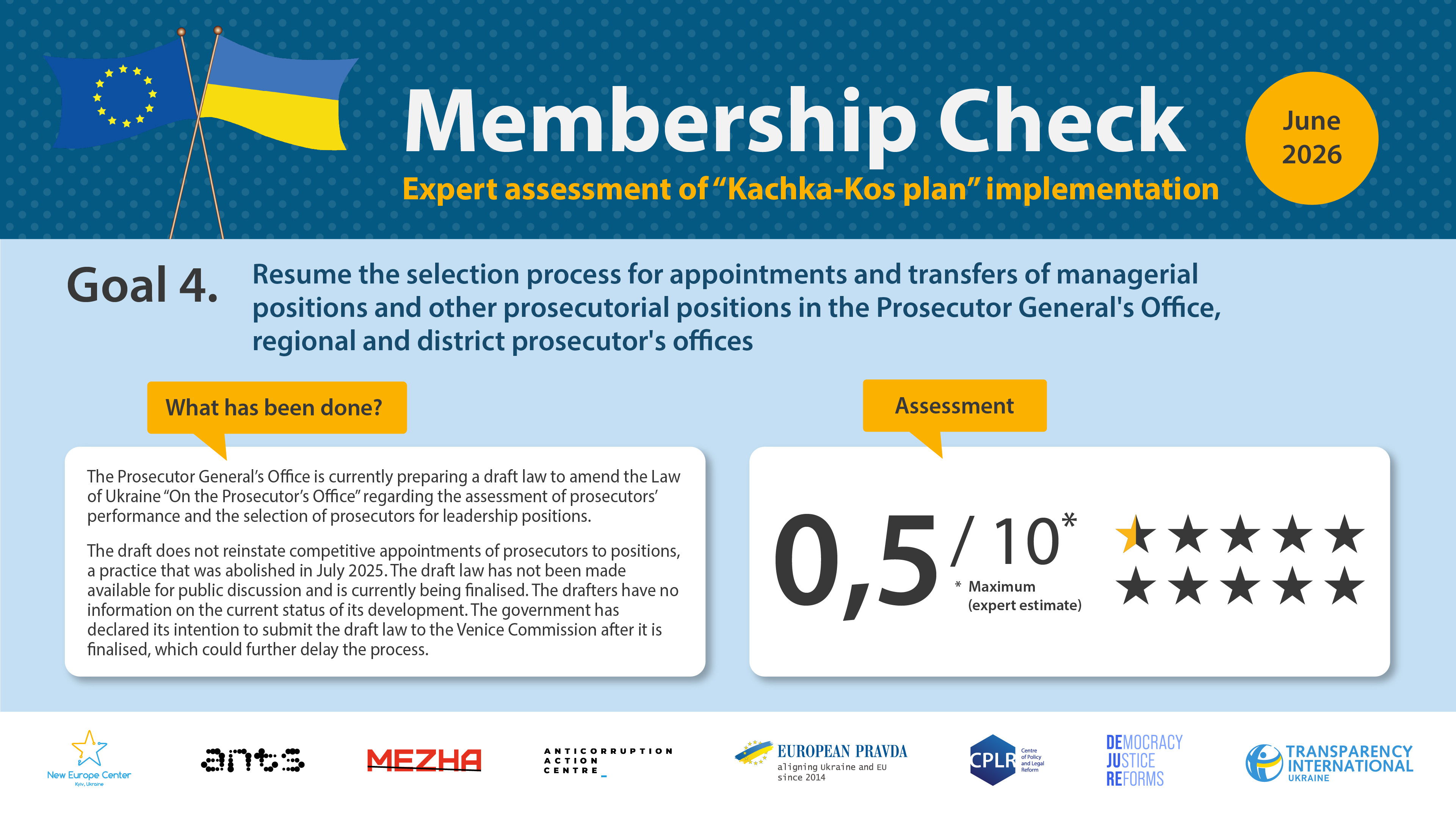
4. Resume the selection process for appointments and transfers of managerial positions and other prosecutorial positions in the Prosecutor General’s Office, regional and district prosecutor’s offices
Assessment – 0.5 out of 10
What should be done? Interim benchmarks, success indicators.
In line with the interim benchmarks, Ukraine is expected to achieve the following results:
IBM 23.2 – Independence, Accountability and Integrity
Further enhanced structural independence, integrity and accountability sustained at all levels of the judiciary, notably through improving merit-based selection processes […].
Expert indicator: Adoption of a draft law introducing amendments to the Law of Ukraine “On the Prosecutor’s Office,” repealing provisions that allow for the appointment and transfer of prosecutors to regional prosecutor’s offices and the Prosecutor General’s Office without a competitive selection procedure, as well as provisions granting the Prosecutor General’s Office the right of access to any materials of pre-trial investigations.
What has been done?
According to Letter №31276/38-6-26/11.3.2 of the Ministry of Justice of Ukraine dated March 6, 2026, the Office of the Prosecutor General has developed a draft law amending the Law of Ukraine “On the Prosecutor’s Office” regarding evaluation of prosecutors’ performance and the selection of prosecutors for managerial (administrative) positions. The draft law is currently being finalised; however, it has not yet been made available for public discussion and remains the only draft law addressing the issue. At the same time, the draft law does not repeal paragraph 5-4 of the Transitional Provisions of the Law of Ukraine “On the Prosecutor’s Office,” under which non-competitive appointments to the position of prosecutor have been possible since July 2025. The results of MEZHA’s analysis of this draft law are available at the link.
In response to a request from MEZHA regarding the current status of the aforementioned bill on June 4, 2026, the Ministry of Justice noted that work on the bill is continuing in collaboration with the Office of the Prosecutor General; however, the Office of the Prosecutor General has not yet submitted its revised draft to the Ministry of Justice. At the same time, the Office of the Prosecutor General reported that it had submitted its proposals for legislative changes as early as December 2025, but that it had no information regarding the current status of this bill. This may indicate shortcomings in cooperation and coordination among the key government agencies involved in the legislative process aimed at improving the procedures for selecting prosecutors for leadership positions.
Thus, the progress of implementation is absent.
Responsible for analysis: Anti-Corruption Action Center (AntAC) and Anti-Corruption Center MEZHA.
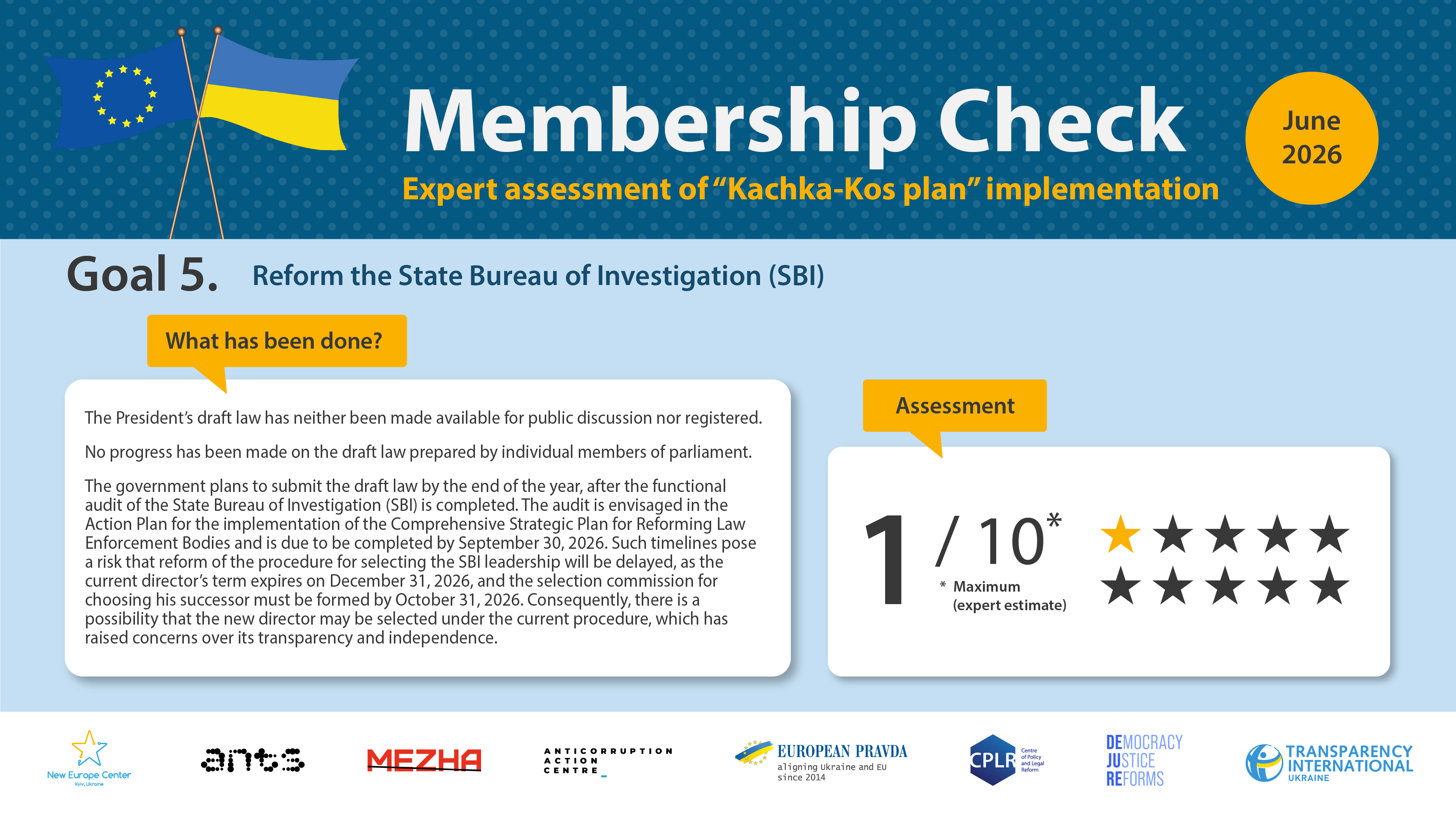
5. Reform the State Bureau of Investigation (SBI)
Assessment – 1 out of 10
What should be done? Interim benchmarks, success indicators.
In line with the interim benchmarks, Ukraine is expected to achieve the following results:
IBM 24.3 – Reform of the State Bureau of Investigation
Made tangible progress in the comprehensive reform of the State Bureau of Investigation, with the meaningful involvement of independent experts nominated by international partners.
Expert indicator: Adoption of a draft law introducing amendments to the Law of Ukraine “On the State Bureau of Investigation,” providing for competitive selection for senior positions with the significant involvement of independent experts nominated by international partners, as well as the re-attestation of staff.
What has been done?
In terms of reforming the State Bureau of Investigation, there are parallel and mostly uncoordinated processes on position development and coming up with the needed legislation between the Government, President’s Office and Parliament.
On August 6, 2025, a number of Members of Parliament, including Anastasia Radina, Yaroslav Zhelezniak, and others, registered draft law №13602 on amendments to certain legislative acts of Ukraine regarding the improvement of the functioning of the State Bureau of Investigation. The draft law is under review by the relevant committee.
At the same time, on January 3, 2026, the President of Ukraine publicly announced the preparation of a presidential draft law on reforming the State Bureau of Investigation, which was to be registered by the end of January 2026. In response to a request for public information from MEZHA on June 4, 2026, the Office of the President reported that it had no information on the status of this draft law’s development. The sources in the Office of the President reported that the presidential draft law was prepared by Oleh Tatarov, Deputy Head of the Office of the President; however, it did not contain any substantive changes and did not comply with international obligations, raising concerns among international partners. At present, this draft law has not yet been registered, and its text remains unpublished.
On May 27, 2026, during “Question Time to the Government,” the Prime Minister of Ukraine announced that a draft law on reforming the State Bureau of Investigation (SBI) would be prepared by the end of the year. According to her, a functional analysis of the Bureau’s powers and status is currently underway, as is the coordination of positions between the Government, the relevant parliamentary committee, and the European Commission. The action plan for implementing the Comprehensive Strategic Plan for Reforming Law Enforcement Agencies calls for a functional review of the State Bureau of Investigation to be completed by September 30, 2026. It is likely this process that the Prime Minister had in mind when she referred to an audit of the Bureau. However, these deadlines raise doubts about the possibility of reforming the procedure for selecting the SBI’s leadership in a timely manner. The current director’s term expires on December 31, 2026, and the selection commission for choosing his successor must be formed no later than October 31, 2026. Thus, there is only one month between the completion of the audit and the start of the selection process, which is insufficient time to adopt the necessary legislative changes. Under these circumstances, the outlined process and timeline appear to be more of a mechanism to delay changes until the conclusion of the new selection process.
The position of the State Bureau of Investigation (SBI), as stated in response to a request from MEZHA on June 10, 2026, warrants separate public attention. The SBI disputes the need for its unconditional reform, arguing that this issue should be resolved based on the results of a comprehensive review of the SBI’s institutional structure. Moreover, the SBI views the dissemination of information regarding the need to reform the agency as media and political pressure on a law enforcement body.
Responsible for analysis: Anti-Corruption Action Center (AntAC) and Anti-Corruption Center MEZHA.
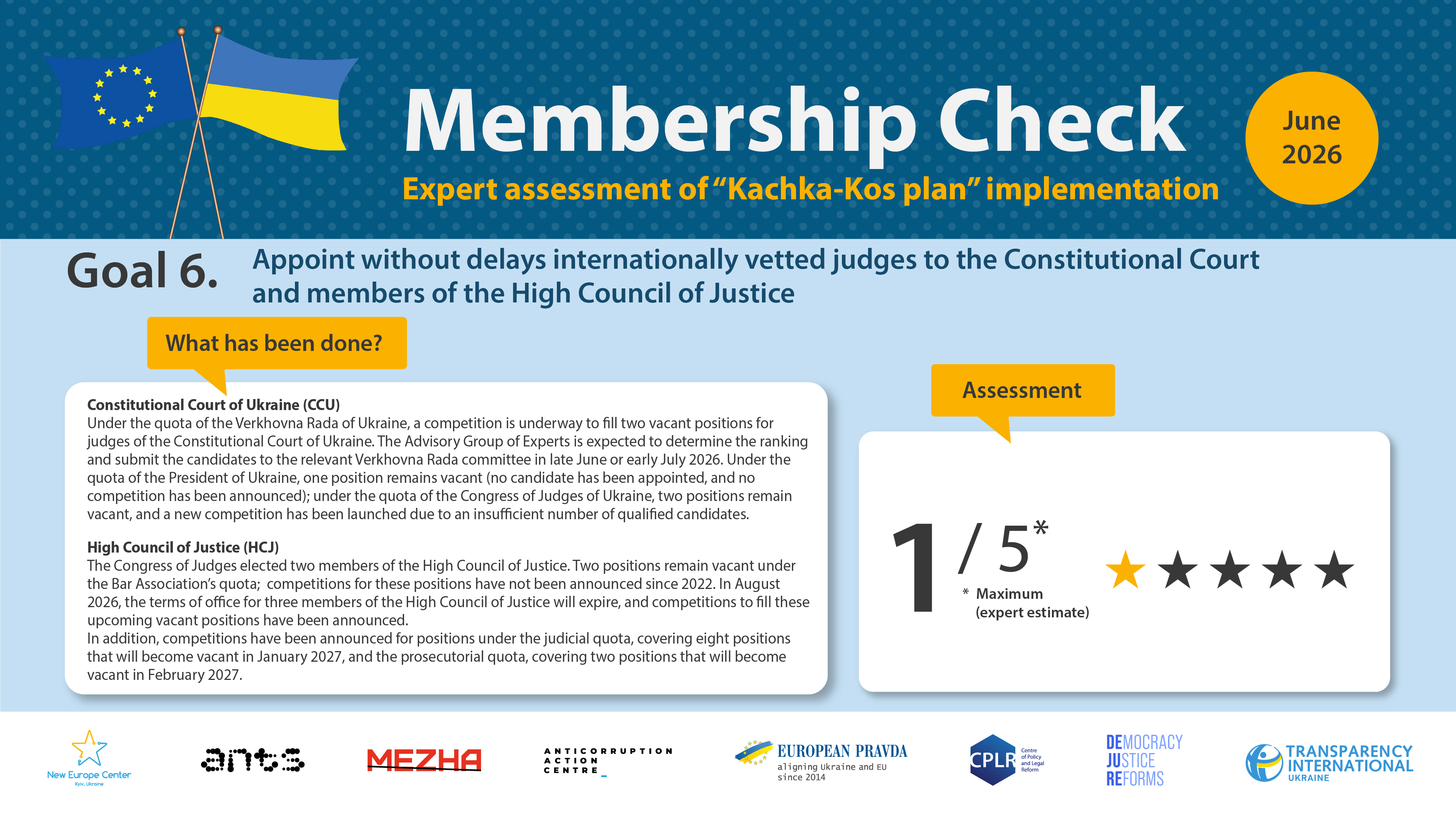
6. Appoint without delays internationally vetted judges to the Constitutional Court and members of the High Council of Justice
Total assessment – 1 out of 5
What should be done? Interim benchmarks, success indicators.
In line with the interim benchmarks, Ukraine is expected to achieve the following results:
IBM 23.4 – Efficiency of the Judiciary
Enhanced the efficiency and performance of courts and prosecution offices, including by improving the legislation on the Constitutional Court’s procedure, ensuring the quorum of the Constitutional Court and the timely appointment of internationally vetted candidates.
Expert indicators:
Regarding the Appointment/Election of Constitutional Court Judges
Interim indicators:
- Election of two Constitutional Court judges under the Verkhovna Rada quota by the end of June 2026 (the Advisory Group of Experts (AGE) is expected to complete its evaluation of candidates and submit the lists to the Verkhovna Rada Committee on Legal Policy in approximately June 2026).
- Announcement by April 2026 of a competition for one vacant position of Constitutional Court judge under the President of Ukraine’s quota, or the appointment of a candidate recommended by the EAG and the competition commission as early as the first half of 2025.
- If a new competition is held, the appointment of one judge to the Constitutional Court of Ukraine under the President of Ukraine’s quota no later than the end of September 2026.
- Submission by mid-September 2026 of two candidates for the position of judge of the Constitutional Court of Ukraine under the quota of the Congress of Judges of Ukraine.
Target indicator (maximum score of 2.5 points): as of December 31, 2026:
- a) all vacant positions on the Constitutional Court of Ukraine have been filled;
- b) the selection process for a judge of the Constitutional Court of Ukraine to fill the positions that will become vacant in November 2026 and March 2027 has been initiated in a timely manner (no later than 90 days before the expiration of the term of office of the respective Constitutional Court judge; 1 – under the quota of the Congress of Judges of Ukraine (to become vacant on November 21, 2026; the competition will be announced in August 2026); 1—under the quota of the President of Ukraine (to become vacant on March 2, 2027; the competition will be announced in December 2026)).
Regarding the Election of Members of the High Council of Justice
Interim indicators:
- Election of 2 members of the High Council of Justice by mid-March 2026 under the quota of the Congress of Judges of Ukraine;
- Election of three members of the High Council of Justice by August 2026 (two under the quota of the Verkhovna Rada of Ukraine, and one under the quota of the Congress of Representatives of Legal Higher Education Institutions and Scientific Institutions; the terms of office of the current members of the High Council of Justice under these quotas expire on August 15 and 19, 2026, respectively);
- Election of 2 members of the High Council of Justice under the quota of the Congress of Lawyers of Ukraine.
Target indicator (maximum score of 2.5 points) as of December 31, 2026:
- a) all vacant positions on the High Council of Justice have been filled;
- b) the selection of High Council of Justice members for positions that will become vacant in January–February 2027 has been initiated in a timely manner (no later than 2 months before the end of the terms of office of the respective members; 8 under the quota of the Congress of Judges of Ukraine, 2 under the quota of the Conference of Prosecutors).
The score for both components may be reduced in the following cases:
- a) filling vacant positions with a significant delay (for example, if the Verkhovna Rada elects members under its quota later than the specified indicative deadlines) (however, delays caused by objective reasons, such as an insufficient number of candidates selected by the Ethics Council, may be taken into account during the evaluation, since the delay may occur through no fault of the appointing/electing body));
- b) failure to take measures to announce a competition for vacant positions or announcing such a competition with a significant delay.
Target indicator (maximum score: 10 points): as of 31 December 2026: a duly authorized composition of the selection commission for members of the HQCJ has been formed, including international experts with a decisive voting role.
What has been done?
Regarding the Constitutional Court:
Under the quota of the Verkhovna Rada of Ukraine, a competition is ongoing for 2 vacant positions of Constitutional Court judges. In early May 2026, the Advisory Group of Experts (AGE) completed the assessment phase to evaluate the competence of candidates for judgeships on the Constitutional Court of Ukraine and identified nine candidates as meeting the criterion of a recognized level of competence. The selection and referral of candidates to the relevant committee of the Verkhovna Rada are expected to take place in late June or early July 2026. Under the quota of the President of Ukraine, 1 vacant position remains unfilled: the candidate recommended by the AGE and the selection commission has not been appointed since the first half of 2025, and no new competition for the position has been announced. Under the quota of the Congress of Judges of Ukraine, 2 positions remain vacant. Due to an insufficient number of candidates meeting the established requirements, a new competition has been launched, and the list of 18 candidates were published on the website.
The score regarding this part is 0 out of 2.5.
Regarding High Council of Justice:
On 10 March 2026, the Congress of Judges of Ukraine elected two members of the High Council of Justice, reducing the number of vacant posts to two (19 out of 21 members have been appointed/elected). Two posts for members of the High Council of Justice allocated to the Ukraine Advocates’ Association have remained vacant since January 2022. No competition has been announced for these positions. In August 2026, the terms of office of three members of the High Council of Justice will expire (two under the quota of the Verkhovna Rada, and one under the quota of the Congress of Representatives of Higher Education Law Schools and Scientific Institutions). In February 2026, competitions were announced to fill the relevant positions.
In June 2026, competitions were announced for 8 positions on the High Council of Justice under the quota of the Congress of Judges of Ukraine and 2 positions under the quota of the All-Ukrainian Conference of Prosecutors, which will become vacant in January and February 2027, respectively. The conference of prosecutors to elect members of the High Council of Justice is scheduled for August 27–28, and the Congress of Judges is scheduled for September 2 of this year.
The score regarding this part is 1 out of 2.5.
Responsible for analysis: DEJURE Foundation, Centre of Policy and Legal Reform (CPLR) (in regards to the issue of the High Council of Justice).
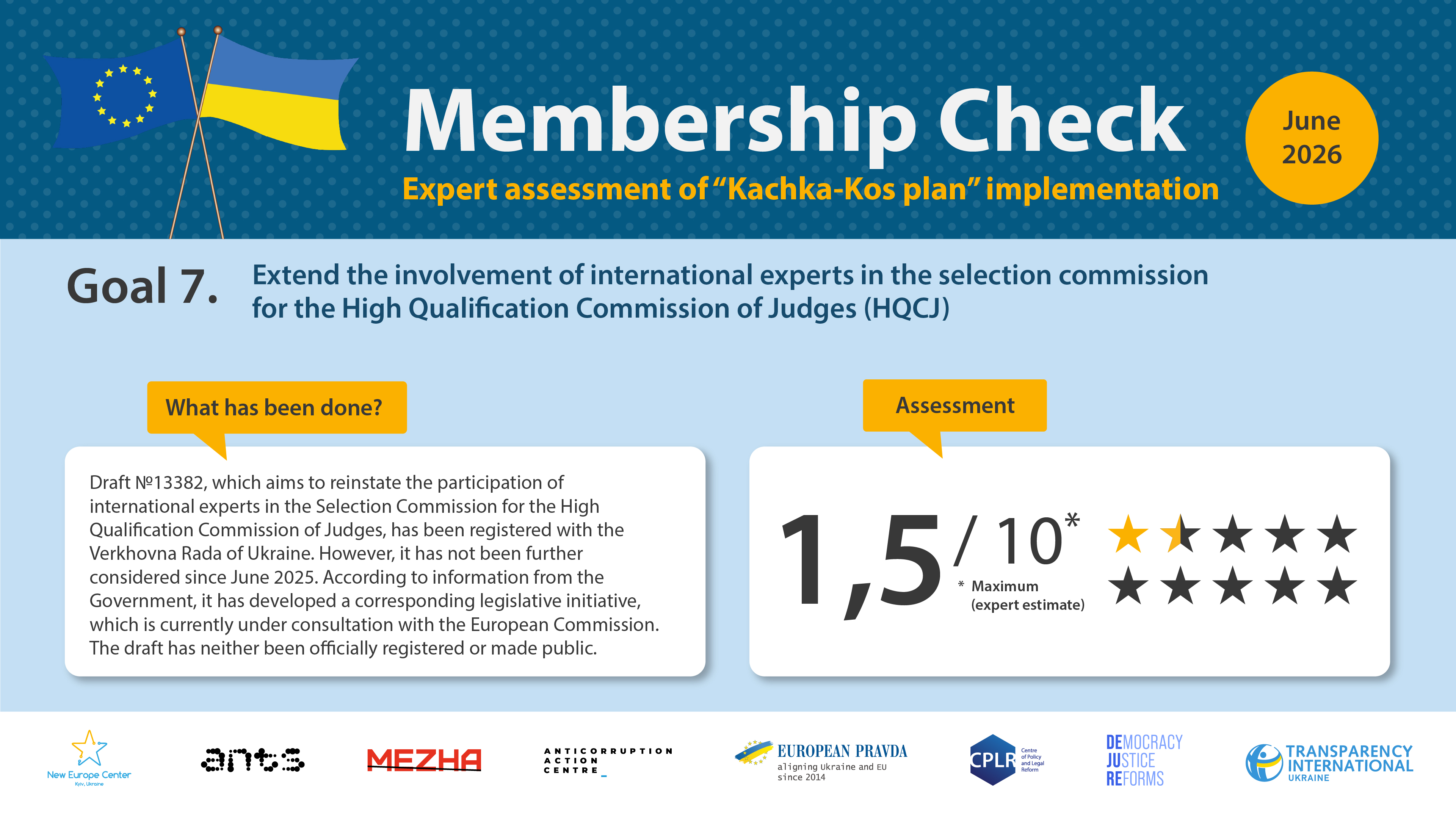
7. Extend the involvement of international experts in the selection commission for the High Qualification Commission of Judges (HQCJ)
Total assessment – 1 out of 10
What should be done? Interim benchmarks, success indicators.
In line with the interim benchmarks, Ukraine is expected to achieve the following results:
IBM 23.2 – Independence, Accountability and Integrity
Further enhanced structural independence, integrity and accountability sustained at all levels of the judiciary, notably through improving merit-based selection processes; revising the integrity vetting procedures for the Supreme Court and other high court judges and the selection procedures for the Supreme Court and extending the selection commission for the members of the High Qualification Commission of Judges of Ukraine (HQCJ) without delay, with the meaningful involvement of independent experts nominated by international partners;
Expert indicators:
Interim indicators:
- Adoption and entry into force of draft law No. 13382 or another draft law providing for the restoration of the participation of international experts in the selection commission for members of the High Qualification Commission of Judges of Ukraine;
- A request by the Head of the High Council of Justice, or a person acting in that capacity, to the appointing entities to submit candidates for the selection commission;
- Submission by the appointing bodies of the selection commission (the Council of Judges of Ukraine, and international and/or foreign organisations that provide Ukraine with international technical assistance in the field of judicial reform and/or anti-corruption under international or intergovernmental agreements) of a sufficient number of candidates to form a duly authorised composition of the commission;
- Formation of a duly authorised composition of the selection commission for members of the HQCJ, including international experts with a decisive voting role.
Target indicator (maximum score: 10 points): as of 31 December 2026: a duly authorized composition of the selection commission for members of the HQCJ has been formed, including international experts with a decisive voting role.
What has been done?
Draft law №13382 has been registered in the Verkhovna Rada of Ukraine, providing for the restoration of the participation of international experts in the selection commission for members of the High Qualification Commission of Judges of Ukraine. As of the time of assessment, there has been no further consideration of this draft law since June 2025. There are also no alternative draft laws on the parliamentary agenda that take into account the current aspects of the functioning of the selection commission, in particular the risk of forming its composition without the participation of international experts prior to the entry into force of the relevant law.
This risk could materialize following the decision adopted on June 5, 2026, by the Council of Judges of Ukraine to appeal to the High Council of Justice with a proposal to consider the issue of beginning the selection of candidates for the Competition Commission for the Selection of Members of the High Qualification Commission of Judges—that is, to begin forming the Competition Commission under rules that do not provide for the involvement of independent experts.
According to information from the Government, it has developed a corresponding legislative initiative, which is currently under consultation with the European Commission. This draft law has not been officially registered or made public; therefore, it is impossible to determine with certainty whether it provides for the expanded involvement of international experts in the Competition Commission for the High Council of Justice.
Responsible for analysis: DEJURE Foundation, Centre of Policy and Legal Reform (CPLR), Transparency International Ukraine (TI), Anti-Corruption Action Center (AntAC).
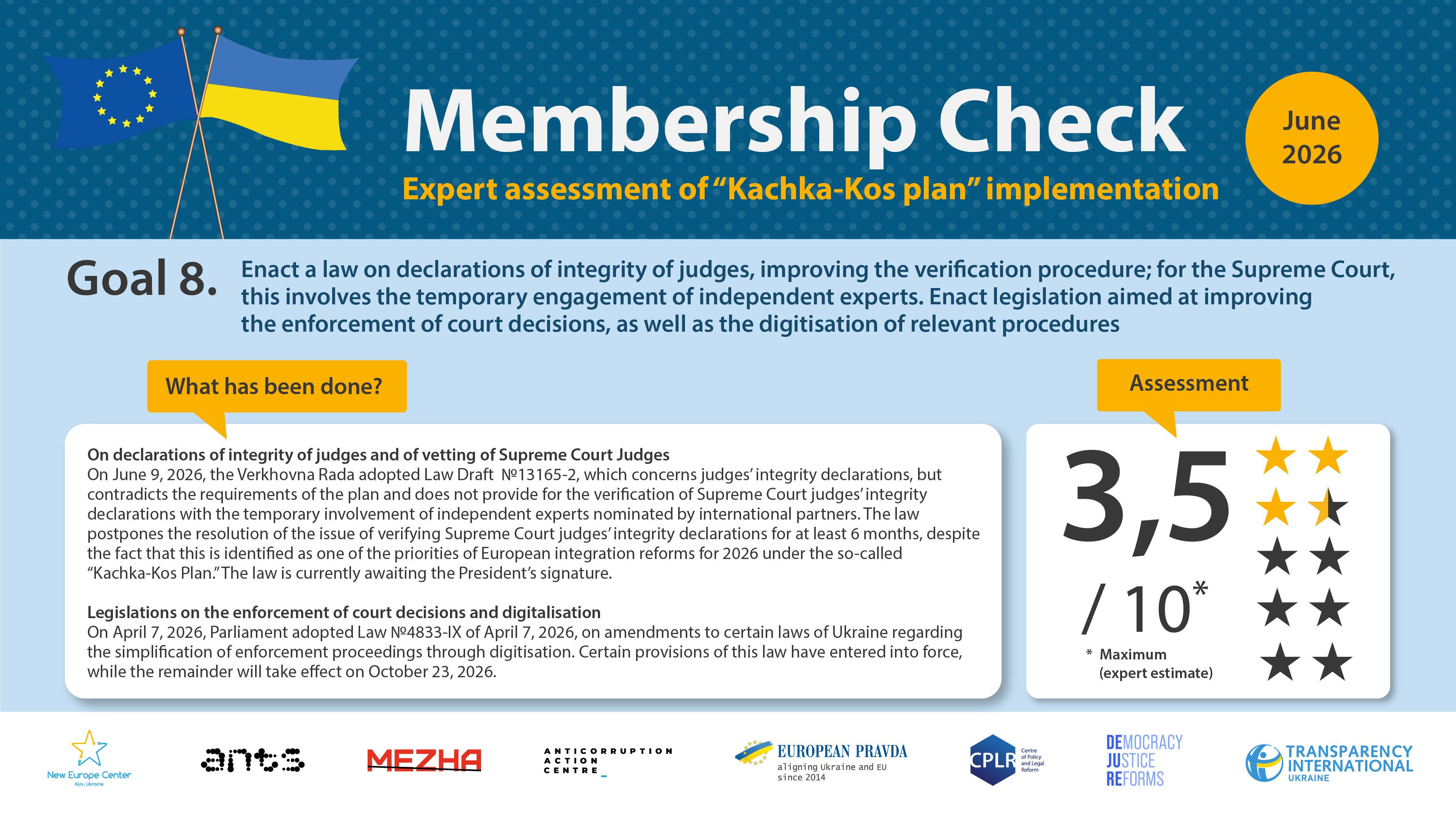
8. Enact a law on declarations of integrity of judges, clarifying the content of such declarations, extending the period they cover, and improving the verification procedure; for the Supreme Court, this involves the temporary engagement of independent experts nominated by international partners. Enact legislation aimed at improving the enforcement of court decisions regarding monetary and non-monetary obligations, as well as the digitisation of relevant procedures
Total assessment – 3,5 out of 10
What should be done? Interim benchmarks, success indicators.
Regarding declaration of integrity and Supreme Court
In line with the interim benchmarks, Ukraine is expected to achieve the following results:
IBM 23.2 – Independence, Accountability and Integrity
Revising the integrity vetting procedures for the Supreme Court and other high court judges and the selection procedures for the Supreme Court and extending the selection commission for the members of the High Qualification Commission of Judges of Ukraine (HQCJ) without delay, with the meaningful involvement of independent experts nominated by international partners;
IBM 23.2.2 – Revised integrity vetting procedures for the Supreme Court and other high court judges
Expert indicators:
- Adoption of the mentioned draft law no later than June 2026.
Entry into force of the law on improving the procedure for verifying judges’ integrity declarations, which provides for:
- a) clarification of the content of integrity declarations and the grounds for initiating verification;
- b) extension of the period covered by the verification;
- c) specification of the verification procedure and timelines;
- d) determination of the rights and obligations of natural and legal persons involved in the verification process;
- e) determination of the legal consequences of the verification;
- f) verification of the integrity declarations of judges of the Supreme Court and higher specialised courts (in line with the recommendations of the European Commission set out in the 2025 Enlargement Report), with the involvement of independent experts delegated by international partners, holding a decisive voting role.
- Adoption by the HQCJ of internal regulatory acts to implement the requirements of the Law.
- The HQCJ launches the verification of integrity declarations of judges of the Supreme Court and higher specialized courts.
Regarding legislation on enforcement of court decision and digitalization
Expert indicators:
- The aforementioned law will be adopted no later than December 31, 2026.
Maximum score (10 points): as of 31 December 2026:
The law on improving the procedure for verifying integrity declarations has entered into force, and the HQCJ has launched the verification of integrity declarations of judges of the Supreme Court and higher specialised courts under the updated procedure.
What has been done?
Regarding declaration of integrity and Supreme Court
On June 9, 2026, the Verkhovna Rada adopted Draft №13165-2, which concerns judges’ integrity declarations. The law is currently awaiting the President’s signature.
Although the law is presented as fulfilling a European integration commitment in the area of judicial reform, its content does not meet the requirements of paragraph 8 of the so-called “Kachka-Kos Plan” regarding strengthening the accountability and integrity of judges.
The “Kachka-Kos Plan” explicitly calls for the adoption of legislation on judges’ integrity declarations, with the temporary involvement of independent international experts to verify the declarations of Supreme Court judges. However, the adopted law does not introduce such a mechanism. It merely instructs the Cabinet of Ministers to prepare, within six months, a separate draft law on the verification of declarations by judges of the Supreme Court and the higher specialized courts with the participation of independent experts. However, the law does not specify that these experts must be international. Thus, the issue of verifying the integrity of Supreme Court judges has effectively been postponed for at least half a year, and the key requirement of the indicator remains unfulfilled.
Furthermore, the law does not address one of the key problems with the current mechanism for verifying integrity declarations—the need to prove that a judge intentionally submitted false information. Instead, to improve the mechanism’s effectiveness, it would be advisable to establish liability not only for intentional violations but also for gross negligence in completing the declaration, which is consistent with the goal of ensuring proper accountability of judges.
Furthermore, instead of clarifying the content of the declarations, some of the information that was previously required to be disclosed has been excluded, and liability applies only for intentional violations. The grounds for initiating a review of a declaration have not changed in practice and, as before, depend largely on the receipt of relevant requests or complaints. At the same time, integrity declarations are not publicly accessible, which significantly limits the public’s ability to exercise oversight and initiate audits.
Furthermore, the law does not extend the time limits for reviewing integrity declarations, as the logic of the reform would have required. On the contrary, for certain provisions, the reporting period has been further limited to one year, which potentially narrows the scope for identifying instances of unethical conduct by judges.
As a result, the adopted amendments do not ensure the achievement of the reform’s key objective—strengthening the accountability and integrity of the judiciary. On the contrary, certain provisions of the law may lead to a weakening of existing oversight mechanisms. Given the lack of a mechanism for vetting Supreme Court justices with the involvement of independent international experts and the fact that the adopted amendments do not align with the essence of the indicator, progress in implementing this point of the Kachka-Kos Plan is rated at 0 points.
The score for this part is 0 out of 6.5.
Regarding legislation on enforcement of court decision and digitalization
On April 7, 2026, Parliament adopted Law №4833-IX of April 7, 2026, on amendments to certain laws of Ukraine regarding the simplification of enforcement proceedings through digitization. Certain provisions of this law have entered into force, while the remainder will take effect on October 23, 2026.
The score for this part is 3.5 out of 3.5.
Responsible for analysis: DEJURE Foundation, Centre of Policy and Legal Reform (CPLR) (on declarations of integrity of judges).
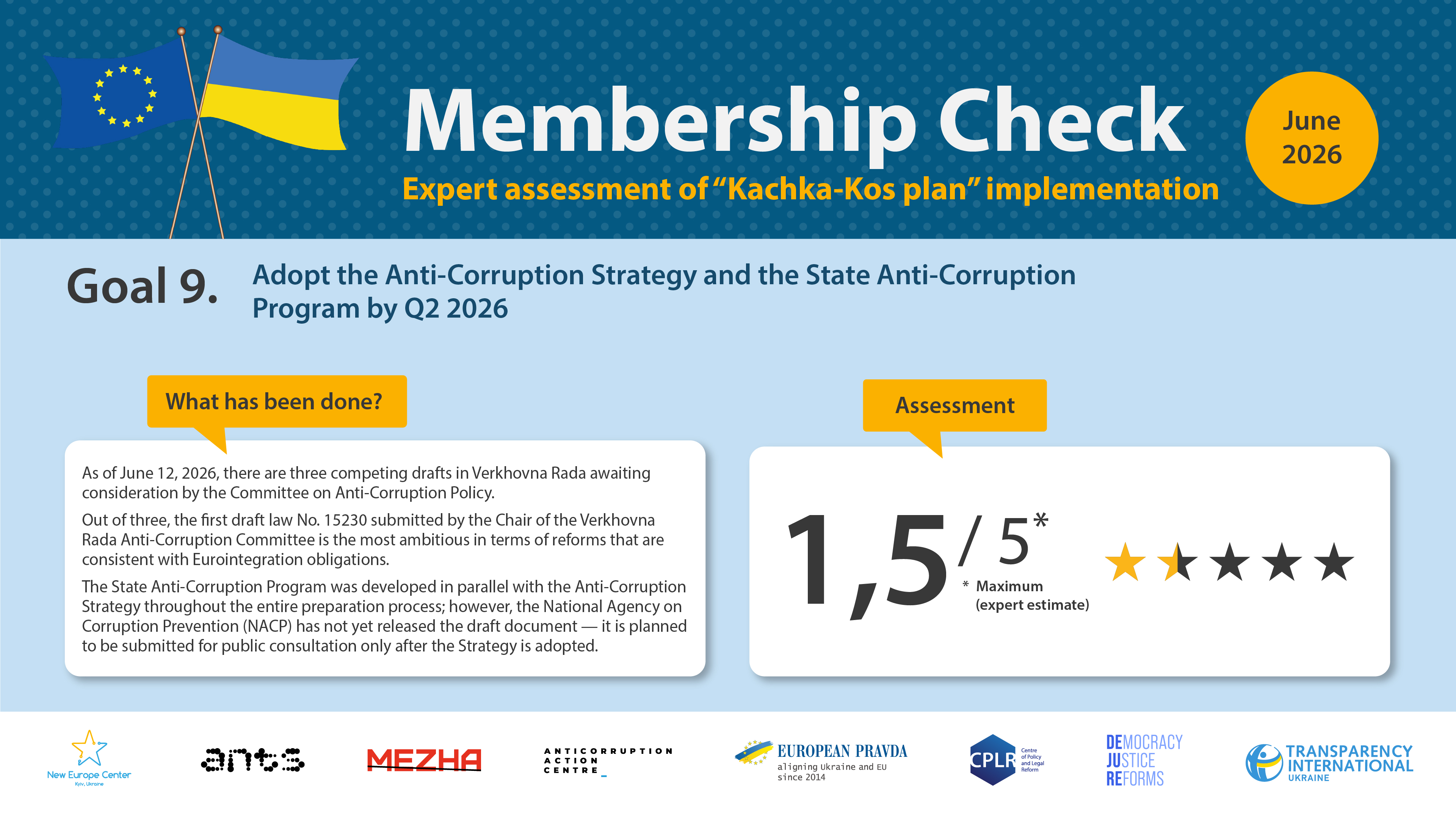
9. Adopt the Anti-Corruption Strategy and the State Anti-Corruption Program by Q2 2026
Assessment – 1,5 out of 5
What should be done? Interim benchmarks, success indicators.
In accordance with the interim benchmarks, Ukraine is expected to achieve the following results:
IBM 23.5 – Legislative Alignment
Advanced, sustained and continuously implement the anti-corruption legal and strategic frameworks, including significant gradual alignment with the EU acquis and implementation of relevant GRECO, OECD and OSCE/ODIHR recommendations, with effective coordination, budgeting, monitoring and evaluation.
IBM 23.9 – Mainstreaming of anti-corruption in relevant sectors
Improved the mainstreaming of anti-corruption through risk assessments and integrity measures in the sectors most vulnerable to corruption.
Expert indicators:
- Adoption of the Anti-Corruption Strategy (ACS) and the State Anti-Corruption Programme (SAP) within the established timelines and their compliance with Ukraine’s EU integration commitments, in particular with regard to: ensuring transparent competitive selection procedures for senior positions in the National Police of Ukraine (NPU), the State Bureau of Investigation (SBI) and the Prosecutor General’s Office, with the participation of international experts; strengthening the institutional capacity of the NABU and the SAPO.
- Development of the ACS and SAP based on a public analysis of the state of corruption and the results of implementation of previous strategic documents, with the involvement of civil society representatives and proper communication on how their proposals are taken into account. Systematic engagement by the NACP of the public and external experts in fulfilling European Union commitments in the field of anti-corruption mainstreaming, as well as ensuring the coordinating and methodological role of the NACP in this area.
- Amendments to legislation to grant the NACP the authority to apply enforcement measures to heads of public authorities, institutions, enterprises and organisations in cases of unjustified failure to implement SAP measures.
What has been done?
On April 2, 2026, the NACP submitted a draft Anti-Corruption Strategy for 2026–2030 to the Cabinet of Ministers following an inclusive development process that involved more than 130 experts. Given that the Cabinet of Ministers had not reviewed the document for over a month, and in light of the approaching deadline for the Ukraine Facility (late June 2026), the chair of the Verkhovna Rada Committee on Anti-Corruption Policy registered a bill based on the NACP’s draft on May 13, 2026; On May 15, the Cabinet of Ministers submitted its own version. Additionally, on May 25, the leader of the opposition political party “European Solidarity” submitted another draft of the Anti-Corruption Strategy. Currently, there are three competing bills before the Verkhovna Rada, awaiting consideration by the Committee on Anti-Corruption Policy.
The governmental draft completely removes important provisions on transparent competitive appointment of the Prosecutor General and heads of the National Police and the State Bureau of Investigation (SBI), identified as 2026 priorities in the Kachka-Kos joint statement. Moreover, along with the European Solidarity draft, it excludes the provision granting the SAPO head autonomous authority to initiate proceedings involving MPs. Draft No. 15230-2 also raises a separate concern on judicial governance: it proposes equal voting rights for international and domestic members in competition commissions for the High Council of Justice (HCJ) and the High Qualification Commission of Judges of Ukraine (HQCJ) — a premature step given that the domestic institutions delegating commission members have not yet completed their own reform and do not yet command sufficient public trust. Out of three, the first draft law No. 15230 submitted by the Chair of the Verkhovna Rada Anti-Corruption Committee is the most ambitious in terms of reforms that are consistent with Eurointegration obligations.
The State Anti-Corruption Program was developed in parallel with the Strategy throughout the entire drafting process; however, the NACP has not yet released the draft document—it is planned to be submitted for public consultation only after the Strategy is adopted.
Responsible for analysis: Anti-Corruption Center MEZHA and Transparency International Ukraine (TI).
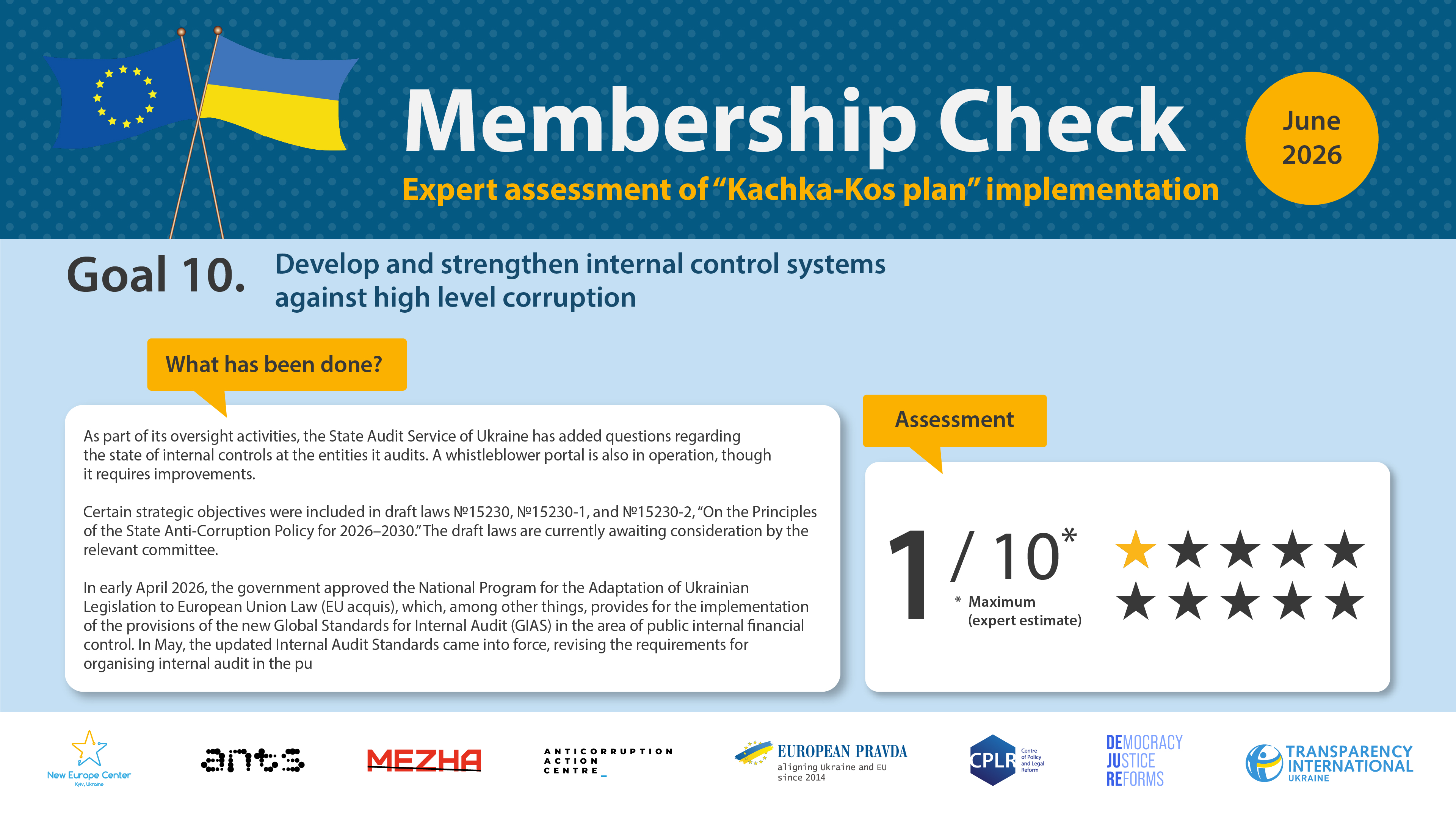
10. Develop and strengthen internal control systems against high level corruption
Assessment – 1 out of 10
What should be done? Interim benchmarks, success indicators.
In accordance with the interim benchmarks, Ukraine is expected to achieve the following results:
IBM 23.7 – Corruption preventionї
Strengthened the efficiency of the corruption prevention framework by making further progress in the development and enforcement of legal and policy frameworks relating to asset declarations, whistleblower protection, conflict of interest, lobbying, financing of political parties/electoral campaigns, including effective, proportionate and sufficiently dissuasive sanctions in case of violations
Expert indicators:
- Introduction of systematic internal control audit assessments in the public sector by the State Audit Service of Ukraine (SASU), specifically:
- a) the development and application of a methodology for assessing internal control;
b) the inclusion of internal control issues as mandatory elements of audit procedures;
c) the provision of training for SASU staff on internal control assessment. - Development and approval of a national action plan to bring internal control and internal audit systems into line with international standards and best practice.
- Integration of corruption risk management into the overall risk management system within public authorities, in particular:
- a) the existence of anti-corruption programmes approved by the National Agency on Corruption Prevention (NAPC), based on
b) a systematic analysis of corruption risks;
c) integration of NACP tools (in particular mechanisms for resolving conflicts of interest and protecting whistleblowers) into internal control and risk management practices;
d) ensuring the institutional capacity of authorised persons for corruption prevention to implement anti-corruption programmes.
What has been done?
As part of its monitoring activities, the State Audit Service has included questions regarding the state of internal controls at the facilities it inspects. A whistleblower portal is also in operation, although it requires significant further development.
Specific strategic objectives aimed at improving the management of corruption risks and protecting whistleblowers have been included in draft laws №15230, №15230-1, and №15230-2, “On the Principles of the State Anti-Corruption Policy for 2026–2030.” The draft laws are currently awaiting consideration by the relevant committee.
In early April 2026, the government approved the National Program for the Adaptation of Ukrainian Legislation to European Union Law (EU acquis), which, among other things, provides for the implementation of the provisions of the new Global Standards for Internal Audit (GIAS) in the area of public internal financial control. In May, the updated Internal Audit Standards came into force, revising the requirements for organizing internal audit in the public sector and strengthening the requirements regarding the organizational and functional independence of internal audit units.
Responsible for analysis: Anti-Corruption Center MEZHA and Transparency International Ukraine (TI).
Methodology of expert monitoring of “Kachka-Kos plan” implementation
Assessment approach
Expert evaluation is based on the complex analysis of the actual progress in reforms implementation. Assessment takes into account:
- matching of taken decisions to the goals of “Kachka-Kos plan”;
- institutional and practical changes that emerge as a result of reforms implementation;
- in case the interim benchmarks set by the Council of the EU for Chapters 23 and 24 provide a more detailed explanation of the substance of the reform, compliance with these benchmarks is also taken into account.
Interim steps (for example, preparation of draft laws, drafts of strategic documents or concepts) will be taken into evaluation only in case that experts have the access to the respective documents and can assess their contents. The exception is the initial stage of the work, for which no more than 10% are awarded for each goal.
Expert evaluation is independent and may not coincide with the evaluation of the European Union institutions. Coalition leaves the right to form its own vision of progress, a success indicator for reforms, based on expert analysis.
The “scaling” of reforms
Every point of “Kachka-Kos plan” received a separate weight, considering the scale of reforms, the amount of needed legislative and institutional changes, as well as the importance for European integration of Ukraine.
The maximum overall evaluation of the plan is 100.
The differentiation of scale is as follows:
- 20 – reform regarding adopting comprehensive amendments to the Criminal Procedure Code and other legislation to ensure fast and high-quality justice. Increased value of this reform stems from its complex nature, as it has the biggest number of elements, involves a substantial number of legislative changes and its proper implementation will have a significant impact on the effectiveness of the anti-corruption system and the functioning of the criminal justice system.
- 5 – two reforms that have a narrow and precise amount of work:
- to appoint without delays internationally vetted judges to the Constitutional Court and members of the High Council of Justice;
- to Adopt the Anti-Corruption Strategy and the State Anti-Corruption Program.
- 10 – other reforms that are set in the “Kachka-Kos plan”.
Such an approach will show the difference in scale, difficulty and systematic influence of various reforms in terms of European integration of Ukraine.
In case of negative tendencies or reform backtracking, experts have the possibility to review evaluation in the next parts of monitoring.
Evaluation scale of reforms progress
Assessment of every reform is made with the help of a scale that demonstrates the level of actual reform implementation.
| Percentage from maximum mark for every goal | Description of the conditions under which points are awarded |
| 0% | No progress has been made, or it is still at the stage of discussing initial implementation ideas; there is a reversal of reform in this area |
| Up to 10% | There are detailed proposals or a well-thought-out vision for reform, government bodies or senior officials make political statements about their intention to carry out the reform |
| Up to 20% | The draft documents implementing the changes were officially presented (published); in particular, the bills were tabled in Parliament |
| Up to 50% | Officially registered draft decisions go through preparatory stages prior to adoption (such as the first reading in Parliament, consideration of amendments for the second reading, review by the European Commission, etc.). If these stages do not improve the quality of the draft and no political commitments are made to rectify the issues, points are not awarded in full. |
| Up to 100% | The reform has been implemented in the form and to the extent set out in the “Kachka-Kos Plan”. In the event of incomplete implementation, or if experts consider that the chosen approach does not deliver the necessary practical changes, points will not be awarded in full. |
*For the assessment of goal 6 “Appoint without delays internationally vetted judges to the Constitutional Court and members of the High Council of Justice” and goal 8 “”a special methodology was set up.
Assessment of Goal 6 “Appoint without delays internationally vetted judges to the Constitutional Court and members of the High Council of Justice”
For this goal 5 points are allocated, that being divided between members’ appointment of HCJ and CCU judges.
Points allocation:
- 2,5 – for filling in vacant positions in HCJ;
- 2,5 –for filling in vacant positions in CCU.
Constitutional Court of Ukraine assessment:
Assessment for the first and second quarters of 2026
As of the time of the assessment (first-second quarter of 2026), there are 5 vacant posts at the Constitutional Court of Ukraine.
The assessment for the first and second quarters of 2026 is carried out in proportion to the number of filled posts:
- 5 points are awarded for each filled vacancy;
- if all 5 posts are filled, a maximum of 2.5 points is awarded.
Assessment in the third and fourth quarters of 2026
In the third and fourth quarters of 2026, the assessment is carried out taking into account not only the filling of existing vacant posts, but also the timely announcement of competitions for the posts of judges of the Constitutional Court of Ukraine, for which the deadline for announcing the competition falls in 2026.
The maximum score in the third and fourth quarters of 2026 is 2.5 points, of which:
- up to 2 points — for filling existing vacant posts;
- up to 0.5 points — for the timely announcement of competitions for the posts of judges of the Constitutional Court of Ukraine, for which the deadline for announcement falls in 2026.
High Council of Justice assessment:
As of the time of the assessment:
- 2 vacant positions remain unfilled (under the quota allocated by the Ukraine Advocate’s Association);
- 2 vacant positions have been filled.
In August 2026, 3 positions of members of the High Council of Justice will become vacant. That is, a total of 5 vacant positions of members of the High Council of Justice are to be filled in 2026 (excluding the vacant positions filled by the Congress of Judges in March 2026).
For filling 2 vacant positions, 1 point is awarded.
Additionally:
- 1 point is reserved for assessing the filling of vacant posts under the advocates’ quota;
- 0,5 point is reduced due to significant delays on the part of the relevant appointing authority (under the advocates’ quota).
Assessment of Goal 8: “Enact a law on declarations of integrity of judges, clarifying the content of such declarations, extending the period they cover, and improving the verification procedure; for the Supreme Court, this involves the temporary engagement of independent experts nominated by international partners. Enact legislation aimed at improving the enforcement of court decisions regarding monetary and non-monetary obligations, as well as the digitisation of relevant procedures.”
Since Goal 8 is comprehensive and consists of two separate areas, the expert coalition has divided the total score into two parts, taking into account the importance and complexity of implementing each of the two parts.
The 10 points are allocated as follows:
- 5 points are awarded for the adoption of legislation on declarations of integrity of judges and the involvement of independent experts in the Supreme Court;
- 5 points are awarded for the adoption of legislation aimed at improving the enforcement of court decisions regarding monetary and non-monetary obligations, as well as the digitization of the relevant procedures.
The increased emphasis on enacting legislation on integrity declarations is justified by the fact that this requirement has two important components for the accountability and integrity of judges: the first involves the adoption of a bill on the verification of integrity declarations, and the second is aimed at fulfilling the conditions for verifying Supreme Court justices. In contrast, the provision regarding the adoption of legislation aimed at improving the enforcement of court decisions concerning monetary and non-monetary obligations, as well as the digitization of the relevant procedures, is substantially simpler to implement and therefore carries less weight.
Expert coalition
Expert coalition consists of leading think tanks and civil society organizations that specialises in European integration, as well as relevant reforms (particularly in the areas of the rule of law and the fight against corruption):
- Anti-Corruption Center MEZHA
- European Pravda
- National Interest Advocacy Network «ANTS»
- DEJURE Foundation
- New Europe Center
- Centre of Policy and Legal Reform
- Anti-Corruption Action Center
- Transparency International Ukraine
Experts that have participated in the research:
- Martyna Bohuslavets, Olena Kupina, Vladyslava Rudyka (Anti-Corruption Center MEZHA)
- Sergiy Sydorenko (European Pravda)
- Hanna Hopko, Kateryna Musiienko (National Interest Advocacy Network «ANTS»)
- Mykhailo Zhernakov, Kateryna Hasymova, Olha Kovalska (DEJURE Foundation)
- Sergiy Solodkyy, Leo Litra, Anton Alimov, Dmytro Babushko (New Europe Center)
- Viktoriia Melnyk, Roman Smaliuk (Centre of Policy and Legal Reform)
- Daria Kaleniuk, Olena Halushka, Tetyana Shevchuk, Kateryna Pityk (Anti-Corruption Action Center)
- Andrii Borovyk, Kateryna Ryzhenko (Transparency International Ukraine)
[1] Interim benchmark