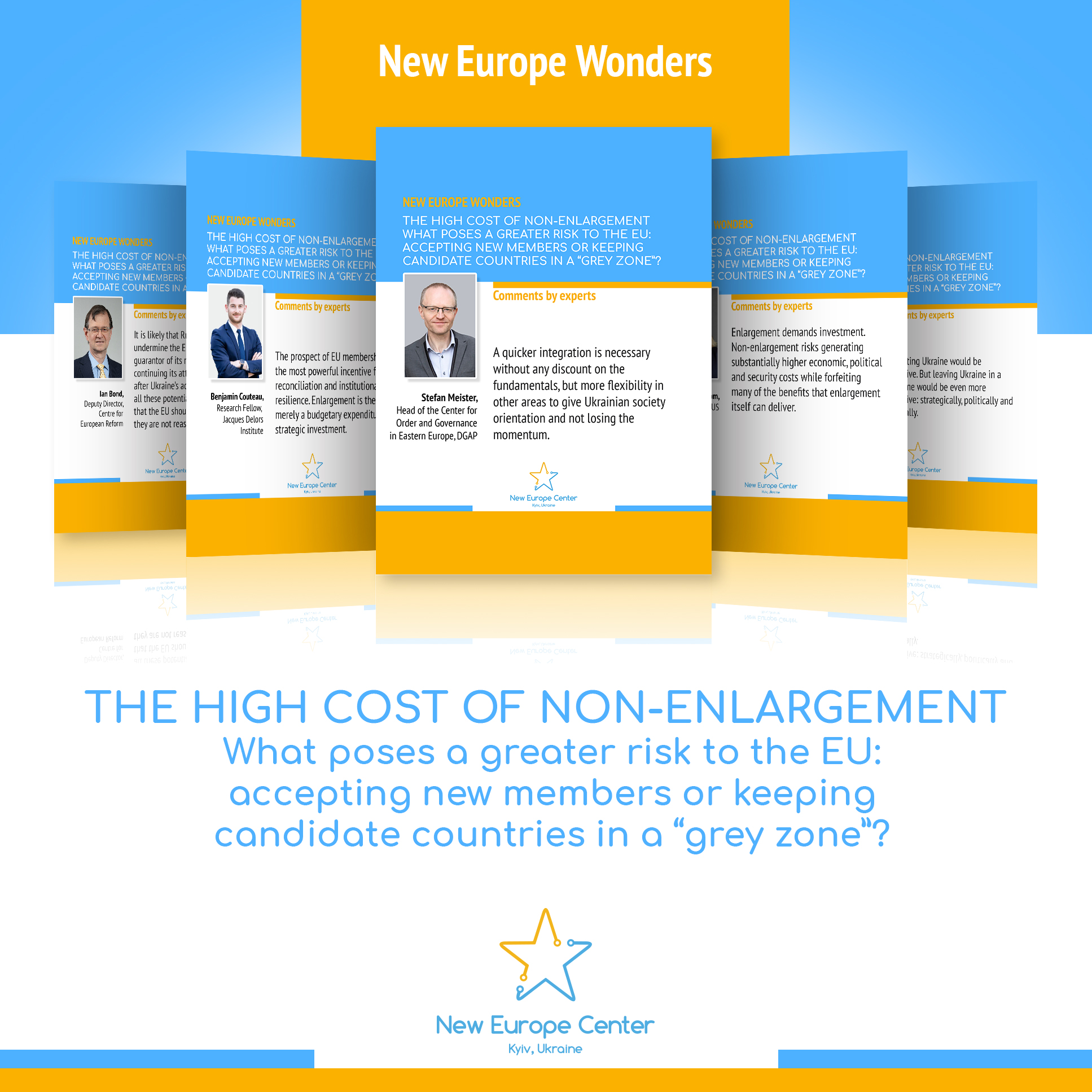
Ukraine and other candidate countries continue on their path toward full EU membership, pledging to ensure the swift implementation of the necessary reforms. At the same time, skeptics warn that admitting new members, particularly Ukraine, will require massive expenditures from the EU budget and will place a burden on current member states. However, an increasing number of analysts and officials insist on the opposite: the true cost is the cost of inaction. Instability at the borders, a loss of geopolitical credibility for the EU, an increase in external threats, and the emergence of “grey zones” where other players are eager to step in – all of this could cost the EU far more than any integration program. The New Europe Center asked leading European experts: which will be more costly for the European Union – enlargement or non-enlargement – and why?
Key conclusions:
- Non-enlargement costs more than enlargement. Financial costs for integration of new members are predictable and spread out over time, whereas the strategic cost of non-enlargement – instability on the border, loss of geopolitical credibility and strengthening of external threats are far more higher and unpredictable. In addition, the EU will bear the costs of supporting Ukraine, regardless of the official status of relations. Institutional integration reduces these costs and increases their effectiveness, transforming Ukraine from an aid recipient into a full-fledged security actor.
- Ukraine is a strategic asset and not a burden. The biggest army in Europe, unique combat experience, technological and agricultural potential makes Ukraine not as an object of support, but as a full partner that strengthens security and potential of the entire EU. A stable, democratic, and economically integrated Ukraine will strengthen the Single Market, expand Europe’s defense and industrial capabilities, and improve the continent’s food and energy security. The question is not whether enlargement comes at a cost, but what cost Europe is willing to bear as non-enlargement risks developing significantly higher economic, political, and security costs.
- The grey zone is dangerous for both Ukraine and the EU. The prolonged uncertainty surrounding the status of candidate countries weakens incentives for reform, opens the door to external influence, and undermines confidence in the EU as a guarantor of stability in the region.
- Ukraine without clear European orientation is a security risk for the entire continent. Refusal from integration will mean the loss of a highly militarized country with a traumatized society that will be left without a sense of direction. At the same time, modern warfare is increasingly becoming a battle of innovation and industrial production, and the EU will not be able to effectively counter Russia without Ukraine’s unique expertise and experience.
- Membership perspective is the most effective incentive for reforms. No other mechanism has the ability to support stable political coalitions and public support for deep reforms as the clear perspective of EU membership does. Partial integration without membership does not have the same effect.
- Enlargement is only possible if there will be reform – both inside the EU, as well as in candidate countries requirements are met. Despite the strategic necessity of integration, candidate countries cannot neglect the fulfillment of accession criteria. Implementing “Fundamentals” remains a prerequisite for demonstrating institutional capacity and preventing a reversal of reforms after accession. At the same time, without internal changes for decision-making process and financial programmes, in particular Common Agriculture Policy and cohesion funds, enlargement could lead to paralysis and financial ruin for the Union.
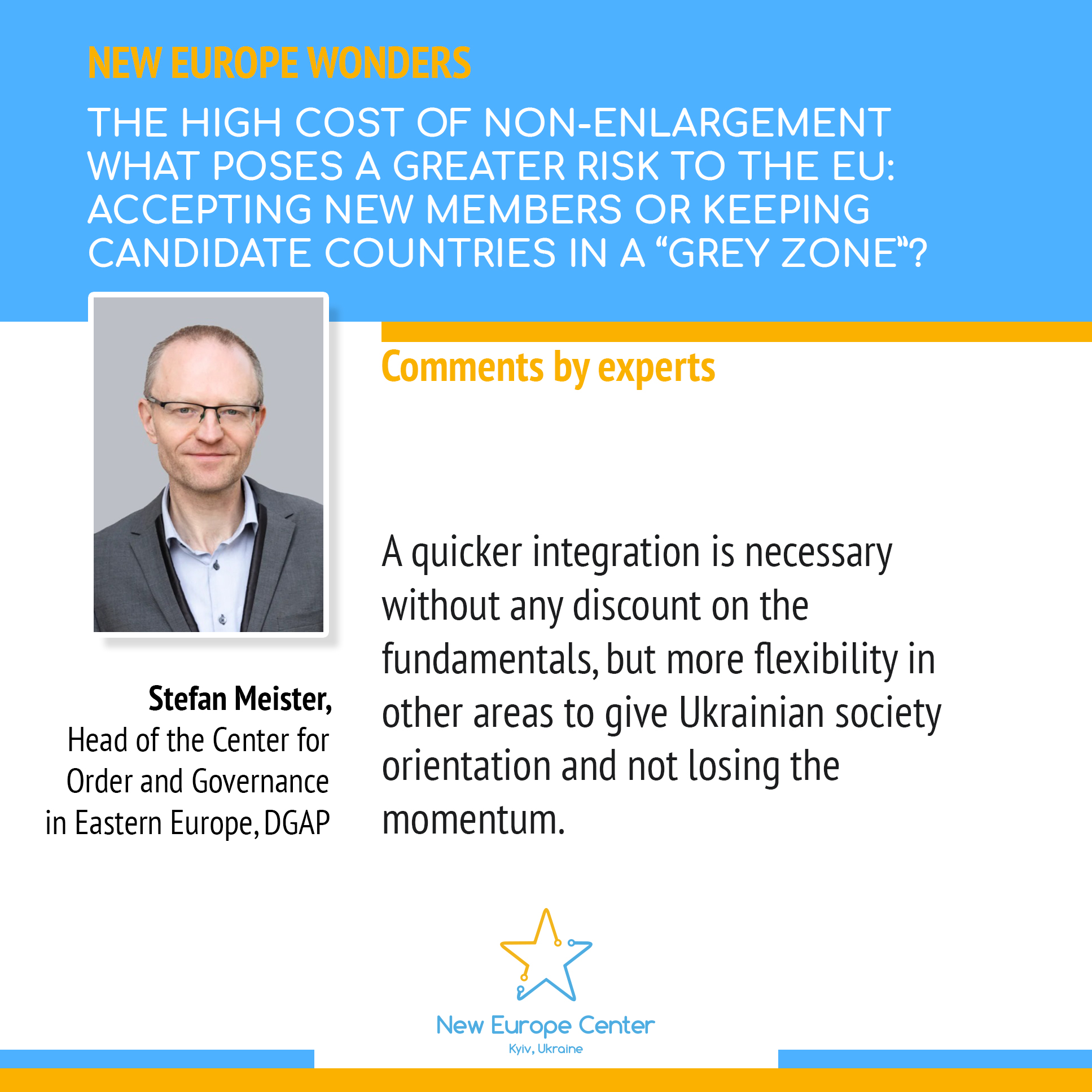
Stefan Meister, Head of the Center for Order and Governance in Eastern Europe, DGAP
There is no alternative to an EU integration of Ukraine and a successful enlargement process in Eastern Europe and Western Balkans. No EU integration of Ukraine would mean for the EU to lose the country with the biggest army in Europe, with a highly militarized and traumatized society as a result of Russia’s war. That would not only be a missed historical opportunity and huge chance for the EU with regard to defense, people, economic and energy potential, it would also be dangerous for Europe to create such a grey zone in its Eastern neighborhood. Ukraine without orientation would be a security risk for Europe. Non enlargement and not integrating Ukraine into the EU would mean a loss of credibility for the EU on any kind of enlargement in the future but also as an actor in its neighborhood. The question is not if, but how fast and under which rules. Ukraine is a special case, bigger than any other member state, a country on war for more than 4 years, in many areas destroyed, with a huge part of its population already working and living in the EU. That means a quicker integration is necessary without any discount on the fundamentals, but more flexibility in other areas to give Ukrainian society orientation and not losing the momentum.
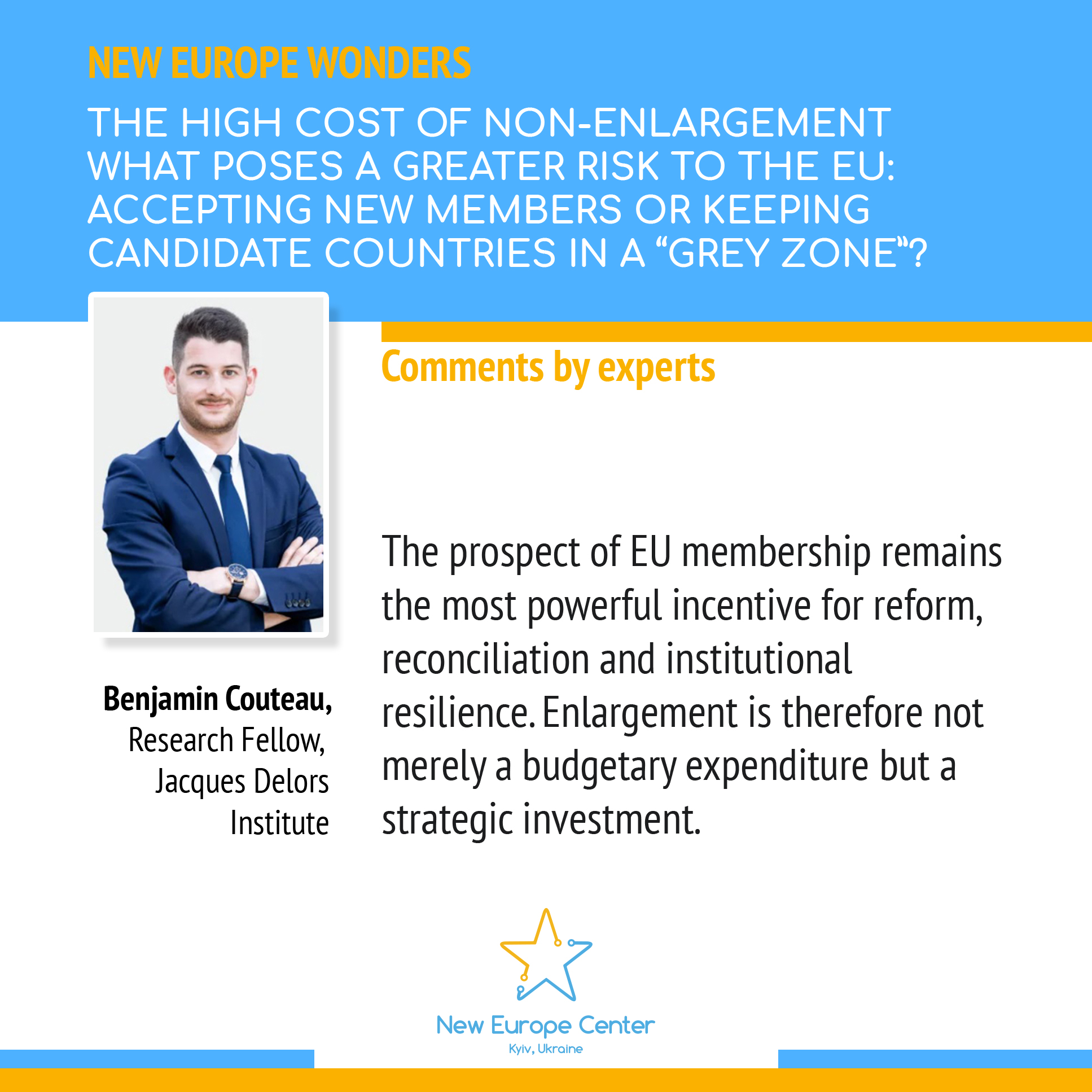
Benjamin Couteau, Research Fellow, Jacques Delors Institute
The European project was born from the ashes of war. Its purpose has always been to secure peace, democracy and prosperity on a continent that had witnessed the worst atrocities of humanity. Significantly, the parts of Europe that remained outside the European Union have been those most exposed to instability or conflict. From the former Yugoslavia to Georgia and Ukraine, non-enlargement has carried a heavy price.
By contrast, the countries that progressively joined the EU have experienced unprecedented political and economic progress. Enlargement has benefited existing Member States as much as the newcomers, expanding markets, strengthening security and increasing the Union’s geopolitical weight.
Recent history suggests that the costs of instability on the EU’s borders can far exceed the budgetary costs of enlargement. When Europe fails to integrate, it often finds itself managing crises that could have been prevented. When Europe hesitates, competing powers fill the vacuum.
Candidate States face challenges that are difficult to address alone, from Russian imperialism to unresolved regional tensions. The prospect of EU membership remains the most powerful incentive for reform, reconciliation and institutional resilience. Enlargement is therefore not merely a budgetary expenditure but a strategic investment. It is the EU’s most effective instrument for promoting peace, strengthening its geopolitical position and shaping a prosperous continent.
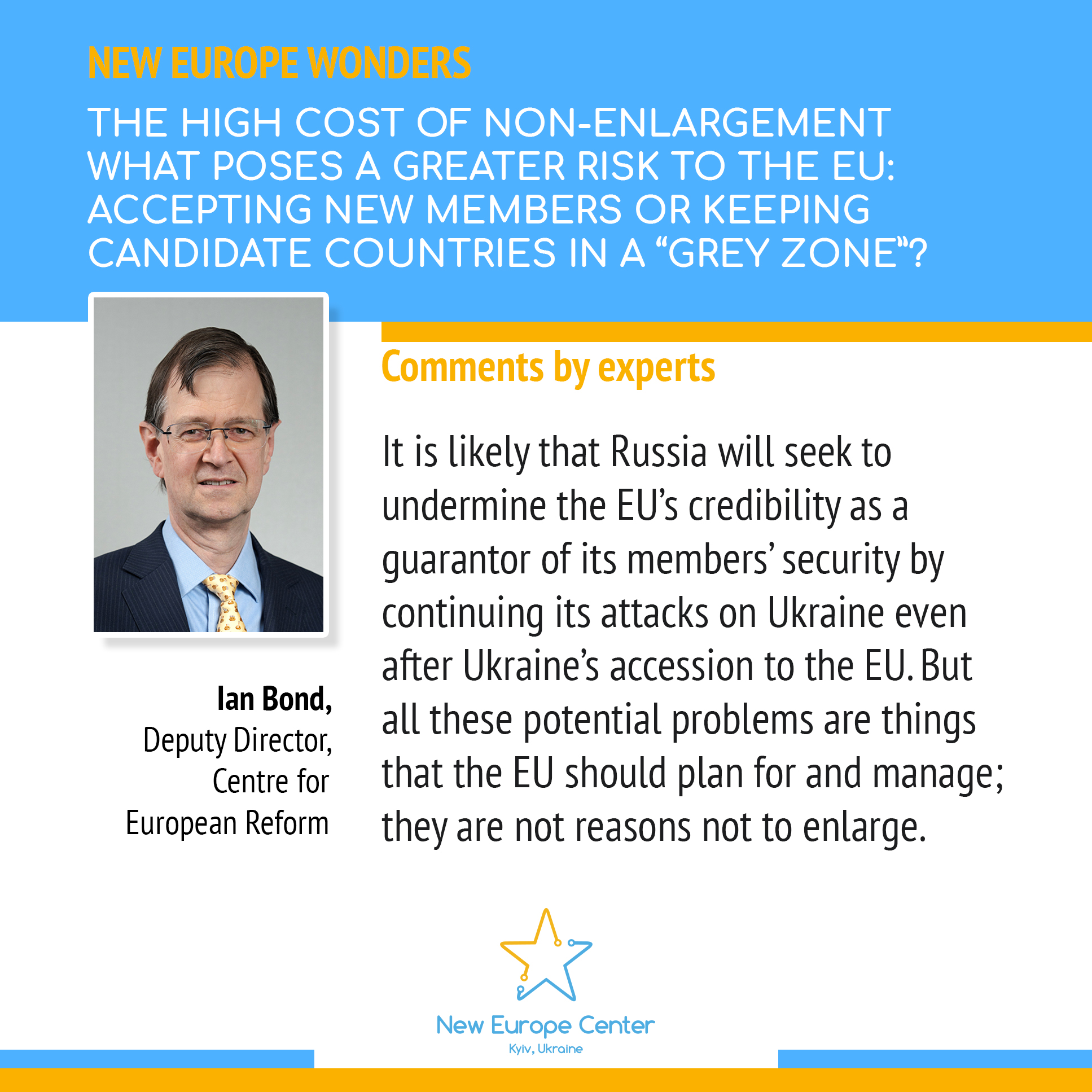
Ian Bond, Deputy Director, Centre for European Reform
In principle, enlargement should bring immense benefits to the EU, both economic and geopolitical. If the EU cannot reform its decision-making processes, however, or spending programmes like the Common Agricultural Policy, then enlargement could lead to paralysis and financial ruin for the Union. When the EU has enlarged in the past, it has generally managed to reform just enough to keep running; hopefully that will be the case again.
If candidate countries do not take seriously enough the need to implement the whole body of EU rules, then that will pose a risk to the EU as a ‘Community of Laws’. After the problems caused by Viktor Orbán when he was Hungarian prime minister, any aspiring member will need to show that it has strong institutions, capable of resisting any would-be authoritarian leader.
Finally, there is the risk that third countries such as Russia may use the enlargement process to weaken the EU – for example, by encouraging the growth of anti-EU sentiments in candidate countries, or hostility to candidate countries in existing member-states. It is likely that Russia will seek to undermine the EU’s credibility as a guarantor of its members’ security by continuing its attacks on Ukraine even after Ukraine’s accession to the EU. But all these potential problems are things that the EU should plan for and manage; they are not reasons not to enlarge.
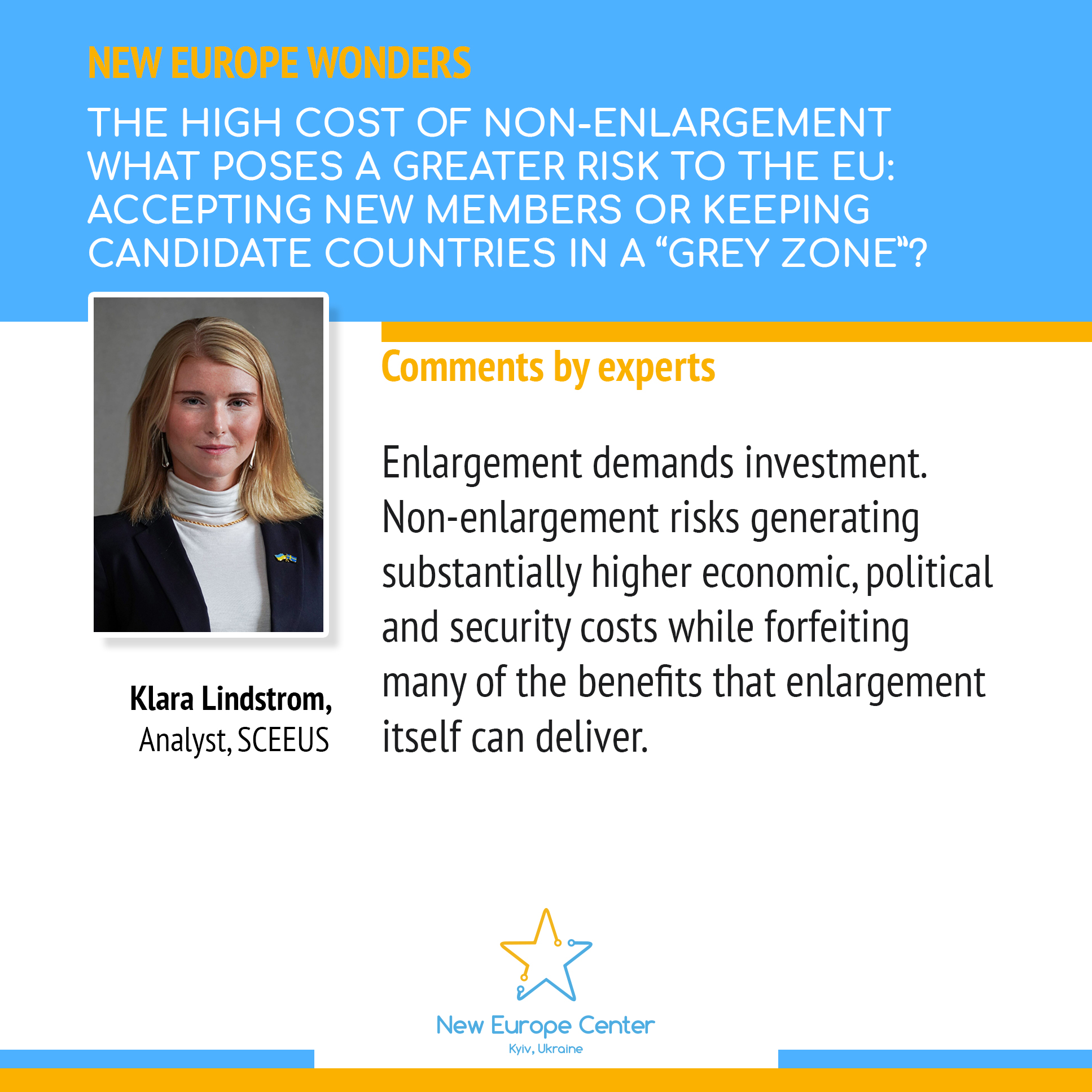
Klara Lindstrom, Analyst, SCEEUS
In the long run, non-enlargement is likely to prove significantly more costly for the European Union than enlargement.
Enlargement carries real financial costs. Expanding cohesion funds, agricultural support and institutional capacity requires political compromise and budgetary resources. However, these costs are manageable, phased and largely predictable.
The costs of non-enlargement are greater because they are strategic, not just financial. Leaving candidate countries in a prolonged grey zone would fuel instability on the EU’s borders, weaken reform incentives, create opportunities for external actors to expand their influence, and undermine the Union’s geopolitical credibility.
The case of Ukraine makes this particularly clear. Supporting Ukraine’s path into the EU is an investment in Europe’s own security and prosperity. A stable, democratic and economically integrated Ukraine would strengthen the Single Market, expand Europe’s defence-industrial capacity, enhance food and energy security, and reinforce the continent’s long-term resilience.
The real question is therefore not whether enlargement has costs, but which costs Europe is willing to bear. Enlargement demands investment. Non-enlargement risks generating substantially higher economic, political and security costs while forfeiting many of the benefits that enlargement itself can deliver.
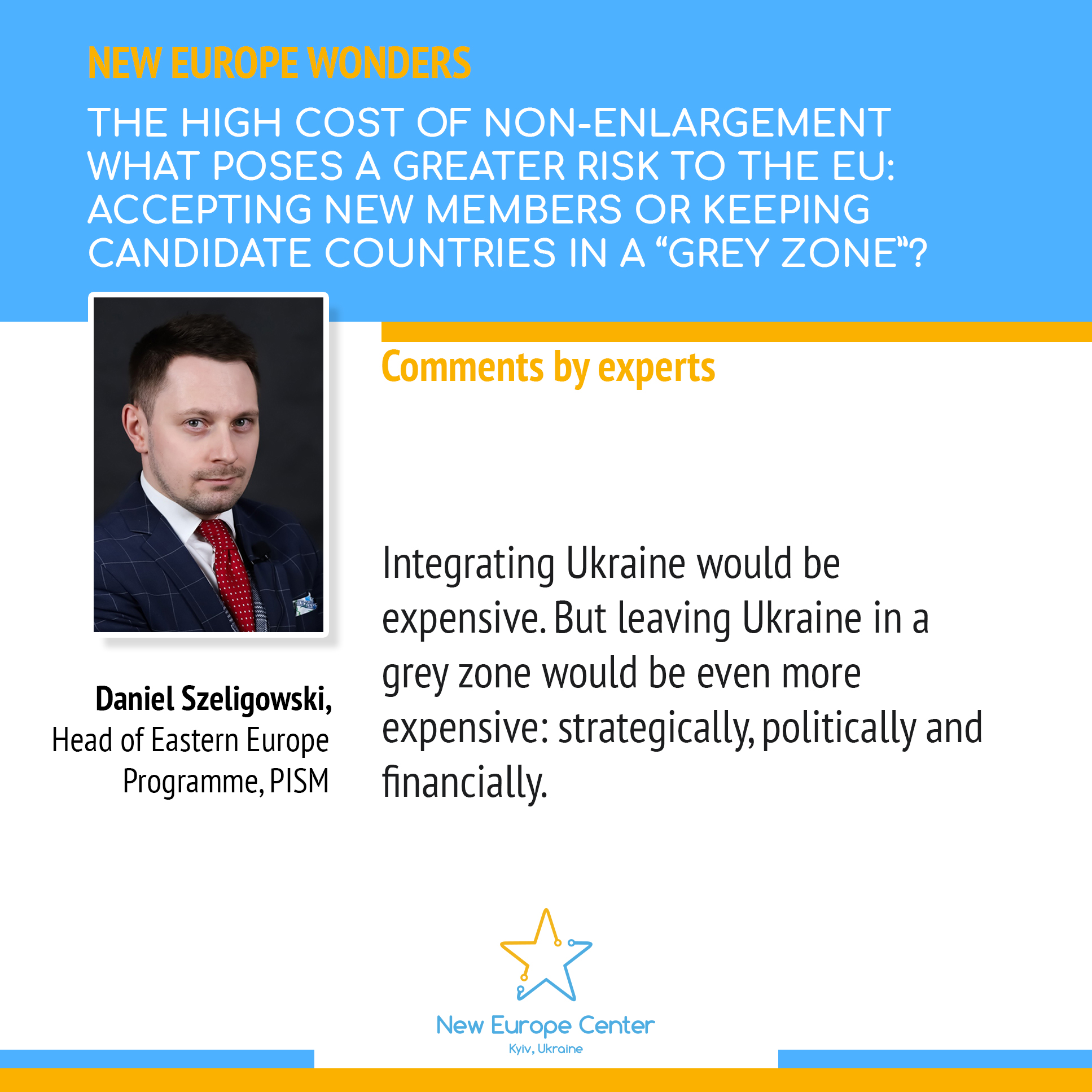
Daniel Szeligowski, Head of Eastern Europe Programme, PISM
The question of EU enlargement largely comes down to Ukraine, yet Ukraine’s future in Europe should be understood in much broader terms than EU membership alone. Ukraine has become a systemic asset for Europe: it creates a strategic dilemma for Russia and already contributes real military capabilities, experience and deterrence value to the defence of the continent’s eastern flank. For this reason, Europe, including the EU, would continue to bear the costs of supporting Ukraine regardless of the formal status of its relationship with the EU.
These costs would not disappear if Ukraine remained outside the EU. On the contrary, they would likely become higher if Ukraine were left in an unstable grey zone between Russia and the West. The real question, therefore, is not whether Europe would pay for Ukraine, but how. Institutionalising the relationship with Ukraine would be in Europe’s interest because it would help anchor Ukraine permanently within the European security architecture and gradually reduce the costs of assistance by turning Ukraine from a permanent recipient of emergency support into a structured partner and contributor to European security.
Integrating Ukraine would be expensive. But leaving Ukraine in a grey zone would be even more expensive: strategically, politically and financially. That said, these costs would not be borne by the EU alone. They would be borne by European states more broadly — both EU and non-EU members.
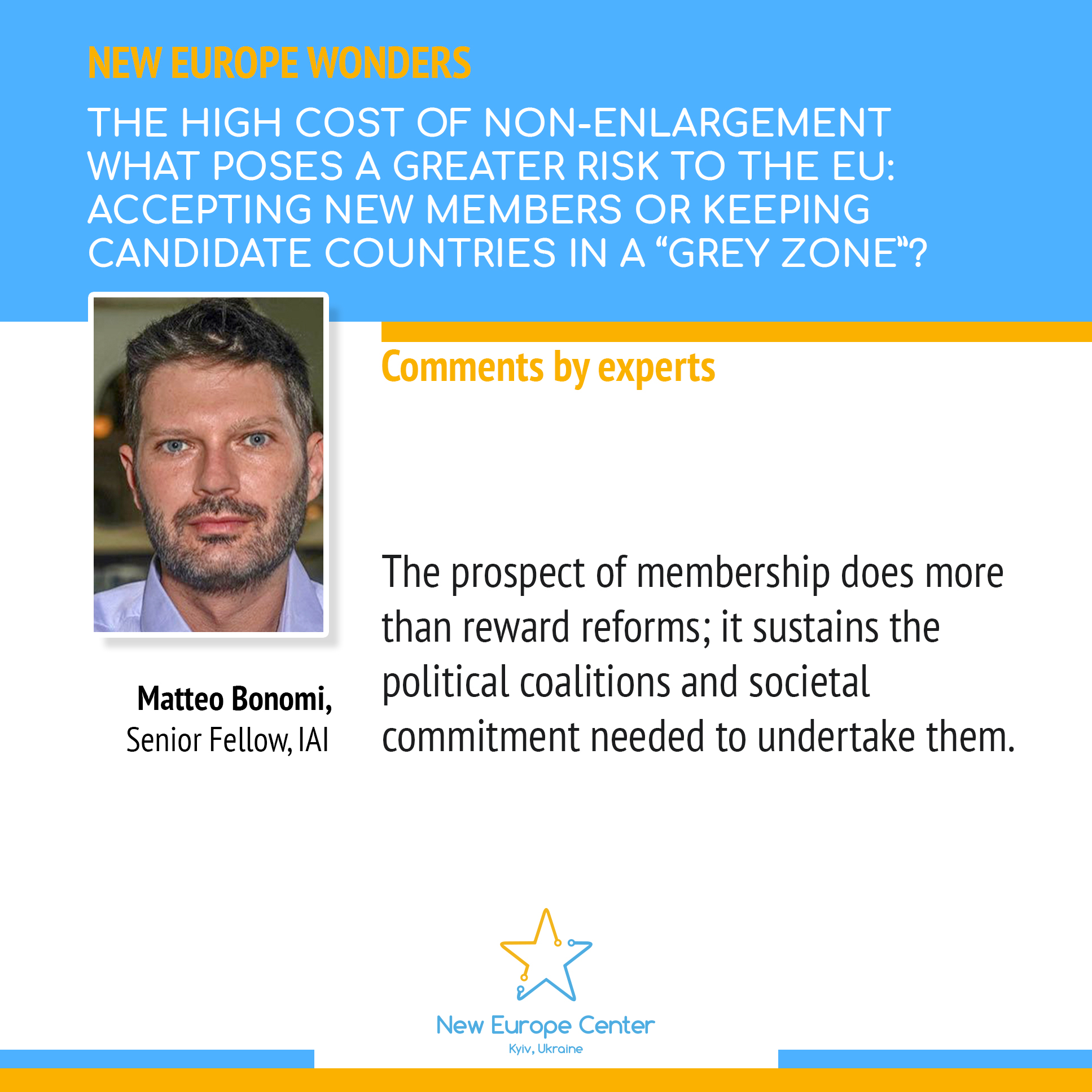
Matteo Bonomi, Senior Fellow, IAI
The real cost of non-enlargement is not the absence of accession, but the emergence of a permanent waiting room: countries deeply integrated with the EU, yet never fully admitted into it.
Over the past few years, the EU has developed powerful tools to support economic integration, institutional convergence and even security cooperation short of membership. These instruments are essential, particularly for Ukraine, where integration strengthens resilience and reconstruction under wartime conditions. Yet they cannot substitute for what has historically made enlargement transformative: a credible path to accession.
The prospect of membership does more than reward reforms; it sustains the political coalitions and societal commitment needed to undertake them. This is especially true in the Western Balkans, where credible accession remains the strongest driver of progress on governance and the rule of law.
Without that perspective, the EU may still be able to stabilise its neighbourhood, manage crises and foster partial integration. What it risks losing, however, is its most effective instrument for achieving deep and lasting political transformation. The long-term costs of political stagnation, instability and geopolitical competition would likely exceed the costs of enlargement itself.
The challenge for the EU is therefore not enlargement per se, but how to calibrate integration and membership according to the different realities of candidate countries. Integration can strengthen resilience and convergence; only credible accession can sustain deeper political transformation.
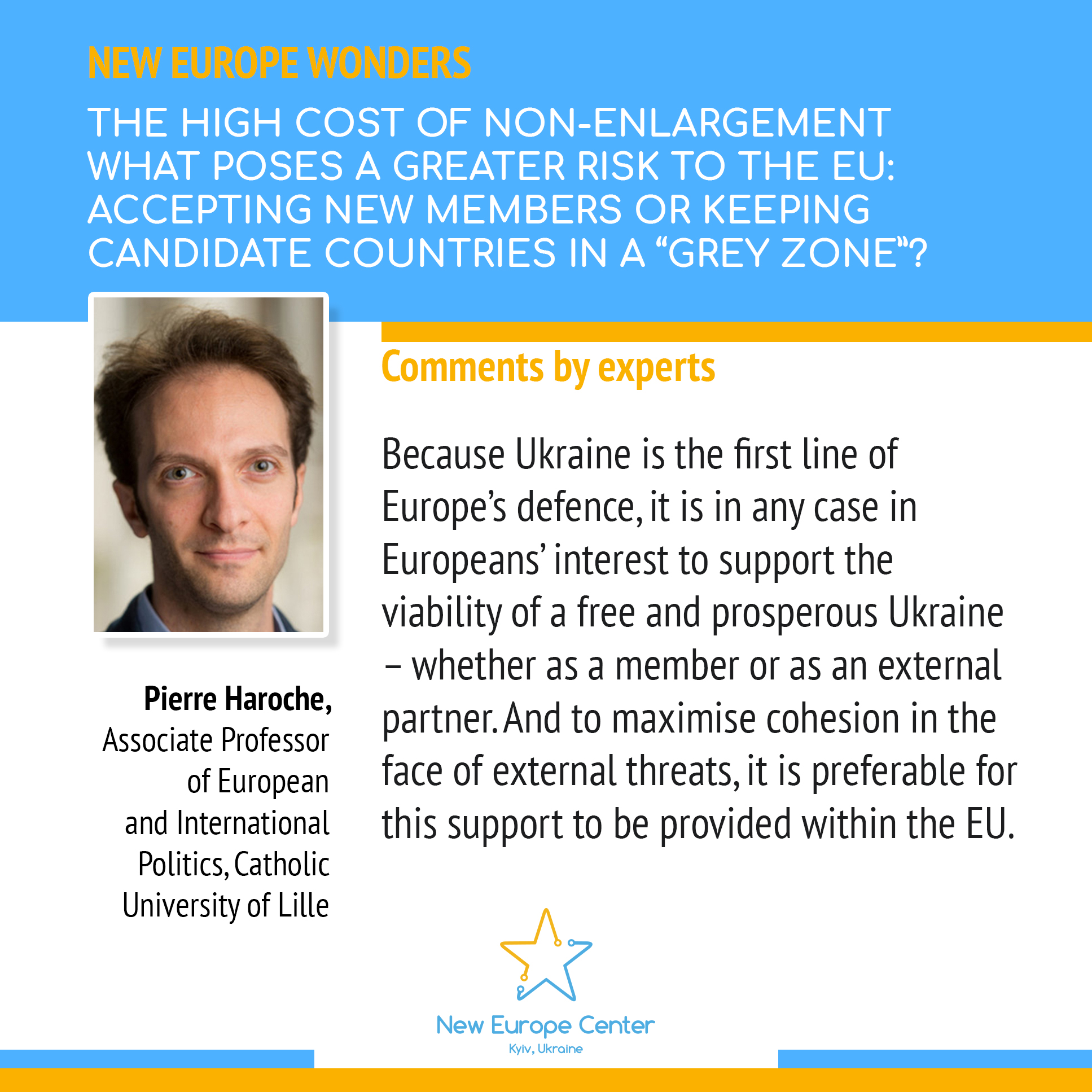
Pierre Haroche, Associate Professor of European and International Politics, Catholic University of Lille
Enlargement to Ukraine is in the EU’s vital interest. Whether it likes it or not, because of the combination of the Russian threat and US disengagement, the EU now finds itself—and is likely to remain so for some time—in a position of geopolitical vulnerability. In this context, Ukrainian forces’ integration into Europe’s defence system is essential to prevent Russia from being able to use a ‘divide and conquer’ strategy. If this integration cannot take place within NATO because of US reluctance, it has to take place within the EU.
Moreover, Ukraine has demonstrated that modern warfare is increasingly a battle of innovation and industrial production. The EU has begun to address these challenges, but will not succeed in outperforming Russia without the full participation of Ukrainians and their unique expertise.
Certainly, enlargement will be costly in terms of economic and financial support. However, precisely because Ukraine is the first line of Europe’s defence, it is in any case in Europeans’ interest to support the viability of a free and prosperous Ukraine – whether as a member or as an external partner. And to maximise cohesion in the face of external threats, it is preferable for this support to be provided within the EU.
This document was prepared with the support of the International Renaissance Foundation. The material reflects the position of the authors and does not necessarily coincide with the position of the International Renaissance Foundation.